

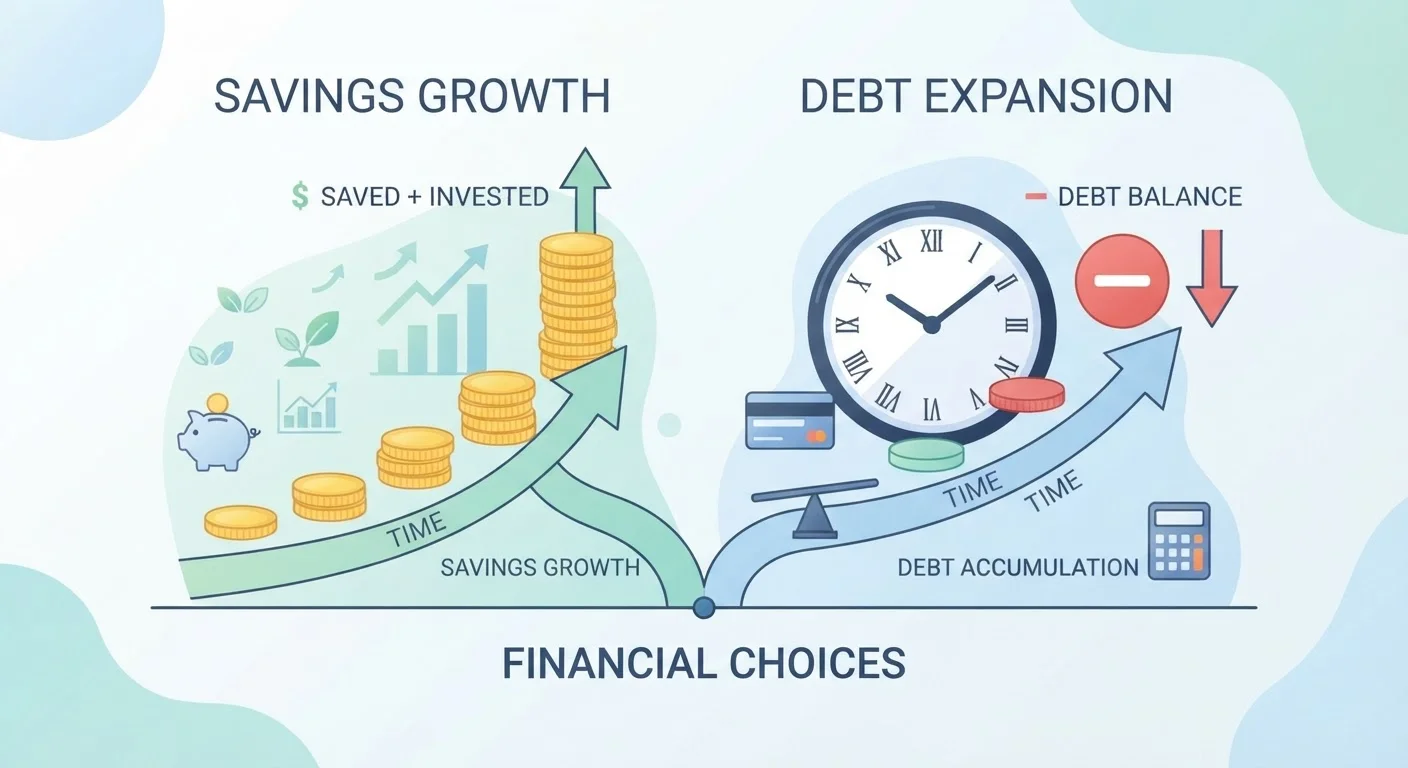
The Core Mechanic: Interest on Top of Interest
Most people learn about interest as a flat percentage - borrow $1,000 at 10%, pay back $100. That's simple interest. Compound interest works differently: once interest is added to your balance, it begins earning interest itself. Each period builds on the last, creating exponential rather than linear growth.
A basic example: $5,000 deposited in an account earning 5% annually, compounded once per year, grows to $5,250 after year one. In year two, the 5% applies to $5,250 - not $5,000 - generating $262.50 in interest instead of $250. The difference seems small at first, but stretch that out over decades and the gap becomes significant.
This is why financial educators refer to compounding as a long-game tool. The formula driving it - A = P(1 + r/n)^(nt), where P is principal, r is the annual interest rate, n is compounding frequency, and t is time - shows that all four variables matter, but time (t) carries the most weight.
Daily
Typical compounding frequency for credit cards
Most major U.S. credit card issuers apply interest daily on unpaid balances, meaning even a few extra days of carrying a balance adds measurable cost.
22%+
Average credit card APR in recent years
According to Federal Reserve data, average credit card interest rates have risen notably, making compounding on revolving balances increasingly costly for cardholders.
10-30 yrs
Time range where compounding shows the largest impact
Financial planning literature consistently shows that compounding's benefit accelerates dramatically after a decade, particularly in tax-advantaged retirement accounts.
When Compounding Works Against You: Debt
The same mechanism that builds wealth quietly also deepens debt. Credit card balances, for instance, typically compound daily. Your card's APR (annual percentage rate) is divided by 365, and that daily rate is applied to your outstanding balance each day. If you carry a $3,000 balance at 22% APR and make only minimum payments, the compounding interest can outpace your payments - meaning your balance grows even as you pay.
This is why high-interest revolving debt is so difficult to escape without a deliberate plan. The interest compounds faster than many borrowers expect, and missing or reducing payments amplifies the effect. Student loans, personal loans, and car loans also involve interest calculations - though many use different structures - so understanding the terms of each account matters.
For a broader look at the vocabulary surrounding debt and savings, see this glossary of personal finance terms covering APR, compounding, and other key concepts.
Check APY, Not Just the Interest Rate
When comparing savings accounts, look at the APY (annual percentage yield) rather than the stated interest rate alone. APY already accounts for compounding frequency, so it gives you a more accurate picture of what you'll actually earn over a year. Two accounts can advertise the same rate but deliver different APYs depending on how often interest compounds.
Time Is the Variable That Changes Everything
Among all the inputs in the compound interest formula, time creates the most dramatic differences. Someone who begins setting aside $200 a month at age 25 will accumulate substantially more by retirement than someone who starts the same habit at 35 - even though the monthly contribution is identical - simply because the earlier saver's interest has more years to compound on itself.
This concept connects directly to the broader idea of the time value of money. Explore how time - not income level - is the most powerful lever in long-term financial planning in a companion article on this topic.
For savers, the practical implication is straightforward: earlier participation - even in small amounts - beats larger contributions made later. For borrowers, the same logic applies in reverse. Debt left unpaid longer compounds more, increasing the true cost of borrowing well beyond the original loan amount.
“Compound interest is the eighth wonder of the world. He who understands it, earns it; he who doesn't, pays it.”
— Commonly attributed to Albert Einstein, Often cited in financial education contexts - original attribution is unverified, but the principle is widely endorsed by financial educators
Applying This Understanding to Real Decisions
Knowing how compounding works doesn't automatically tell you whether to prioritize saving or paying down debt first - that depends on the interest rates involved and your personal situation. As a general framework, financial educators often suggest comparing the rate your debt is accruing against the rate you'd earn on savings. High-interest debt typically costs more than savings earn, making debt reduction the mathematically efficient choice in many cases.
That said, completely foregoing savings - even while in debt - carries its own risks. Without a financial cushion, unexpected expenses often land back on high-interest credit. Understand the trade-offs between building savings and repaying debt to find an approach that fits your circumstances.
If you're managing both simultaneously, concrete strategies for saving money while carrying debt can help you move both goals forward without losing ground on either front.
This article is for general informational and educational purposes only and does not constitute personalized financial, tax, or investment advice. For guidance tailored to your specific situation, consult a qualified and licensed financial professional.
Frequently Asked Questions
Simple interest is calculated only on the original principal. Compound interest is calculated on the principal plus any interest already earned or owed. Over time, compound interest produces significantly larger totals - for better or worse - than simple interest does.
It depends on the account or loan. Savings accounts often compound daily or monthly, while some bonds compound annually. Credit cards typically compound daily on the outstanding balance. More frequent compounding means faster growth - or faster debt accumulation.
Yes. Credit card balances typically compound daily at a high annual percentage rate (APR). If you carry a balance month to month, interest is added to your balance regularly, and future interest is then calculated on that higher number - making the debt harder to pay off over time.
The two key inputs are time and consistency. Starting to save early - even with modest amounts - gives compounding more time to work. Reinvesting earned interest rather than withdrawing it keeps the compounding cycle going. Consulting a licensed financial adviser can help tailor a strategy to your situation.
Yes. The APY, or annual percentage yield, reflects the actual return on your deposit after accounting for compounding frequency. A savings account with a 5% annual interest rate compounded daily will have a slightly higher APY than 5%, because interest is being added - and then earning more interest - throughout the year.
The content on this site is provided for informational purposes only and should not be considered a substitute for professional advice. While we strive to provide accurate and up-to-date information, we make no guarantees regarding its completeness or accuracy. Always consult a qualified professional for advice specific to your circumstances before making any decisions