

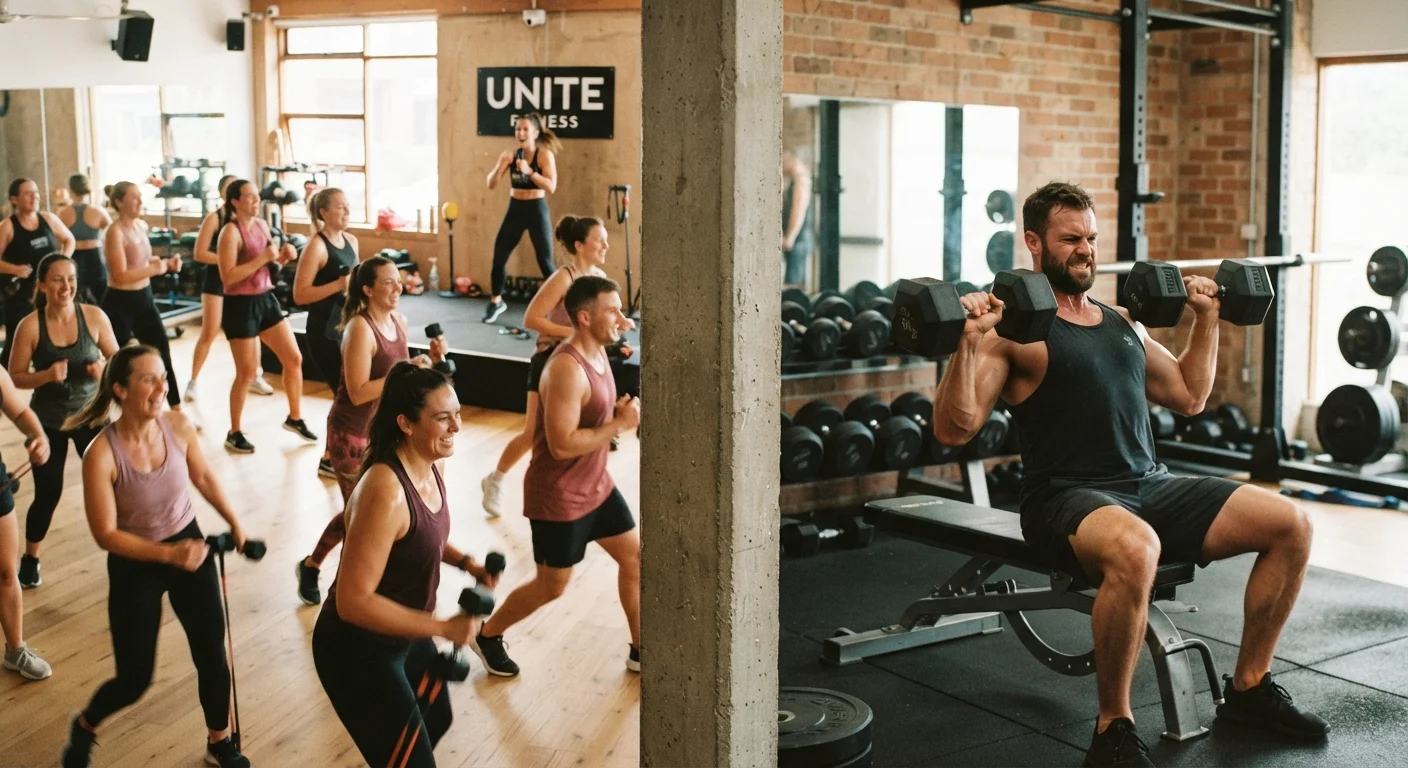
Option A
Group Fitness Classes
The socially energized, structure-driven approach.
Best for: People who thrive on community, accountability, and prefer a led format that removes workout-planning decisions.
Option B
Solo Training
The flexible, self-directed path to personal goals.
Best for: People who prefer full control over their schedule, exercise selection, and training pace.
What Each Training Environment Actually Offers
Group fitness classes - from yoga and cycling to HIIT and dance - place you inside a structured session led by a certified instructor, surrounded by other participants. That environment is not merely social convenience; it changes the nature of the workout itself. Instructors cue form corrections, control pacing, and build progression across weeks or months. The social dynamic can push effort levels upward in ways that are genuinely hard to replicate alone.
Solo training, by contrast, hands you complete authorship of every session. You choose the exercise, the order, the intensity, and the duration. That autonomy is powerful when you have a clear program to follow - and it aligns naturally with approaches like prioritizing strength or cardio based on your goals, where individual programming matters enormously. The trade-off is that without external structure, decision fatigue or low motivation can quietly erode workout frequency.
| Criterion | Group Fitness Classes | Solo Training |
|---|---|---|
| Structure | Provided by instructor | Self-directed |
| Scheduling | Fixed class times | Fully flexible |
| Social motivation | High - group energy | Low - self-motivated |
| Personalization | Limited to class format | Fully customizable |
| Form guidance | Real-time instructor cues | Self-monitored |
| Typical cost | Varies; often higher | Varies; often lower |
| Best for beginners | Strong fit | Requires self-education |
| Accountability | External - peers and instructor | Internal - self-driven |
The Science on Social Exercise and Adherence
Research published in peer-reviewed exercise science journals has found that exercising in a group setting can increase feelings of enjoyment and reduce perceived exertion compared with working out alone - meaning the same effort feels less hard in company. Social facilitation, a well-documented psychological phenomenon, suggests that the presence of others can raise performance, particularly on tasks the individual already has some competence in.
However, social pressure can also backfire. If a class moves too fast for a beginner, or the group culture feels intimidating, it may discourage rather than motivate. Self-determination theory, a framework used widely in exercise psychology, emphasizes that autonomy - feeling in control of your choices - is a key driver of long-term behavior change. Solo training scores high on autonomy; group classes score high on structure and relatedness.
~95%
Group exercise completion rate in one study
A study in the Journal of the American Osteopathic Association found group exercisers completed significantly more of a 12-week program than those working out alone.
26%
Reduction in stress levels reported by group exercisers
The same 2017 study found participants in group fitness classes reported meaningfully lower stress and higher quality of life scores than solo trainers.
~50%
Adults who drop new exercise programs within 6 months
According to research cited by the American College of Sports Medicine, roughly half of people who begin an exercise routine discontinue within six months, regardless of format.
Understanding how your own psychology responds to these dynamics is arguably more predictive of your success than any specific format. Consider whether you have historically shown up more consistently when accountable to others or when operating on your own schedule.
Practical Trade-Offs Worth Considering
Cost and access are real factors. Group fitness memberships at specialty studios can carry significant monthly fees, while a home workout routine or basic gym membership may be considerably less expensive. That said, a class you attend consistently delivers more value than a cheaper option you skip repeatedly.
Injury risk differs between formats too. A qualified group instructor can spot and correct poor form across a class - a genuine safety advantage for newer exercisers. Solo training requires you to self-monitor, which demands greater body awareness. If you are exploring specific exercise types for the first time, resources like a clear overview of exercise categories and what each one trains can fill knowledge gaps before you go it alone.
Scheduling flexibility also weighs differently depending on your life. Class-based fitness requires aligning with fixed timetables. Solo training adapts to shift work, family demands, and irregular routines - including lower-intensity methods like Zone 2 cardio, which can be done almost anywhere without equipment or a booked slot.
This article is for general informational and educational purposes only and is not a substitute for professional medical or fitness advice. Consult a qualified healthcare provider or certified fitness professional before beginning any new exercise program, particularly if you have an existing health condition or injury.
The content on this site is provided for informational purposes only and should not be considered a substitute for professional advice. While we strive to provide accurate and up-to-date information, we make no guarantees regarding its completeness or accuracy. Always consult a qualified professional for advice specific to your circumstances before making any decisions