

Our Verdict
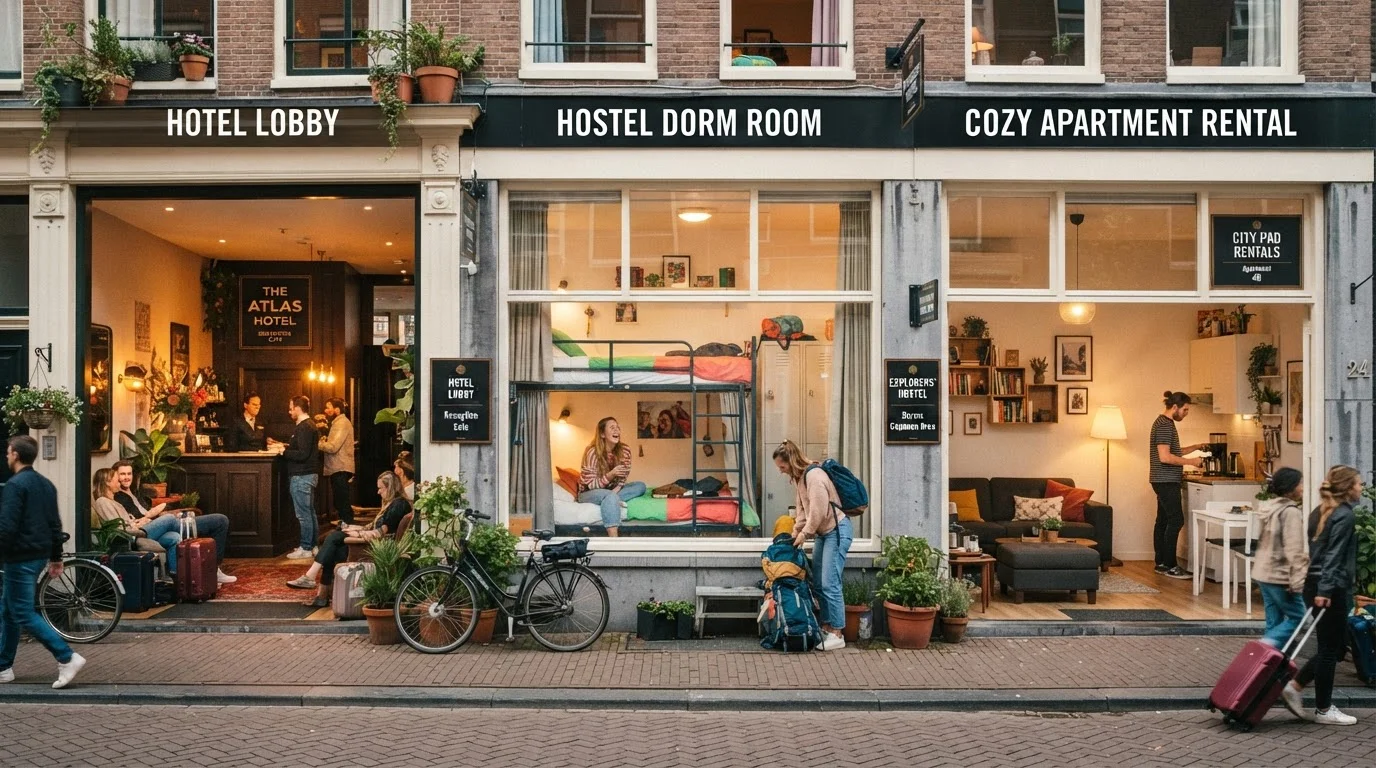
No single accommodation type wins across every scenario. Hotels deliver reliability and services that justify their cost for short stays or business travel; hostels dramatically reduce nightly spend for solo and budget-conscious travelers; and alternatives like vacation rentals or guesthouses often offer the best value for groups, families, or longer trips. The decision is ultimately about aligning lodging cost with everything else competing for space in your budget.
| Best for | Recommended |
|---|---|
| Travelers prioritizing comfort and convenience on short trips | Hotels |
| Solo travelers and backpackers keeping nightly costs minimal | Hostels |
| Families, groups, or travelers staying a week or longer | Vacation Rentals |
| Travelers seeking local character on a mid-range budget | Guesthouses and B&Bs |
Why Lodging Deserves More Budget Attention Than It Gets
Most travelers fixate on flight prices but treat lodging as an afterthought - booking whatever looks reasonable once the flight is confirmed. That's a costly mistake. Accommodation typically represents 25-40% of a total trip budget, and unlike flights, it compounds nightly. A $50 difference per night becomes $350 over a week.
Understanding what each lodging type actually costs - and what those costs include or exclude - is one of the most effective ways to stretch a travel budget without sacrificing the experience you're after. For a broader look at where travel money goes, see where your travel money actually goes.
30%
Average share of travel budget spent on lodging
Industry travel surveys consistently find accommodation claiming roughly 25-40% of total trip spend for leisure travelers.
$50
Per-night savings compounded over one week
A $50/night difference in lodging type translates to $350 saved over seven nights - enough to fund significant additional activities.
Hotels: What You're Paying For (and What You're Not)
Hotels offer a familiar, predictable experience: a private room, daily housekeeping, front-desk support, and usually reliable Wi-Fi. That consistency has real value - particularly on short trips or when you need guaranteed comfort after a long travel day. But hotels also carry the highest baseline cost of any mainstream lodging type.
In major U.S. cities and popular international destinations, mid-range hotels frequently run $150-$300 per night before fees. Resort fees, parking charges, and in-room extras can add $30-$75 per night on top of the advertised rate. Loyalty programs can offset some cost over time, but rarely enough to close the gap with cheaper alternatives on any single trip.
Hotels make the most financial sense for business travel, one- or two-night stops, or destinations where safety and location access outweigh cost concerns.
| Hotels | Hostels (Dorm) | Vacation Rentals | Guesthouses/B&Bs | |
|---|---|---|---|---|
| Typical nightly cost (USD) | $150-$300+ | $15-$50 | $80-$200 (whole unit) | $60-$130 |
| Privacy level | High | Low | High | Moderate |
| Best group size | 1-2 | 1-2 | 3+ | 1-2 |
| Kitchen access | Rarely | Often shared | Yes | Sometimes |
| Flexibility / cancellation | Usually flexible | Often flexible | Varies widely | Varies |
| Social/local experience | Low-Moderate | High | Moderate | Moderate-High |
| Hidden fees risk | High (resort fees) | Low | Moderate (cleaning fees) | Low |
Hostels: The Numbers Behind the Savings
Hostels are no longer just for college backpackers. Modern hostels - particularly in Europe, Southeast Asia, and Latin America - offer dormitory beds for $15-$50 per night in most destinations, and private rooms for $50-$100. That's a substantial reduction from hotel rates, often with included breakfast, common kitchens, and built-in social infrastructure.
The trade-off is primarily privacy and sleep quality. Shared dorm rooms mean shared bathrooms, varying noise levels, and limited personal space. For solo travelers or pairs comfortable with that dynamic, the savings can fund extra days of travel or meaningfully reduce total trip cost.
Hostels work best for flexible itineraries where you're spending most of your time out exploring rather than in the room. If lodging is mainly a place to sleep, the savings are hard to argue with.
Vacation Rentals, Guesthouses, and Other Alternatives
The lodging landscape between "hotel" and "hostel" has expanded significantly. Vacation rentals - entire apartments or homes booked through short-term rental platforms - often deliver the best per-person value for groups of three or more. A two-bedroom apartment at $150/night splits to $75 per person for two people and $50 for three - often undercutting even mid-range hotels on a per-head basis, with the added benefit of a kitchen that reduces food costs.
Guesthouses and bed-and-breakfasts occupy a middle ground: more personal than a hotel, more private than a hostel, often priced at $60-$130 per night. In many destinations, they offer a more authentic local experience than chain hotels.
Other options worth knowing about:
- Home exchanges: Swap your home with another traveler's - accommodation cost drops to zero, though logistics require advance planning.
- Housesitting: Stay in someone's home in exchange for caring for pets or property. Free accommodations, but availability is limited and vetting is essential.
- Camping and glamping: Range from minimal-cost tent camping to mid-range glamping setups; highly destination-dependent.
For guidance on how pre-booking accommodation fits into overall trip finances, see pre-trip spending vs. on-the-road spending.
Making the Choice That Fits Your Budget
The right accommodation choice isn't universal - it depends on group size, trip length, destination, and what you're trying to accomplish with the trip. A few practical frameworks:
- Solo, short trip, urban destination: Hostel private room or budget hotel.
- Family or group, 7+ nights: Vacation rental almost always wins on per-person cost and kitchen access.
- Couple, mid-range budget: Guesthouse or mid-tier hotel depending on destination.
- Backpacker-style trip: Hostel dorms with strategic hotel nights for recovery or special occasions.
Lodging decisions also interact with food costs. A kitchen-equipped rental can cut daily food spending by $20-$40 per person, which partially offsets a higher nightly rate. Factor in the full picture, not just the nightly price tag.
For a structured approach to fitting lodging into a complete trip budget, the guide on travel budgeting from scratch walks through every major cost category together.
Accommodation prices noted in this article reflect general market ranges and will vary significantly by destination, season, and availability. Always verify current rates and fees directly before booking.
The content on this site is provided for informational purposes only and should not be considered a substitute for professional advice. While we strive to provide accurate and up-to-date information, we make no guarantees regarding its completeness or accuracy. Always consult a qualified professional for advice specific to your circumstances before making any decisions