

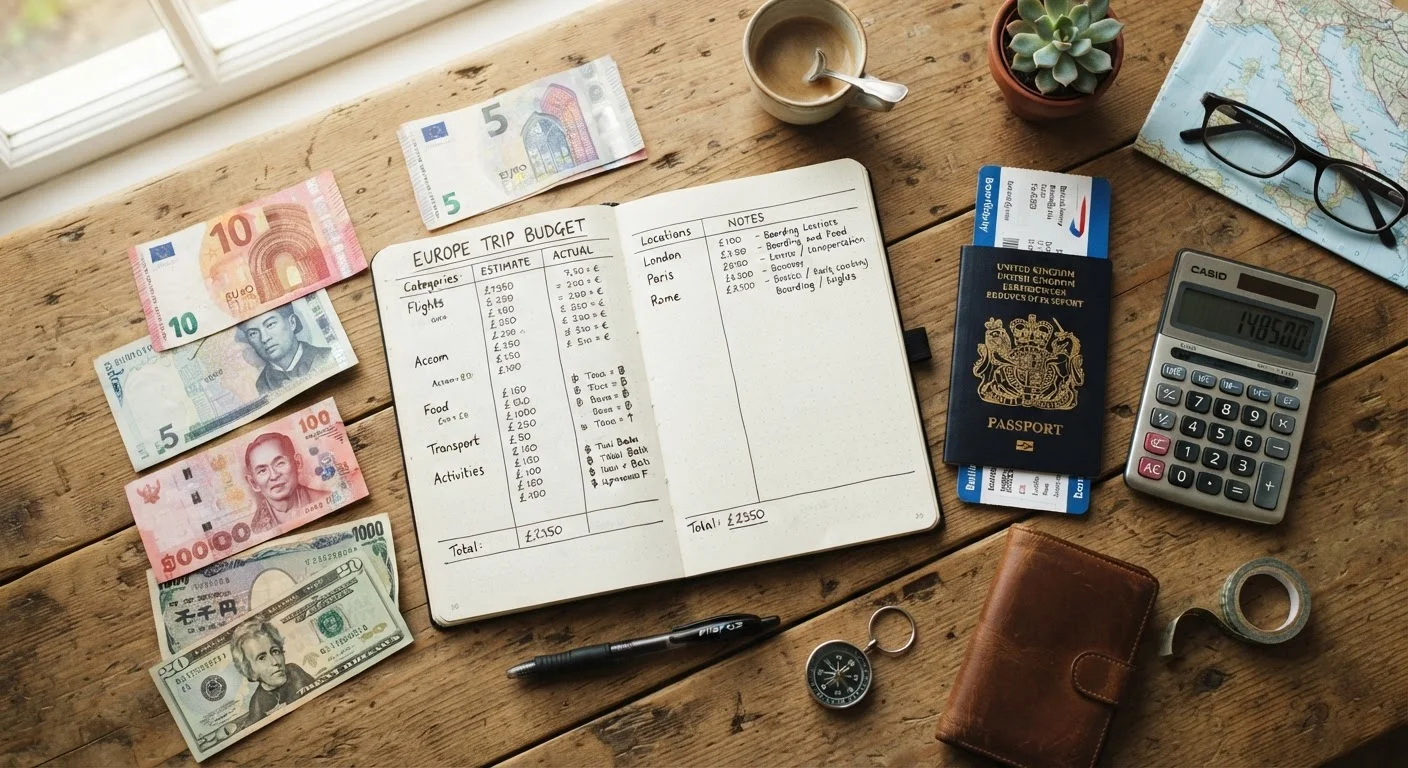
Why Most Travel Budgets Fall Apart
The typical travel budget fails not because travelers are careless with money, but because the planning process itself has structural gaps. People budget for what they remember to include - and forget the rest. Airport meals, baggage fees, travel-day transportation, tipping customs, attraction booking fees, and destination-specific taxes are among the most frequently omitted costs.
There's also a tendency to plan for the best version of the trip: the cheapest restaurant every night, no impulse splurges, perfect weather requiring no plan changes. Real trips don't work that way. Building a budget that survives contact with reality means deliberately planning for friction, not just the ideal itinerary.
If you want grounding in the fundamentals before diving into the steps below, Travel Budgeting From the Ground Up walks through every core component. The Trip Planning hub also offers broader planning context.
Spreadsheet software (e.g., Google Sheets or Excel)
Organize fixed and variable cost categories, run exchange rate calculations, and model different spending scenarios.
Budget tracking app
Log real-time trip expenses by category so you can compare actuals against your planned budget on the go.
Official government travel advisory site (e.g., travel.state.gov for US travelers)
Verify entry requirements, safety conditions, and any costs associated with visas or travel documentation.
Bank or credit union contact information
Confirm foreign transaction fees, ATM withdrawal limits, and whether your card will work at your destination.
Step-by-Step: Building Your Trip Budget
The six steps below move from broad categorization to daily tracking. Work through them in order - each one builds on the last. Use a spreadsheet or dedicated app to document your numbers as you go.
What you will need
List every cost category before estimating a single number
Before you type a single dollar amount, write down every possible category of expense the trip could involve. Most budget failures stem from missing categories entirely, not from underestimating ones you did include.
Standard categories include: flights or other transportation to the destination, accommodation, local ground transport (buses, taxis, rideshares, car rental), food and beverages, activities and entrance fees, travel insurance, visas and entry fees, phone or data plan costs, and shopping or souvenirs. Also list one-time pre-trip purchases: luggage, travel adapters, medications, and gear.
For a deeper look at where travel money typically flows, see Travel Budgeting From Scratch: Where the Money Actually Goes.
Separate fixed costs from variable daily spending
Fixed costs are amounts you lock in before departure: flights, accommodation, travel insurance premiums, and prepaid tours. These are largely non-negotiable once booked. Variable costs - food, local transport, activities, incidentals - flex based on your choices each day.
Keeping these two buckets separate is essential. It lets you see exactly how much of your budget is already committed versus how much you control daily. If your fixed costs consume 70% of your total, you know your daily spending ceiling is tight before you even leave home.
Research realistic costs - not best-case scenarios
Use current data rather than aspirational guesses. Check recent traveler forums, official tourism board websites, and general price-level indices for your destination. Search for average meal costs, typical taxi fares, and common museum or attraction entry prices. When you find a range, budget toward the higher end of it.
If you're new to building budgets from research, the framework in Your First Budget, Built from Scratch applies directly to trip planning - particularly the discipline of using real numbers rather than round-number guesses.
Account for exchange rates and foreign transaction fees
For international travel, calculate your estimated costs in the local currency first, then convert to USD using a conservative exchange rate. Add a 5-10% currency cushion to absorb rate movement between now and your travel dates.
Check with your bank or credit card issuer about foreign transaction fees, which typically range from 1% to 3% per purchase. Some accounts waive these fees; others do not. ATM withdrawal fees and unfavorable in-network rates at destination ATMs are also real costs worth quantifying in advance.
[warning_callout]Add a contingency buffer and stress-test your total
Once you have a subtotal of all estimated costs, add a contingency reserve - typically 15-20% of the full budget. This covers medical expenses, rebooking fees, unexpected accommodation changes, and the general unpredictability of travel.
Then stress-test the total: if every variable cost ran 20% over estimate, could you still cover it? If not, revisit your variable spending categories to find where you can build in more flexibility. For extended trips, this exercise is even more critical - the Complete Guide to Managing Money on an Extended Trip covers contingency planning in detail for longer journeys.
[important_callout]Track spending in real time during the trip
A budget that sits in a spreadsheet at home while you spend freely abroad is not a functional budget. Commit to logging every purchase - or at minimum, every category total - at the end of each travel day. Compare your running total against your planned daily allowance.
When you notice a category running over, adjust others proactively. If food spending is higher than planned, scale back on paid activities the next day. This kind of active management is what separates travelers who land comfortably within budget from those who calculate the damage only after returning home.
[tip_callout]Keeping the Budget Working After You Return
When you get home, compare your actual spending against your original estimates by category. This post-trip reconciliation is more valuable than it sounds - it turns your travel experience into calibrated data for every future trip. Categories where you consistently overspend are a signal to budget more generously next time; categories where you underspend may reveal where your estimates were unnecessarily conservative.
If the trip strained your broader personal finances, the strategies in Making a Budget That Holds Up When Life Gets Complicated can help you rebuild and rebalance your household finances after returning. Good travel budgeting doesn't end at the airport - it feeds back into your overall financial health.
This article provides general travel budgeting information for educational purposes. Costs, fees, exchange rates, and entry requirements vary widely and change over time. Always verify current figures with your financial institution and official government sources before traveling.
The content on this site is provided for informational purposes only and should not be considered a substitute for professional advice. While we strive to provide accurate and up-to-date information, we make no guarantees regarding its completeness or accuracy. Always consult a qualified professional for advice specific to your circumstances before making any decisions