

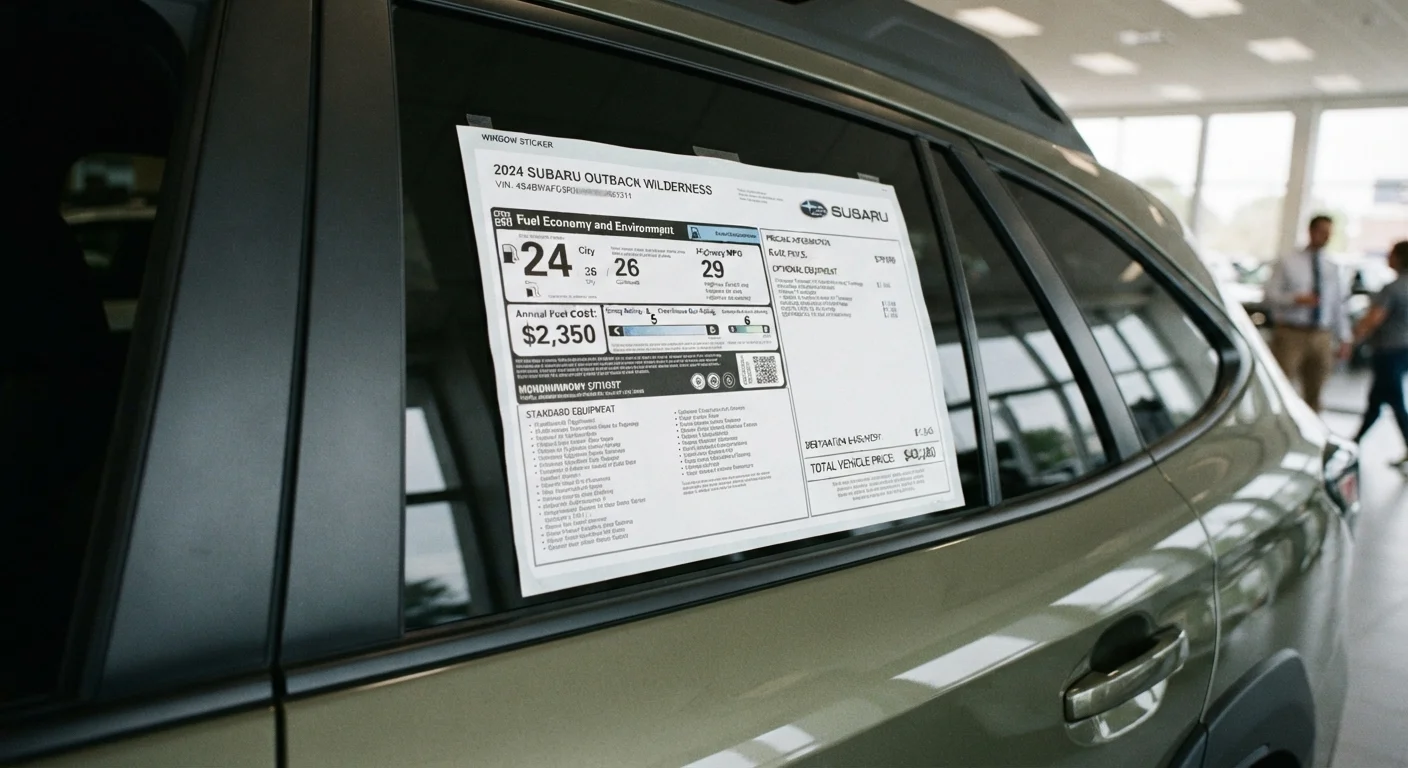
Why the Window Sticker Exists
Before 1958, car buyers had little way to verify whether the price on a vehicle was fair or what equipment they were actually getting. The Automobile Information Disclosure Act changed that by mandating a uniform, manufacturer-produced label on every new vehicle. The goal was straightforward: give buyers reliable, standardized information before they signed anything.
The sticker is not a sales tool - it is a disclosure document. Understanding the difference matters. Everything on the Monroney comes from the manufacturer, not the dealer, which means it reflects the same information whether you are at a small rural lot or a large urban showroom. That consistency is the sticker's core value.
The Sticker Must Stay On Until Sale
Federal law prohibits removing the Monroney sticker before the vehicle's first retail sale is complete. If you encounter a new car without its window sticker, ask the dealer to produce it. The sticker is your legal right as a prospective buyer, not a courtesy.
Breaking Down the Monroney: Section by Section
The sticker is divided into several distinct areas. Here is what each one is actually communicating:
Base Price and Options
The top section lists the vehicle's base MSRP - what the car costs with standard equipment only - followed by a line-by-line breakdown of any factory-installed packages or individual options and their prices. Adding these together gives you the total vehicle price before fees.
Destination and Delivery Charge
Below the equipment list, you will find a flat fee for transporting the car from the factory to the dealership. This figure is set by the manufacturer and applies uniformly across all dealerships for that model. It is not a dealer markup and is not typically negotiable.
Total MSRP
This is the sum of the base price, all options, and the destination charge. It is the number most people think of as "the sticker price." Remember: it is a starting point for a conversation, not a fixed transaction price.
Fuel Economy Estimates
The large MPG figures in the center of the sticker come from EPA standardized testing. City and highway estimates are listed separately because driving conditions differ significantly. A combined figure is also shown. These numbers allow you to compare vehicles on equal footing - but your actual mileage will depend on how, where, and how aggressively you drive.
1958
Year Monroney sticker became federal law
The Automobile Information Disclosure Act was signed into law, making the window sticker mandatory on all new vehicles sold in the U.S.
5-Star
NHTSA's highest overall safety rating
The National Highway Traffic Safety Administration uses a five-star scale to rate new vehicles across multiple crash test categories, with results summarized on the Monroney sticker.
City vs. Highway
Two separate EPA fuel economy estimates
The EPA tests vehicles under distinct city and highway driving cycles because real-world fuel use differs significantly between stop-and-go and sustained-speed driving.
Safety and Crash Test Ratings
If the vehicle has been tested by the National Highway Traffic Safety Administration (NHTSA) or the Insurance Institute for Highway Safety (IIHS), those ratings may appear on the sticker. Star ratings and specific category scores help you compare how different models perform in crash scenarios.
Standard Features List
The sticker also enumerates the equipment included in the base configuration - things like engine type, transmission, safety technology, and infotainment features. This section is useful for confirming that what the salesperson described verbally is actually part of the vehicle in front of you.
The Dealer's Supplemental Sticker: A Different Document
Many dealerships attach a second sticker alongside the Monroney. This is not a federal document - it is produced by the dealer and may include market adjustments (especially on high-demand vehicles), dealer-installed accessories like floor mats or window tinting, and additional fees or protection packages.
Items on the supplemental sticker carry different weight than items on the Monroney. Accessories you did not request and market adjustments are generally more open to discussion than manufacturer-set charges. Knowing which sticker you are looking at - and which line items originate from whom - is essential before any negotiation begins.
For a closer look at what dealers may present at the closing table, see our guide on dealer add-ons and what they actually cover.
Pull the Sticker Before You Visit
Most manufacturers allow you to build and price any trim level on their official website, which generates a sticker-equivalent breakdown. Reviewing this before your dealership visit means you already know the configured price, standard features, and EPA figures - leaving less room for surprises at the lot.
Using the Sticker as a Research Tool
The best time to read a window sticker is before you visit a dealership. Manufacturers publish sticker information - including full option breakdowns and pricing - on their official websites for every trim level. Reviewing this information in advance lets you walk in knowing the vehicle's configured price, which options you actually want, and what the fuel economy figures mean for your commute.
The window sticker is one piece of a larger information picture. For used vehicles, the sticker is no longer present, but a vehicle history report fills a similar role by disclosing prior ownership, accident records, and title status. See our walkthrough on reading a vehicle history report for guidance on that process.
Approaching a vehicle purchase with the sticker already decoded shifts the dynamic. You are not learning about the car at the dealership - you are confirming what you already know.
Frequently Asked Questions
No. MSRP stands for Manufacturer's Suggested Retail Price - the key word is 'suggested.' Dealers may sell above or below MSRP depending on market demand, inventory, and negotiation. Understanding what the sticker says helps you enter that conversation informed.
The destination charge covers the cost of shipping the vehicle from the assembly plant to the dealership. It is set by the manufacturer and is generally non-negotiable, unlike other line items on the sticker.
EPA estimates are derived from standardized laboratory tests and serve as a consistent comparison tool across vehicles. Real-world fuel economy varies based on driving habits, road conditions, and climate, so treat the figures as a benchmark rather than a guarantee.
The Monroney sticker contains manufacturer-provided information required by federal law. A supplemental sticker is added by the dealership and may list market adjustments, dealer-installed accessories, or additional fees. Items on the supplemental sticker are often more negotiable.
Used vehicles are not required to carry a Monroney sticker. However, used car dealers are typically required to display an FTC Buyers Guide that discloses warranty status. For used vehicle background information, a vehicle history report is a more relevant document to review.
Federal law prohibits removing the Monroney sticker before the first retail purchase is complete. Once you have taken delivery, the sticker may be removed. If a sticker is missing from a new car, that is worth questioning.
The content on this site is provided for informational purposes only and should not be considered a substitute for professional advice. While we strive to provide accurate and up-to-date information, we make no guarantees regarding its completeness or accuracy. Always consult a qualified professional for advice specific to your circumstances before making any decisions