

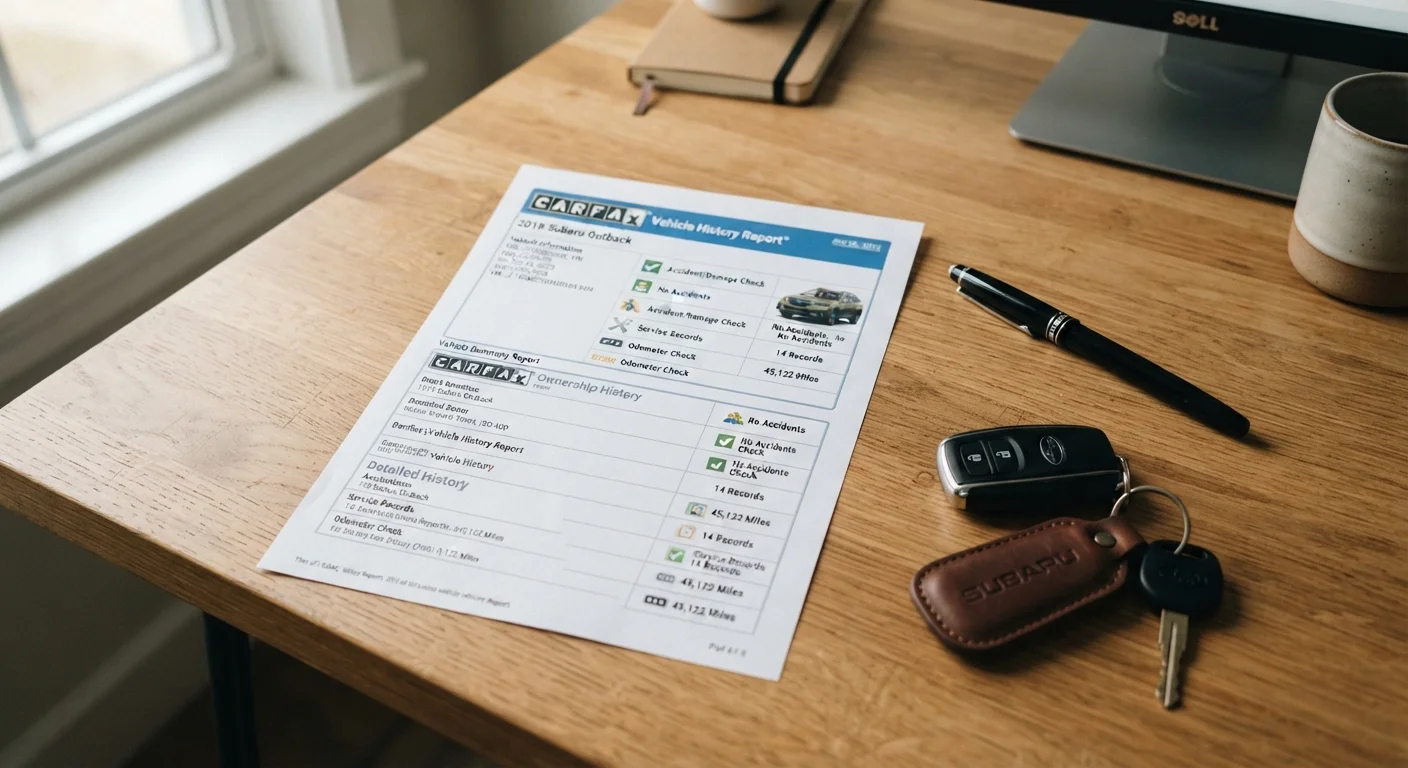
What a Vehicle History Report Actually Contains
A vehicle history report is a compiled record drawn from state DMV filings, insurance claims, salvage auctions, inspection stations, and dealer service networks. It is not a complete picture of everything a car has ever experienced - it reflects only what was formally reported through those channels. Understanding that limitation is the first step to reading one clearly.
Reports typically organize information into sections covering title history, odometer readings, accident and damage records, ownership transfers, and sometimes service history. Each section has different implications, and not every entry signals a problem. The goal is to identify entries that require follow-up and to put everything else in context.
What you will need
For a broader look at what to review before any vehicle purchase, see our pre-purchase checklist covering paperwork, financing terms, and inspection steps.
Reports Have Gaps - Always Get an Inspection
Vehicle history reports only reflect events that were formally reported to insurers, state agencies, or dealers. A serious accident repaired privately, or flood damage that was never claimed, may not appear at all. Always pair any history report with a physical inspection by a qualified, independent mechanic before finalizing a purchase.
How to Read Each Section Without Overreacting
Most buyers either ignore the details or treat every entry as disqualifying. Neither approach serves you well. The steps below walk you through each major section in the order that matters most - starting with the highest-stakes information.
Locate the VIN and pull the report
Find the 17-character Vehicle Identification Number on the driver's side dashboard (visible through the windshield) or on the door jamb sticker. Confirm it matches the number on the title and any other paperwork the seller provides - a mismatch is an immediate red flag. Use the VIN to request the history report through a recognized reporting service.
Check the title history section first
The title section tells you how ownership transferred over time and whether the vehicle carries any special designations. Look for these terms and understand what they mean:
- Clean title - No declared total-loss history; generally the most straightforward situation.
- Salvage title - The vehicle was declared a total loss by an insurance company.
- Rebuilt/Reconstructed title - Previously salvaged, repaired, and re-registered after a state inspection.
- Lemon law buyback - The manufacturer repurchased the vehicle due to persistent defects.
- Flood or fire damage - Documented damage from environmental events.
Salvage and rebuilt designations are the most consequential. They affect insurability, resale value, and long-term reliability in ways that are difficult to fully assess without specialist help.
Review odometer readings for consistency
Vehicle history reports log odometer readings at registration renewals, inspections, and dealer service visits. Read through every entry chronologically and verify the mileage increases logically. Flags to watch for include:
- A reading that is lower than a previous entry (rollback)
- A gap in readings followed by an unusually large jump
- An explicit "odometer discrepancy" or "rollback" alert from the reporting service
Odometer fraud is illegal under federal law, but it still occurs. Any inconsistency warrants a direct conversation with the seller and verification by a mechanic who can assess wear patterns against reported mileage.
Read the accident and damage history carefully
Accident entries vary significantly in severity. A minor rear-end collision with cosmetic damage only is a very different situation from a frontal impact involving airbag deployment. When reading accident entries, note:
- Which area of the vehicle was affected (front, rear, side, roof)
- Whether airbags deployed - this indicates a meaningful impact
- Whether damage was classified as minor, moderate, or severe
- Whether a repair facility record is attached
A single reported fender-bender doesn't automatically disqualify a vehicle. However, structural or frame damage - especially to the front or roof - warrants close scrutiny from a mechanic. Poorly repaired structural damage can affect handling and crash protection in ways that aren't visible to the eye.
Examine the ownership and usage history
The report will show how many times the vehicle has changed ownership and where it was registered. Pay attention to:
- Number of owners - Frequent ownership changes over a short period may suggest recurring problems.
- Usage type - Rental, fleet, taxi, or government use is sometimes listed. High-cycle fleet use can mean more wear, though fleet vehicles are often serviced on schedule.
- Geographic history - Registration in regions with heavy road salting may mean more rust risk; coastal registration can raise concerns about salt air corrosion.
Review service and recall records
Some reports include records of dealer service visits, oil changes, and recall completion. A vehicle with a documented service history at consistent intervals is generally a more predictable ownership proposition. Also check whether any open recalls are listed - unresolved recalls are worth addressing before or immediately after purchase. You can verify recall status independently through the National Highway Traffic Safety Administration (NHTSA) website using the VIN.
Cross-Check Mileage Across Every Entry
As you read through dated service and ownership entries, verify that odometer readings increase logically over time. A number that drops, stalls, or jumps inconsistently is a red flag worth investigating with the seller and a mechanic.
Once you've worked through the report, you'll have a much clearer sense of what questions to raise. Our guide on questions to ask before a used car test drive can help you use that information effectively with any seller.
Putting the Report in the Bigger Picture
A vehicle history report is a starting point, not a verdict. It tells you what was officially recorded - it cannot tell you about the quality of repairs, the condition of wear items, or problems that were never reported to an insurer or government agency.
Salvage and Rebuilt Titles Carry Lasting Risk
A salvage title means an insurer declared the vehicle a total loss. A rebuilt title means it was repaired and passed a state inspection - but standards vary widely by state. Vehicles with these designations can be harder to insure, difficult to resell, and may carry undetected structural issues. Approach them with significant caution and consult a specialist mechanic if you proceed.
After reviewing the report, bring the vehicle to an independent mechanic for a pre-purchase inspection. This is especially important if you spotted any accident history, a rebuilt title, or odometer inconsistencies. A qualified mechanic can assess structural integrity, check for hidden flood damage indicators, and evaluate whether recorded repairs were done properly.
For perspective on how a vehicle's maintenance demands shift over time, our overview of long-term maintenance costs explains how wear and upkeep expenses typically evolve as mileage climbs. Understanding that context helps you weigh what you find in the history report against the full cost of ownership.
Reading a vehicle history report well is a skill that pays off in confidence at the negotiating table - and in fewer surprises after the sale. Pair it with a thorough inspection and the right questions, and you're making a decision based on real information rather than a seller's assurances alone.
The content on this site is provided for informational purposes only and should not be considered a substitute for professional advice. While we strive to provide accurate and up-to-date information, we make no guarantees regarding its completeness or accuracy. Always consult a qualified professional for advice specific to your circumstances before making any decisions