

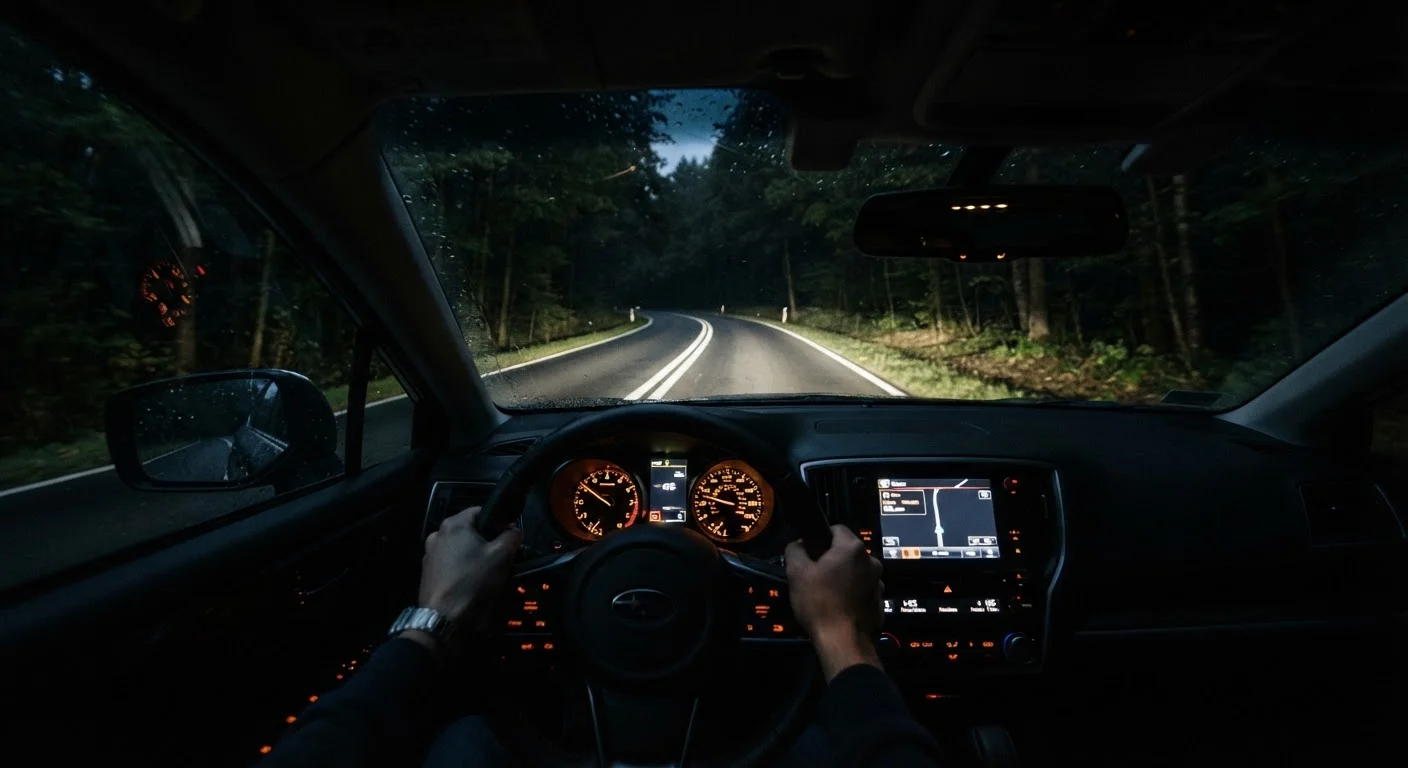
What Actually Happens to Your Eyes After Dark
Most drivers assume their eyes adjust to darkness quickly - a minute or two, and vision feels normal. In reality, full dark adaptation is a gradual biological process. When you move from a bright environment into darkness, your eyes shift from using cones (which process color and fine detail in daylight) to rods (which are more sensitive to low light but cannot distinguish color or sharp edges). This shift takes up to 30 minutes to complete.
During that transition window, your vision is compromised in ways that aren't always obvious from behind the wheel. Contrast sensitivity drops, making it harder to distinguish objects that aren't sharply silhouetted. Peripheral vision narrows. And critically, depth perception - your brain's ability to judge how far away something is - becomes less reliable without the full visual information daylight provides.
Even a brief glance at a bright phone screen, a lit billboard, or an oncoming high-beam can reset parts of this adaptation process, forcing your eyes to re-adjust all over again.
Glare Recovery Takes Longer Than You Think
When an oncoming vehicle's high beams hit your eyes, the temporary visual impairment - sometimes called glare blindness - can last several seconds after the vehicle passes. At highway speeds, several seconds represents hundreds of feet of road traveled with significantly reduced vision. Being aware of this lag is the first step to compensating for it by slowing down slightly and keeping your gaze toward the road edge.
Age, Health, and How They Affect Night Vision
Night vision is not static throughout your life. The pupil - which controls how much light enters the eye - becomes less responsive with age, meaning older eyes admit less light in dim conditions. The eye's lens also gradually becomes less transparent over time, scattering light and increasing sensitivity to glare from oncoming headlights.
Drivers in their 40s may begin noticing that night driving feels more tiring or that oncoming lights seem harsher. By the 60s and beyond, the contrast can be substantial. This is not a reason to stop driving at night, but it is a reason to adapt: reducing speed, increasing following distance, and being more deliberate about scanning the road ahead are all reasonable adjustments.
Certain health conditions and medications can also affect night vision. If you notice a sudden or significant change in how well you see after dark, an eye care professional is the right first call - not a driving accessories retailer.
Schedule Regular Eye Exams if You Drive at Night
Night vision problems are often gradual and easy to normalize over time. A comprehensive eye exam - typically recommended every one to two years for adults - can identify changes in contrast sensitivity or pupil response that affect driving. Many conditions that impair night vision are correctable or manageable when caught early.
The Overdriving Problem and Stopping Distance
Standard low-beam headlights illuminate roughly 160 feet ahead. At 60 mph, a vehicle needs approximately 200 feet to come to a complete stop under good conditions. That gap - between what you can see and how far you need to stop - is where many night driving accidents originate.
This is called overdriving your headlights: traveling at a speed where your reaction and braking distance exceeds the distance your headlights reveal. An animal, a pedestrian, or road debris appearing at the edge of your lit zone may not give you enough time to stop safely.
Slowing down on unlit or rural roads at night is not overly cautious - it is a direct response to a real physics problem. High beams extend visibility to around 350-500 feet, and using them appropriately on open roads (while dimming for oncoming traffic) is one of the more effective ways to reduce this risk.
For more on preparing your vehicle's lighting systems before a drive, see our pre-trip safety walkthrough.
~50%
Of fatal crashes occur at night
According to the NHTSA, roughly half of all traffic fatalities in the United States occur during nighttime hours, despite far less overall traffic volume than daytime.
160 ft
Typical low-beam headlight range
Standard low-beam headlights illuminate approximately 160 feet ahead - less than the stopping distance needed at 60 mph under average road conditions.
30 min
Time for full dark adaptation
The human eye can take up to 30 minutes to complete the dark adaptation process, during which visual sensitivity is measurably lower than fully adapted night vision.
Practical Habits That Make a Real Difference
Understanding the biology behind night vision limitations is most useful when it translates into habit changes. A few practical adjustments that safety researchers and driving experts broadly support:
- Keep your windshield clean - inside and out. Interior film buildup scatters oncoming light dramatically, worsening glare. This is one of the most overlooked night visibility factors.
- Ensure headlights are properly aimed. Misaligned headlights can point too low, too high, or to the side - all of which reduce usable illumination. A qualified mechanic can check alignment during routine maintenance. See our car maintenance hub for related guidance.
- Increase your following distance. Reaction time remains important regardless of experience level - and night conditions compound the challenge. Our companion piece on how fatigue affects reaction time is worth reading alongside this one, since nighttime driving and drowsiness often coincide.
- Avoid looking directly at oncoming headlights. Shift your gaze to the right edge of your lane. This reduces glare exposure and preserves your adapted vision.
- Scan actively, not passively. Night vision relies on peripheral rod cells more than central vision does, meaning hazards at the edge of your visual field are sometimes more detectable with slightly off-center scanning.
New and younger drivers face additional challenges because night driving experience takes time to accumulate. Our article on what new teen drivers need to understand addresses some of the specific gaps that standard driver education often leaves.
Frequently Asked Questions
Headlights illuminate only a limited cone of road ahead, while your eyes simultaneously lose the sharpness and color sensitivity they rely on during daylight. The eye shifts to using rods rather than cones in low light - rods detect motion well but lack fine detail and color. This combination means hazards at the edges of the road or at distance are genuinely harder to detect, not just a perception issue.
Many drivers notice some degradation in night vision starting in their 40s, as the pupil becomes less responsive and the eye's lens gradually yellows. By age 60, the eye may require significantly more light to see as clearly as it did at 20. This is a normal part of aging, not a disorder, but it does mean older drivers should factor reduced night acuity into their habits.
Severe vitamin A deficiency is a known cause of impaired night vision, though it is uncommon in the U.S. with a typical diet. Certain medications, including some antihistamines and blood pressure drugs, can also affect visual acuity or pupil response. If you notice a sudden change in your night vision, consult an eye care professional rather than self-diagnosing.
Overdriving your headlights means traveling at a speed where your stopping distance exceeds the distance your headlights actually illuminate. If something appears in the lit zone ahead, you would not have enough space to brake safely. It's a common night driving mistake, especially on rural or unlit roads, and slowing down is the straightforward fix.
The research on yellow-tinted lenses for nighttime driving is mixed, and many vision experts caution that they can reduce the total amount of light reaching the eye, making visibility worse in already dim conditions. They are not a substitute for proper headlight use and speed adjustment. Consult an optometrist before using specialty lenses for driving.
The content on this site is provided for informational purposes only and should not be considered a substitute for professional advice. While we strive to provide accurate and up-to-date information, we make no guarantees regarding its completeness or accuracy. Always consult a qualified professional for advice specific to your circumstances before making any decisions