

Why Time, Not Distance, Is What Actually Matters
Most drivers were taught the 3-second rule at some point, but the reason it works is often glossed over. The rule is based on time, not feet or car lengths - and that distinction is what makes it practical at any speed.
At 30 mph, three seconds translates to roughly 132 feet of following distance. At 65 mph, the same three seconds equals about 285 feet. If the rule were expressed as a fixed number of car lengths, it would need to change every time your speed changed. Counting seconds sidesteps that problem entirely.
Human reaction time alone - the gap between seeing a hazard and pressing the brake - averages around 1.5 seconds for most drivers. Add the physical stopping distance of the vehicle, and the math becomes clear: anything less than three seconds leaves almost no margin for error.
“Space and time are your two most important safety resources on the road. The 3-second rule is really just a way to make sure you have enough of both.”
— Traffic Safety Instructors Association, Driver education industry body representing certified driving instructors across the U.S.
How to Apply the Rule Correctly
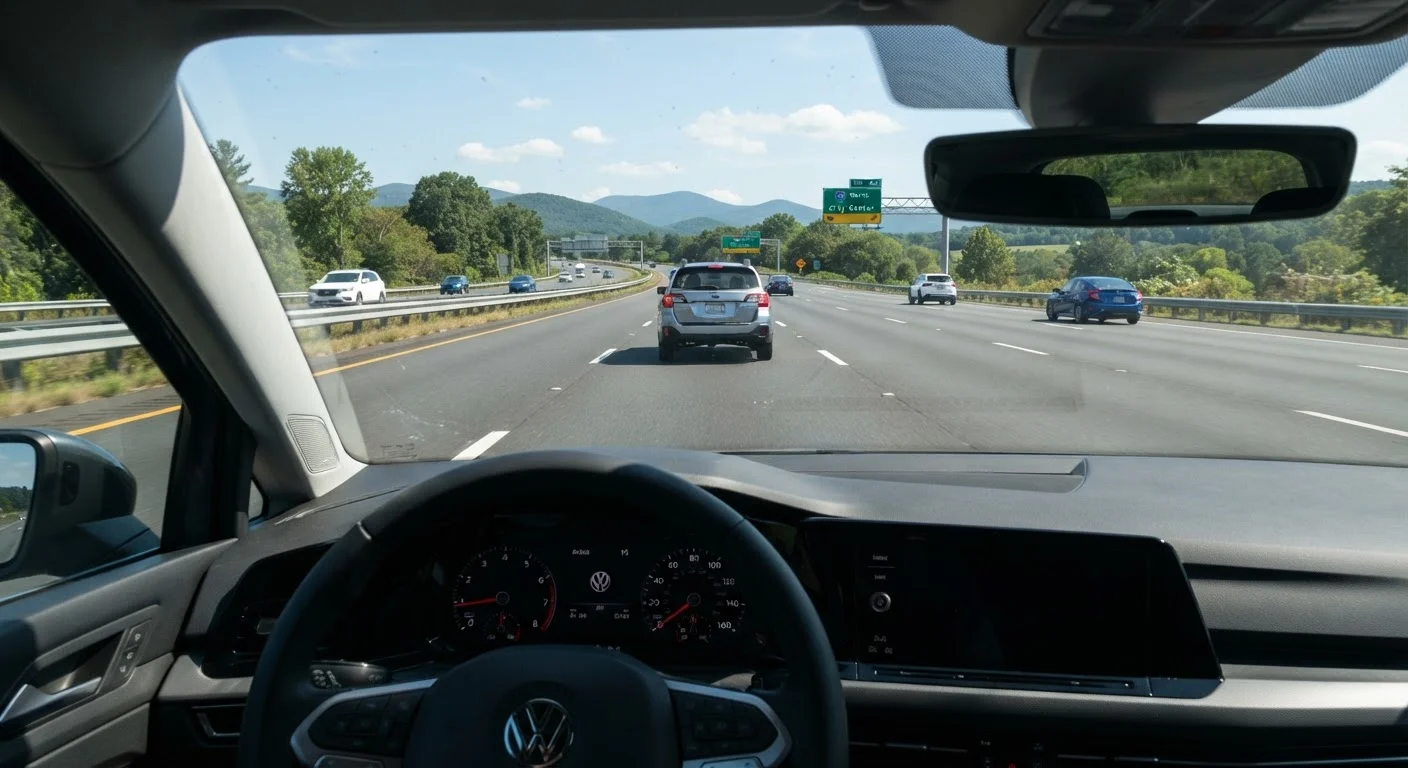
The counting method is straightforward. As the vehicle in front of you passes a fixed landmark - a highway sign, an overpass shadow, or a road marking - begin counting at a steady pace: one-thousand-one, one-thousand-two, one-thousand-three. If you pass that same landmark before you finish counting, close the gap by easing off the accelerator rather than braking hard.
Common mistakes that undermine the rule:
- Counting too fast. Rushing through the count defeats the purpose. Each 'one-thousand' beat should represent roughly one second.
- Choosing a poor landmark. Use something stationary and clearly defined. A moving object or a vague shadow won't give you an accurate reference point.
- Forgetting to recalibrate after a lane change. Every time the vehicle directly ahead of you changes, start your count again.
Restore Your Gap Without Hard Braking
If you realize you're following too closely, ease off the accelerator gradually rather than tapping the brakes. Gentle deceleration helps you reestablish a safe gap without disrupting traffic flow or startling the driver behind you.
When Three Seconds Isn't Enough
Three seconds is a floor, not a ceiling. Several conditions shift the math against you, and a larger buffer becomes necessary:
- Rain, snow, or ice: Wet pavement can double your stopping distance. A four-to-six second gap is a reasonable starting point.
- Reduced visibility: Fog, glare, or nighttime driving slow your hazard detection, which extends effective reaction time.
- Towing or carrying a heavy load: Extra weight means longer stopping distances regardless of speed.
- Driving a large vehicle: Trucks, SUVs, and vans handle braking differently than compact cars.
- Fatigue or distraction: If your attention isn't fully on the road, your reaction time is already compromised.
Understanding when to extend your following gap is just as important as knowing the rule itself. For a deeper look at the consequences of following too closely, see our article on tailgating and the real cost of closing the gap.
~1.5 sec
Average driver reaction time before braking
Research from traffic safety organizations consistently places average driver reaction time between 1.5 and 2 seconds under normal conditions.
~29%
Share of U.S. crashes that are rear-end collisions
According to the National Highway Traffic Safety Administration (NHTSA), rear-end crashes are among the most common collision types on American roads.
285 ft
Distance covered in 3 seconds at 65 mph
At highway speeds, three seconds of travel equals nearly the length of a football field - illustrating why fixed car-length rules fail to scale with speed.
Building the Habit - Especially for Newer Drivers
The 3-second rule is one of those habits that feels slightly uncomfortable at first because highway culture often normalizes following far too closely. Leaving visible space in front of your car can feel like an invitation for others to merge in. It isn't - and even when someone does merge, restoring the gap is as simple as lifting your foot slightly from the accelerator.
For newer drivers still building situational awareness, the rule provides a useful anchor: rather than guessing, you have a repeatable method you can apply on every road in every condition. The rule works the same on a city street at 25 mph as it does on the interstate at 70 mph.
If you're helping a new driver learn, this is one of the most practical habits to reinforce early. Our overview of what new teen drivers need to know covers additional safety concepts that don't always make it into formal driver's education.
Consistent following distance won't eliminate every crash risk, but it removes one of the most avoidable ones. That's worth the small habit shift it takes.
Frequently Asked Questions
Pick a fixed roadside landmark - a sign, an overpass, or a painted line. When the vehicle ahead passes it, begin counting 'one-thousand-one, one-thousand-two, one-thousand-three.' If you reach that landmark before finishing your count, you're following too closely and should ease back.
Yes - the rule applies anywhere you're following another vehicle, including city streets and residential roads. At lower speeds, three seconds still translates to meaningful stopping distance. The same counting method works regardless of your speed.
Increase your following gap whenever conditions make stopping harder: rain, snow, ice, fog, nighttime driving, towing a trailer, or driving a large vehicle. A four-to-six second cushion is appropriate in those situations.
Yes. Following too closely is a leading cause of rear-end collisions, which account for a significant portion of all vehicle crashes in the U.S. The shorter your following distance, the less time you have to react to any unexpected braking ahead.
If another car merges into your following gap, simply ease off the accelerator slightly until you've restored a safe distance. There's no need to match the original vehicle's position - your goal is always three or more seconds to whoever is directly ahead.
The content on this site is provided for informational purposes only and should not be considered a substitute for professional advice. While we strive to provide accurate and up-to-date information, we make no guarantees regarding its completeness or accuracy. Always consult a qualified professional for advice specific to your circumstances before making any decisions