

Our Verdict
Neither short-term nor long-term financial goals should be treated as optional. The most resilient plans treat them as complementary layers, not competing priorities. Structuring goals by time horizon - and automating contributions where possible - allows you to protect today's stability while steadily building tomorrow's security.
| Best for | Recommended |
|---|---|
| Those with limited cash flow or existing debt | Short-term goal focus first |
| Those with stable income and a funded emergency cushion | Balanced dual-horizon approach |
| Those early in their careers with decades ahead | Long-term goal prioritization with minimum short-term safeguards |
| Those approaching major life transitions (retirement, home purchase) | Goal-specific milestone planning |
Why the Time Horizon on a Goal Changes Everything
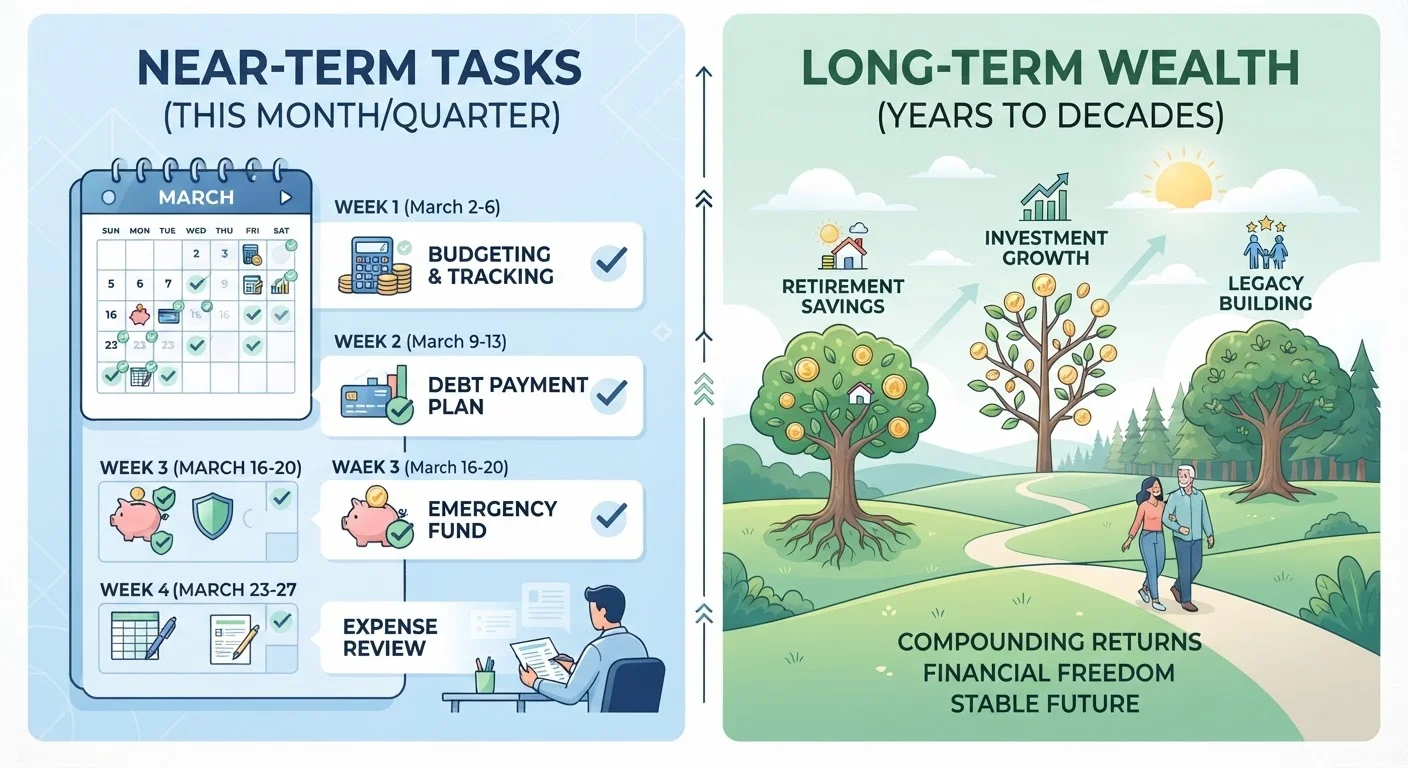
Financial goals are not one-size-fits-all - their urgency, risk tolerance, and funding strategy differ dramatically depending on when you need the money. A short-term goal typically has a timeline of two years or less: building an emergency fund, paying off a credit card, or saving for a vacation. A long-term goal extends beyond five years and includes milestones like retirement, a child's education, or buying a home.
Medium-term goals - two to five years out - sit in between and often require their own planning layer. Think of the three categories as separate buckets that draw from your income simultaneously, not in sequence.
The risk of treating them as sequential is significant. Readers who delay all retirement contributions until short-term debts are resolved may sacrifice years of compound growth they can never recover. Conversely, those who funnel every dollar into long-term accounts without maintaining a cash buffer can find themselves taking on high-interest debt the moment an unexpected expense arises. See how to weigh savings against debt repayment for a closer look at that specific trade-off.
Short-Term vs. Long-Term Goals: A Side-by-Side View
Understanding where these goal types differ - and where they overlap - makes it easier to allocate resources without feeling like you're robbing one to fund the other.
| Short-Term Goals | Medium-Term Goals | Long-Term Goals | |
|---|---|---|---|
| Typical timeline | Under 2 years | 2-5 years | 5+ years |
| Common examples | Emergency fund, debt payoff | Home down payment, car purchase | Retirement, college funding |
| Primary objective | Liquidity and stability | Moderate growth with access | Maximum long-term growth |
| Risk tolerance | Very low | Low to moderate | Moderate to higher |
| Funding approach | Consistent cash saving | Dedicated savings account or CDs | Tax-advantaged or investment accounts |
| Review frequency | Monthly | Quarterly | Annually |
Notice that short-term goals prioritize liquidity and safety, while long-term goals rely on growth and time. Mixing up the strategies - for example, investing emergency funds in volatile assets for higher returns - introduces risk that undermines the purpose of the goal itself.
How to Structure Goals Across Time Horizons
A layered funding approach helps prevent goal conflicts. Start by identifying your most urgent financial gap - most commonly, an underfunded emergency reserve. Financial educators generally suggest three to six months of essential expenses held in an accessible, low-risk account, though the right amount depends on your job stability and household obligations.
Once a baseline safety net is in place, the next layer involves automating contributions to long-term accounts. Automation is important because it removes the monthly decision of whether to contribute - a decision that often loses to short-term spending pressure. As the time value of money illustrates, even modest early contributions can outpace larger ones started later.
Medium-term goals, such as a home down payment or a major planned expense, typically fit best in accounts that offer modest growth with lower volatility than equity markets - but this depends on individual circumstances. Consulting a licensed financial adviser can help you match account types to specific goal timelines.
Automate Before You Can Spend It
Setting up automatic transfers to goal-specific accounts on payday - before discretionary spending begins - is one of the most effective ways to consistently fund multiple goals. Even small automated contributions to long-term accounts accumulate meaningfully over years. Treat savings transfers with the same priority as fixed bills.
For practical budgeting frameworks that can accommodate multiple goal layers simultaneously, the comparison of popular budgeting strategies covers options ranging from the envelope method to pay-yourself-first approaches.
Common Pitfalls That Throw the Balance Off
Even well-intentioned planners run into predictable traps. One of the most common is setting goals without specificity - vague intentions like "save more" or "invest for retirement" rarely produce consistent behavior. Goals work better when tied to a specific dollar amount and a target date, as explored in setting financial goals that are actually worth pursuing.
Another frequent mistake is abandoning long-term contributions during financial stress without a plan to resume them. A temporary pause may be necessary, but leaving long-term savings on hold indefinitely compounds the loss - not just in contributions missed, but in growth not earned.
Pausing Long-Term Savings Carries a Hidden Cost
Stopping retirement or long-term investment contributions - even temporarily - can have a larger impact than the missed dollar amount suggests. Time out of the market means missed compounding that cannot be recaptured by simply contributing more later. If cash flow is strained, consider reducing contributions rather than eliminating them entirely, and set a clear date to restore them.
Finally, lifestyle inflation - spending more as income rises without proportionally increasing savings - quietly erodes the margin available for both goal types. Reviewing your goal allocations annually, especially after income changes, is a habit that pays off over time. The year-end financial readiness checklist offers a structured way to do exactly that.
This article is for general informational and educational purposes only and does not constitute personalized financial, investment, tax, or legal advice. Consult a qualified financial professional before making decisions specific to your situation.
The content on this site is provided for informational purposes only and should not be considered a substitute for professional advice. While we strive to provide accurate and up-to-date information, we make no guarantees regarding its completeness or accuracy. Always consult a qualified professional for advice specific to your circumstances before making any decisions