

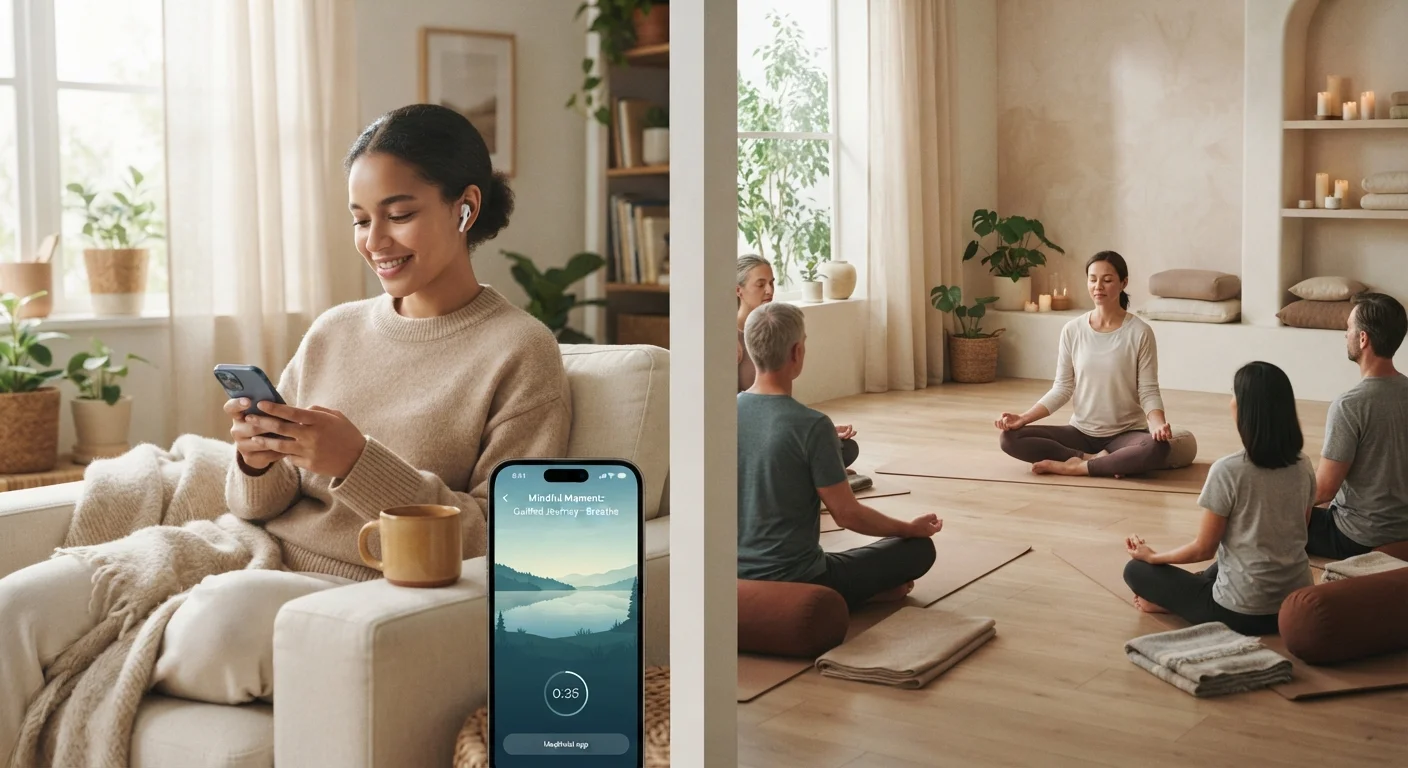
Option A
Meditation Apps
The flexible, on-demand mindfulness companion.
Best for: Individuals who want low-cost, anytime access to guided meditation without committing to a schedule.
Option B
Guided In-Person Mindfulness Classes
The structured, community-supported mindfulness experience.
Best for: People who thrive with accountability, direct instructor feedback, and a shared group environment.
What Each Format Actually Offers
Mindfulness practice has moved well beyond the meditation cushion. Today, millions of Americans access it through a smartphone, while others still seek out a local studio or community center class. Understanding what you are actually getting from each format helps you invest your time and, potentially, your money wisely. For a broader orientation to mental well-being concepts, see our beginner's guide to mental well-being.
Meditation apps deliver audio and video-guided sessions across a wide range of techniques - breath awareness, body scan, loving-kindness, sleep meditations, and more. You set the pace, choose the duration, and practice wherever you are. Most apps track streaks and progress, which some users find motivating.
In-person mindfulness classes are typically led by a trained or certified instructor in real time. Session formats vary: some follow structured curricula such as Mindfulness-Based Stress Reduction (MBSR), an eight-week program developed at the University of Massachusetts Medical School and widely studied in peer-reviewed research. Others are more informal drop-in classes offered at yoga studios, libraries, or community centers.
| Criterion | Meditation Apps | In-Person Mindfulness Classes |
|---|---|---|
| Typical cost | Free to ~$100/year | $10-$500+ depending on program |
| Scheduling flexibility | Anytime, on-demand | Fixed class times |
| Instructor feedback | None (pre-recorded guidance) | Real-time, personalized |
| Community support | Limited or none | Group setting, shared experience |
| Technique variety | Very broad library | Depends on instructor/program |
| Evidence depth | Growing, shorter track record | Decades of peer-reviewed studies |
| Accessibility (location) | Available anywhere with a device | Requires local availability |
| Best for beginners | Adequate for self-starters | Stronger foundational support |
Evidence, Effectiveness, and What Research Actually Says
Both formats are backed by research, though the evidence base differs in depth. In-person MBSR and similar structured programs have decades of peer-reviewed studies supporting their effectiveness for reducing perceived stress, improving attention, and supporting emotional regulation in non-clinical populations. The American Psychological Association recognizes mindfulness-based interventions as well-established approaches for stress reduction.
App-based meditation has a shorter research history, but a growing number of controlled studies - including a 2018 review published in Mindfulness - suggest that app-guided programs can meaningfully reduce stress and anxiety symptoms compared to no intervention. Effect sizes tend to be modest, and researchers note that user drop-off rates are high, meaning consistency matters more than format.
~500
Mindfulness apps available on major app stores
A 2019 review in npj Digital Medicine identified nearly 500 mindfulness apps, noting wide variation in content quality and research support.
8 weeks
Duration of the standard MBSR program
Mindfulness-Based Stress Reduction, developed at UMass Medical School, follows an eight-week structured curriculum with the strongest published evidence base among mindfulness programs.
~58%
App users who disengage within the first month
Research on digital health apps consistently finds high early drop-off rates, underscoring that sustained engagement - not format alone - drives outcomes.
Neither format should be treated as a substitute for professional mental health care. If you are experiencing significant anxiety, depression, or other mental health concerns, please consult a qualified healthcare professional. For context on how self-help tools compare with professional therapy, our article on therapy vs. self-help strategies provides useful framing.
Practical Considerations: Cost, Access, and Consistency
Cost and logistics often determine what people actually sustain. Apps typically range from free (with limited content) to roughly $70-$100 per year for full access - far less than most in-person class packages. In-person classes vary widely: community center programs may cost $10-$20 per session, while private studio packages or full MBSR courses can run $300-$500 or more.
Access is another real variable. Urban and suburban residents generally have more class options within a reasonable commute. Rural residents, those with mobility limitations, or anyone with highly irregular hours will find apps far more practical. The social dimension of group classes - the shared silence, the community check-ins, the instructor's presence - is something apps cannot replicate, and for some people that human element is the difference between an occasional experiment and a lasting habit. This parallels the dynamic explored in our comparison of group fitness classes vs. solo training: community structure genuinely helps certain learners.
Consistency is the strongest predictor of benefit in the mindfulness literature. Choose the format - or combination of formats - you are most likely to return to week after week. Many practitioners begin with in-person classes to build foundational skills, then use an app to maintain daily practice between sessions. That hybrid approach is both common and pragmatic.
This article is for general informational and educational purposes only. It is not a substitute for professional medical or mental health advice, diagnosis, or treatment. Always consult a qualified healthcare professional for concerns about your mental or physical health.
The content on this site is provided for informational purposes only and should not be considered a substitute for professional advice. While we strive to provide accurate and up-to-date information, we make no guarantees regarding its completeness or accuracy. Always consult a qualified professional for advice specific to your circumstances before making any decisions