

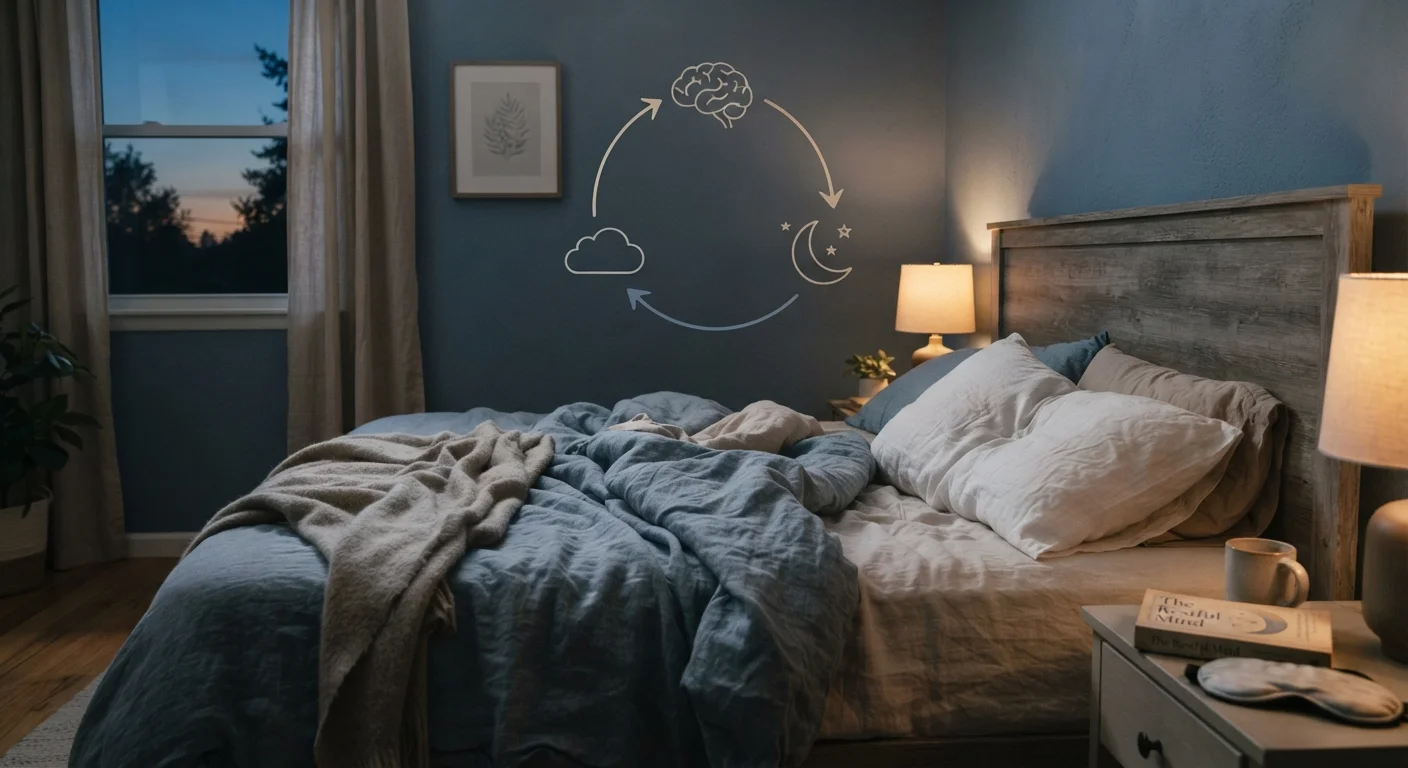
How the Cycle Works
Stress, sleep, and mood are not independent variables - they form a tightly coupled feedback loop. Disrupting one reliably destabilizes the others. Understanding why this happens, rather than just accepting it as inevitable, gives you actionable leverage points.
At its core, the cycle operates like this: psychological or physical stress triggers hormonal and neurological changes that fragment sleep; disrupted sleep impairs the emotional regulation systems in the brain; and compromised emotional regulation makes a person more reactive to stressors, restarting the loop. The cycle is self-reinforcing, which is why people often feel stuck - each problem is simultaneously a cause and a consequence of the others.
Research published in journals such as Sleep Medicine Reviews and work summarized by the American Psychological Association consistently identifies this bidirectional relationship. The good news is that the loop has multiple entry points, meaning you don't need to solve all three problems at once to see meaningful improvement.
43%
Adults reporting stress-related sleep disruption
According to the American Psychological Association's Stress in America survey, nearly half of adults report that stress keeps them awake at night.
60%
Increased emotional reactivity after sleep loss
Neuroimaging research published in the journal Current Biology found amygdala reactivity increased by approximately 60% following sleep restriction compared to well-rested conditions.
7-9 hrs
Recommended nightly sleep for adults
The American Academy of Sleep Medicine and the Sleep Research Society jointly recommend 7 or more hours of sleep per night for adults to support optimal health.
Stress and Its Effect on Sleep
When the brain perceives a threat - whether it's a work deadline or a difficult conversation - the hypothalamic-pituitary-adrenal (HPA) axis releases cortisol and adrenaline. These hormones are designed for short-term alertness. They raise heart rate, heighten sensory awareness, and suppress processes the body considers non-urgent. Sleep is one of those suppressed processes.
Cortisol follows a natural diurnal rhythm, peaking in the morning and tapering toward bedtime. Chronic stress keeps cortisol elevated into the evening hours, making it physiologically difficult to initiate and maintain sleep. Importantly, stress also increases cognitive arousal - the mind replays worries, plans, and unresolved problems - which is one of the primary drivers of onset insomnia.
Stress-disrupted sleep tends to reduce the proportion of slow-wave (deep) sleep and REM sleep, both of which are essential for memory consolidation and emotional processing. For evidence-backed routines that support better sleep architecture, see sleep hygiene habits that hold up under scientific scrutiny.
Schedule a 'worry window' of 15 minutes earlier in the evening to consciously process concerns, then consciously redirect at bedtime. This trains the brain to defer rumination rather than bring it to bed.
Cognitive behavioral research shows that scheduled worry time reduces pre-sleep cognitive arousal, which is a primary driver of sleep-onset difficulty.
Set your alarm for the same time every morning - including weekends - before you try to fix anything else about your sleep. Consistent wake time is the single most effective anchor for your circadian rhythm.
Sleep science consistently identifies wake-time consistency as more influential than bedtime in stabilizing sleep architecture, because it regulates adenosine pressure and melatonin timing.
How Poor Sleep Shapes Mood
The prefrontal cortex - the brain region most responsible for rational thought, perspective-taking, and impulse control - is acutely sensitive to sleep deprivation. Studies using neuroimaging have shown that even partial sleep restriction (sleeping roughly five to six hours instead of seven to nine) increases amygdala reactivity, the brain's alarm center, by a substantial margin. The result is stronger emotional responses to negative stimuli and a reduced ability to contextualize them.
Poor sleep is also associated with lower levels of serotonin and dopamine availability, neurotransmitters that underpin feelings of well-being and motivation. This is why a run of bad nights can feel emotionally indistinguishable from low mood or mild depression, even in otherwise healthy individuals.
Irritability, pessimism, reduced frustration tolerance, and social withdrawal are all documented consequences of insufficient sleep. These changes are not character flaws - they are predictable neurological outcomes of inadequate rest. Physical movement can provide a meaningful counterbalance; the mechanisms are explained in detail in our overview of physical activity and mood.
How Mood Feeds Back Into Stress
Negative mood states - particularly anxiety and low mood - do not merely reflect stress; they actively generate it. When a person feels persistently low or anxious, their threat-appraisal system becomes sensitized. Neutral events are more likely to be interpreted as threatening, minor setbacks feel catastrophic, and social interactions feel more effortful. Each of these appraisals triggers another cortisol response, sustaining the elevated baseline that keeps sleep elusive.
This mechanism, known as cognitive hyperarousal, is well-documented in insomnia research. Rumination - repetitive, negatively focused thinking - is particularly disruptive because it maintains physiological arousal even in the absence of an external stressor. The body responds to imagined threats and replayed worries much as it does to real ones.
Rumination Sustains the Stress Response
Replaying worrying thoughts activates the same physiological stress response as facing an actual threat. If you find yourself regularly lying awake mentally rehearsing problems, this is not simply a personality trait - it is a modifiable cognitive pattern. CBT-based techniques and guided mindfulness practice have demonstrated efficacy in reducing rumination; speaking with a therapist can provide structured support.
Practical Tools for Breaking the Cycle
Because the cycle has multiple entry points, interventions can target stress, sleep, or mood - and gains in one area tend to spread. The following approaches are supported by substantial evidence and are appropriate for general use, though they should be adapted to individual circumstances.
Address Stress at the Source
Structured problem-solving - identifying a stressor, listing realistic responses, and choosing one to act on - reduces the open loops that fuel rumination. Mindfulness-based stress reduction (MBSR), a standardized program developed at the University of Massachusetts, has demonstrated measurable reductions in cortisol and self-reported stress in multiple randomized controlled trials.
Stabilize Sleep Behavior
Maintaining a consistent wake time (even after a poor night) is one of the highest-leverage sleep behaviors because it regulates the body's circadian rhythm. Limiting screen exposure before bed, keeping the sleep environment cool and dark, and reserving the bed primarily for sleep reduce conditioned arousal. Cognitive Behavioral Therapy for Insomnia (CBT-I) is the first-line treatment recommended by the American Academy of Sleep Medicine for chronic insomnia.
Support Mood Through Daily Structure
Predictable daily routines, adequate light exposure in the morning, regular physical movement, and social connection all support mood regulation through measurable neurobiological pathways. A weekly mental health check-in can help you spot early warning signs before one bad night becomes a persistent pattern.
When to Seek Professional Support
General wellness strategies are appropriate starting points, but they have limits. If sleep difficulties, low mood, or anxiety have persisted for several weeks, are significantly impairing daily functioning, or are accompanied by thoughts of self-harm, these are signals to consult a qualified healthcare provider - a primary care physician, psychologist, or licensed therapist.
Conditions such as clinical depression, generalized anxiety disorder, and sleep disorders like sleep apnea require professional evaluation and tailored treatment. Self-directed strategies alone are not sufficient for managing these conditions, and delaying care can allow them to deepen.
A healthcare provider can assess whether contributing factors - thyroid function, medication side effects, nutritional deficiencies, or underlying mood disorders - may be driving the cycle and recommend evidence-based treatments appropriate to the individual.
This article is for general informational and educational purposes only and does not constitute medical advice. Always consult a qualified healthcare professional for guidance specific to your health situation.
The content on this site is provided for informational purposes only and should not be considered a substitute for professional advice. While we strive to provide accurate and up-to-date information, we make no guarantees regarding its completeness or accuracy. Always consult a qualified professional for advice specific to your circumstances before making any decisions