

Our Verdict
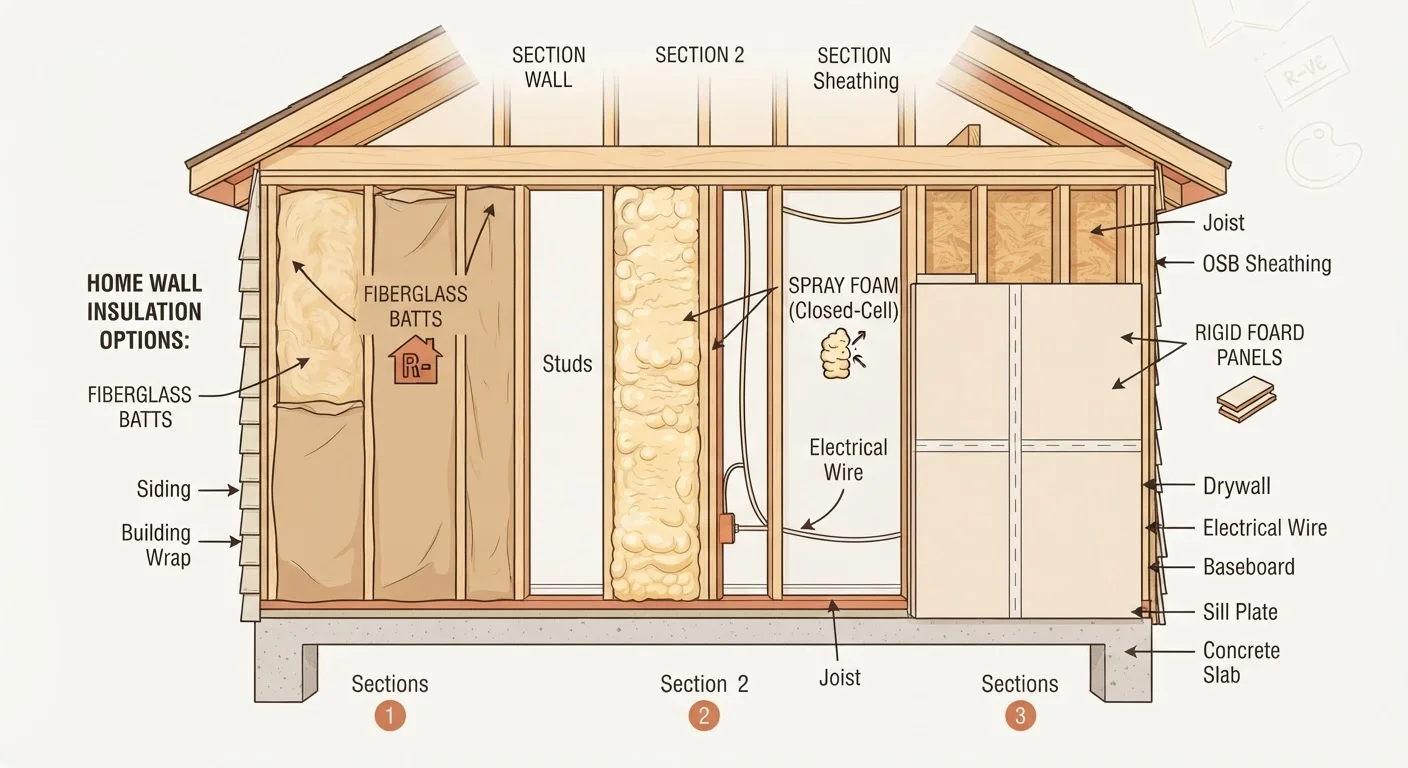
Each insulation type fills a distinct role in home performance. Fiberglass batts are the practical choice for budget-conscious projects in standard stud-framed walls and attics. Spray foam wins on air sealing and is worth the investment in hard-to-reach areas or when energy losses are significant. Rigid board shines anywhere moisture, space constraints, or continuous coverage is a priority.
| Best for | Recommended |
|---|---|
| Budget-conscious renovations with accessible wall or attic cavities | Fiberglass Batts |
| Crawl spaces, rim joists, and areas with significant air leakage | Spray Foam |
| Basement walls, exterior sheathing, and moisture-prone areas | Rigid Board |
| Whole-home renovations blending performance and cost | Combination approach |
Understanding R-Value Before You Choose
Every insulation comparison starts with R-value - a measure of thermal resistance. The higher the R-value, the more effectively the material slows heat transfer. The U.S. Department of Energy provides climate-zone guidelines recommending specific R-values for attics, walls, floors, and foundations depending on your region.
However, R-value alone doesn't tell the whole story. A perfectly rated batt installed with gaps around pipes or wires will underperform significantly. Air movement through and around insulation can reduce effective performance by a larger margin than the material rating suggests. That's why air sealing - covered in detail in our guide to caulk and weatherstripping - should always accompany insulation work.
Fiberglass Batts: Affordable and Widely Available
Fiberglass batts are the pink or yellow rolls found in nearly every home improvement store. They consist of spun glass fibers pressed into pre-sized widths designed to fit standard 16-inch or 24-inch stud spacing.
Where they work best
- Open attic floors and cathedral ceilings with adequate rafter depth
- Interior partition walls for sound control
- Exterior wall cavities in new construction or gut renovations
Limitations to know
Batts do not air-seal on their own. They must be paired with a vapor retarder in climate zones where moisture control is important. Compression reduces R-value, so avoid stuffing batts into undersized spaces. Gaps around electrical boxes and pipes are common installation errors that measurably reduce performance. Professional installation isn't required, but careful DIY work is essential.
Wear Protection When Handling Fiberglass
Fiberglass fibers are irritating to skin, eyes, and lungs. Always wear long sleeves, gloves, safety glasses, and an N95 or better respirator when cutting or installing fiberglass batts. Work in a well-ventilated space and wash exposed skin promptly after handling.
Spray Foam: High Performance, Higher Cost
Spray polyurethane foam (SPF) comes in two forms: open-cell and closed-cell. Open-cell foam is softer, vapor-permeable, and less expensive, with an R-value around R-3.5 to R-3.7 per inch. Closed-cell foam is denser, moisture-resistant, and delivers roughly R-6 to R-7 per inch - the highest of all three types covered here.
Where spray foam excels
- Rim joists and band joists where air infiltration is heavy
- Crawl spaces and vented attics being converted to unvented (conditioned) spaces
- Irregular cavities, around pipes, and in hard-to-reach voids
Important considerations
Spray foam must be installed by a licensed professional using proper protective equipment - the chemicals involved are hazardous during application and require cure time before occupancy. Closed-cell foam can also act as a vapor barrier, which may cause moisture problems if misapplied in certain climate zones. Always consult a building performance professional before choosing foam for a sealed-cavity application.
Spray Foam Is Not a DIY Product
Two-component spray polyurethane foam involves chemicals that pose serious respiratory and skin hazards during mixing and application. Improper installation can also trap moisture or create vapor-barrier problems that lead to structural damage over time. Always hire a certified spray foam contractor and vacate the space for the manufacturer-recommended cure period before re-entry.
Rigid Board: Versatile and Moisture-Resistant
Rigid insulation boards are manufactured from expanded polystyrene (EPS), extruded polystyrene (XPS), or polyisocyanurate (polyiso). They come in standard sheet sizes, typically 4×8 feet, and range from R-3.8 to R-6.5 per inch depending on the material.
Where rigid board performs well
- Basement walls and below-grade applications where moisture resistance matters
- Exterior continuous insulation over wall sheathing to reduce thermal bridging through studs
- Under slab foundations and in crawl space floors
- Garage doors and attic hatches where space is limited
Installation notes
Rigid board requires mechanical fastening or adhesive and seam taping for air control - it is not inherently airtight at edges. Foil-faced polyiso boards are not appropriate for below-grade use because the facing can trap moisture. Many rigid board products require a fire-rated covering such as drywall when installed in occupied spaces; check local building codes before leaving boards exposed.
Side-by-Side Comparison
The table below summarizes how the three insulation types compare across the criteria homeowners most commonly weigh.
| Fiberglass Batts | Spray Foam | Rigid Board | |
|---|---|---|---|
| Typical R-value per inch | R-2.9 to R-3.8 | R-3.5 to R-7 (open/closed cell) | R-3.8 to R-6.5 |
| Air sealing ability | None (requires separate sealing) | Excellent (especially closed-cell) | Moderate (seams must be taped) |
| Moisture resistance | Low - absorbs moisture | High (closed-cell) | High (XPS and EPS) |
| DIY-friendly | Yes, with care | No - professional required | Yes, manageable for most |
| Relative material cost | Low | High | Moderate |
| Best application | Wall cavities, attics | Crawl spaces, rim joists | Basements, exterior walls |
Keep in mind that local labor costs, climate zone requirements, and the specific location in your home will influence which type - or which combination - makes the most sense for your project.
The content on this site is provided for informational purposes only and should not be considered a substitute for professional advice. While we strive to provide accurate and up-to-date information, we make no guarantees regarding its completeness or accuracy. Always consult a qualified professional for advice specific to your circumstances before making any decisions