

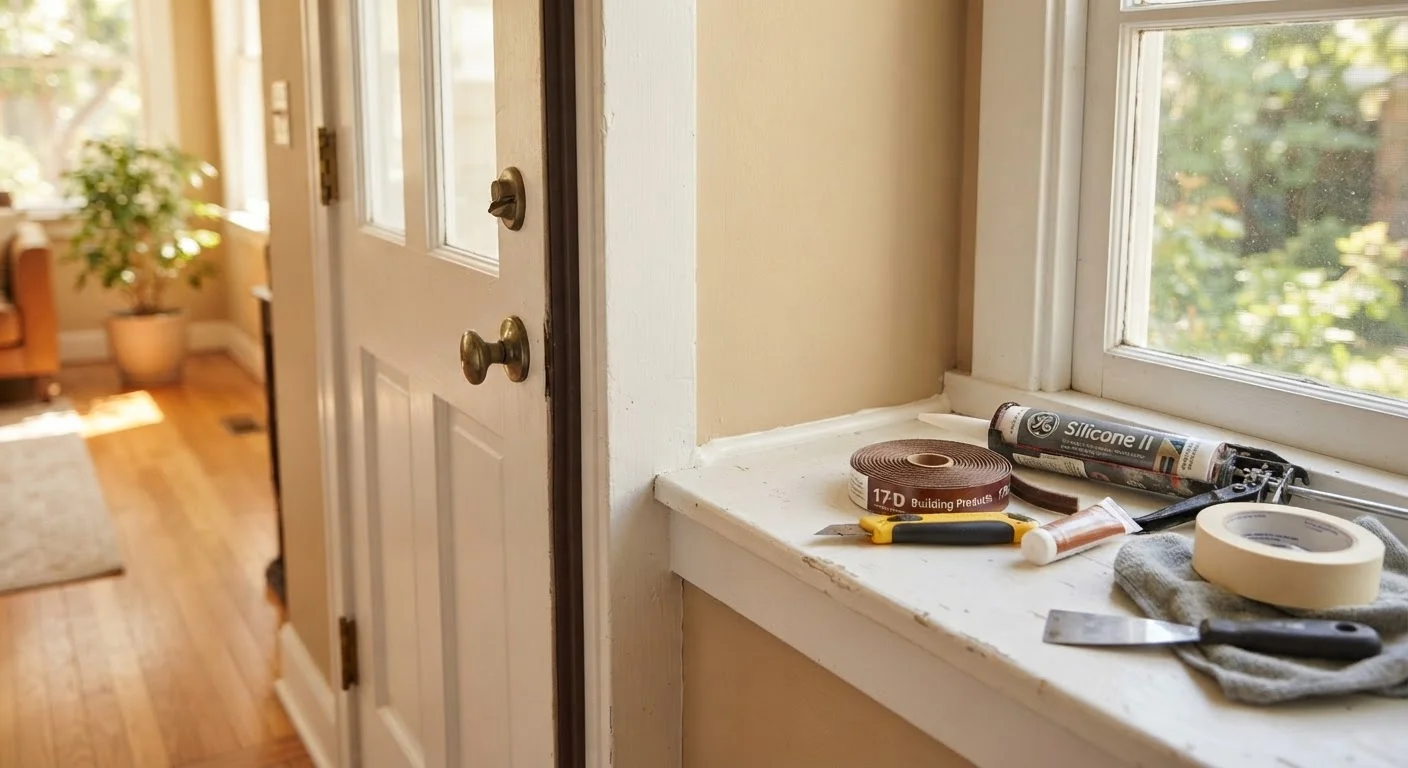
Option A
Caulk
The permanent, flexible sealant for stationary gaps.
Best for: Sealing fixed, non-moving gaps around window frames, door casings, pipes, and baseboards where surfaces don't shift.
Option B
Weatherstripping
The removable, compressible seal for moving parts.
Best for: Sealing the dynamic gaps created by doors and operable windows that open, close, and flex with use.
The Core Difference: Movement Is Everything
When it comes to stopping drafts and cutting energy loss, both caulk and weatherstripping do important work - but they're engineered for entirely different situations. The single most useful question to ask before reaching for either material is: does this gap move?
Caulk is a flexible sealant applied as a paste that cures into a rubbery or silicone-based bead. Once set, it bonds to surrounding surfaces and holds firm. That makes it perfect for stationary gaps - places where two building materials meet but don't shift, like where a window frame meets siding, or where a pipe passes through drywall. It's also the right choice for interior air sealing around baseboards, crown molding, and wall penetrations.
Weatherstripping, by contrast, is a compressible material - available in foam tape, V-strip, door sweeps, and reinforced rubber forms - designed to be compressed and released repeatedly. It lines the edges of doors and operable windows, creating a temporary seal that holds when the door is closed but releases cleanly when it opens. Applying caulk to a door's hinge side or bottom edge would either crack immediately under use or prevent the door from closing properly.
| Criterion | Caulk | Weatherstripping |
|---|---|---|
| Best for | Stationary, non-moving gaps | Moving parts - doors and operable windows |
| Application method | Applied as a paste, cures in place | Adhered, nailed, or screwed along edges |
| Common materials | Silicone, latex, polyurethane | Foam tape, V-strip, rubber, door sweep |
| Durability | 5-20 years depending on type and exposure | 1-5 years depending on material and use |
| DIY difficulty | Low - caulk gun and basic prep required | Low to moderate - varies by type |
| Failure mode | Cracks, shrinks, or separates from surface | Compresses permanently, loses seal |
| Cost | Generally low per linear foot | Low to moderate depending on type |
Where Each Material Belongs in Your Home
A practical air-sealing strategy uses both materials in concert, each assigned to the right location.
Where to use caulk
- Around window and door frames where they meet the wall or siding (not the sash itself)
- Where baseboards, crown molding, or trim meet walls
- Around plumbing pipes, electrical conduit, and HVAC ducts passing through walls, floors, or ceilings
- At the sill plate - the framing lumber that sits on your foundation - which is one of the largest air-leakage zones in most homes
- Around recessed lighting fixtures and attic access hatches (use fire-rated caulk where required)
Where to use weatherstripping
- Along the top and side edges (stops) of entry and interior doors
- At the bottom of doors, using a door sweep or threshold seal
- Around the sash edges of double-hung, casement, or sliding windows
- On garage doors, where foam-backed seals compress against the floor and side jambs
For deeper energy performance gains, pairing thorough air sealing with proper insulation helps significantly. See our comparison of insulation types to understand how insulation and air sealing work together.
Don't Caulk Weep Holes or Expansion Joints
Some gaps in your home's exterior are intentional. Weep holes in brick veneer and window frames allow moisture to drain out, and sealing them with caulk can trap water inside the wall assembly. Expansion joints in concrete and masonry are designed to flex with temperature changes - caulk them with a backer rod and flexible sealant rather than a rigid product, or leave them to a masonry professional.
Choosing the Right Product and Maintaining What You Install
Not all caulk is the same. Silicone-based formulas bond well to non-porous surfaces like glass and metal and resist moisture, making them suitable for exterior and bathroom applications. Paintable latex or acrylic caulk works better on wood trim and interior surfaces where you'll want to paint over the bead. Polyurethane caulk offers excellent durability on exterior gaps but requires solvent cleanup.
Weatherstripping also comes in several forms for different gaps. Foam tape is inexpensive and easy to apply but tends to compress permanently over time, reducing its effectiveness within a season or two. V-strip (tension seal) made of metal or plastic holds its shape longer and suits the sides of windows and doors well. Door sweeps attach to the door bottom and are available in automatic versions that retract slightly when the door opens to avoid floor drag.
25-30%
Estimated home heating/cooling energy lost to air leaks
The U.S. Department of Energy estimates that air infiltration through gaps and cracks accounts for roughly 25-30% of a home's heating and cooling energy use.
$0.10-$0.50
Typical cost of weatherstripping per linear foot
General market estimates place basic foam or V-strip weatherstripping between $0.10 and $0.50 per linear foot, making it one of the most affordable home improvement investments available.
Both materials require periodic inspection. Check caulk for cracking, shrinkage, or separation from the surface - common after harsh winters or intense summer heat. Test weatherstripping by closing a door on a strip of paper; if it pulls out easily, the seal has lost compression. Replacing worn weatherstripping is a straightforward DIY task that typically requires only a utility knife and basic adhesive or screws.
The content on this site is provided for informational purposes only and should not be considered a substitute for professional advice. While we strive to provide accurate and up-to-date information, we make no guarantees regarding its completeness or accuracy. Always consult a qualified professional for advice specific to your circumstances before making any decisions