

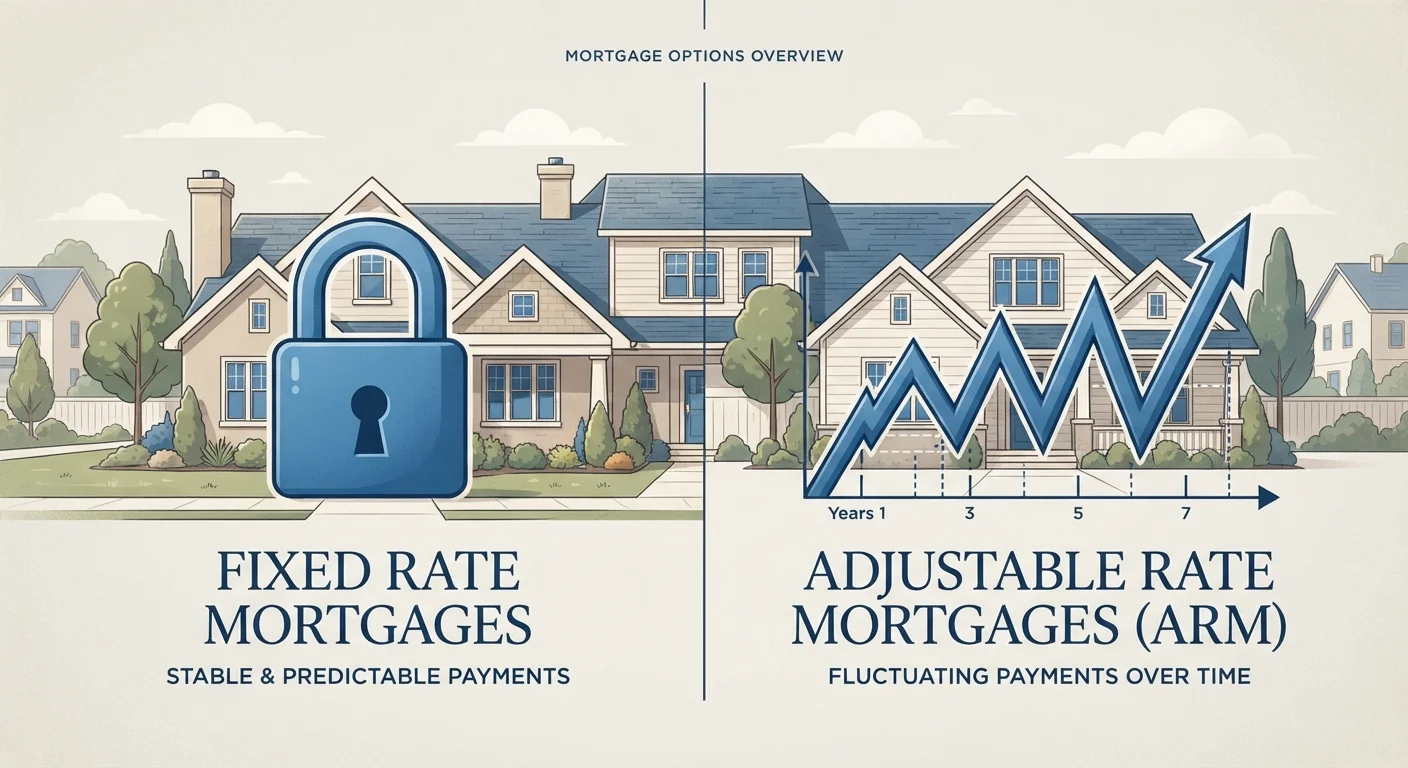
Option A
Fixed-Rate Mortgage
The predictable, long-term stability choice.
Best for: Buyers who plan to stay in a home for many years and want consistent monthly payments regardless of market conditions.
Option B
Adjustable-Rate Mortgage (ARM)
The flexible, lower-entry-cost alternative.
Best for: Buyers with a defined shorter-term horizon or strong confidence they will refinance or sell before the rate adjustment period begins.
How Each Structure Actually Works
A fixed-rate mortgage does exactly what its name implies: your interest rate is set at closing and never changes, regardless of what happens to broader interest rates. Whether you hold a 15-year or 30-year loan, every scheduled principal-and-interest payment is identical from month one to the final payment.
An adjustable-rate mortgage (ARM) works differently. ARMs are typically described with two numbers - for example, a 5/1 ARM. The first number (5) is the initial fixed period in years during which your rate doesn't move. The second number (1) tells you how frequently the rate can reset after that, in this case annually. Common structures include 5/1, 7/1, and 10/1 ARMs. After the fixed period ends, the rate is recalculated based on a benchmark index (such as the Secured Overnight Financing Rate, or SOFR) plus a set margin determined by your lender.
Critically, ARMs include rate caps - contractual limits on how much the rate can change. A typical cap structure might be expressed as 2/2/5, meaning the rate can increase no more than 2 percentage points at the first adjustment, no more than 2 points at any subsequent adjustment, and no more than 5 points above the initial rate over the loan's lifetime. Understanding these caps is essential to evaluating your worst-case payment scenario.
| Criterion | Fixed-Rate Mortgage | Adjustable-Rate Mortgage (ARM) |
|---|---|---|
| Interest rate over time | Never changes | Fixed initially, then adjusts periodically |
| Typical initial rate | Higher than ARM's intro rate | Lower than fixed for the intro period |
| Payment predictability | Fully predictable | Predictable only during fixed period |
| Rate cap protections | Not applicable | Per-adjustment and lifetime caps apply |
| Best ownership horizon | Long-term (10+ years) | Short-to-medium term (under 7-10 years) |
| Exposure to market rate changes | None | Present after initial fixed period |
| Complexity to understand | Straightforward | Requires understanding index, margin, caps |
The Trade-Offs That Actually Drive the Decision
The most important variable is how long you intend to stay in the home. If you sell or refinance before an ARM's fixed period expires, you capture the benefit of the lower starting rate and never experience a reset. If you stay longer than anticipated - which is common - you become exposed to rate movements you hadn't planned for.
Rate environment matters too, though predicting where rates will move is genuinely difficult. When prevailing rates are historically high, ARMs can offer a meaningful initial discount, and some borrowers accept the structure expecting to refinance if rates decline. When rates are low, the spread between fixed and adjustable rates may narrow enough that a fixed rate becomes even more attractive. This mirrors a broader principle explored in fixed versus variable financial obligations - predictability has real value when planning a household budget.
Income stability and risk tolerance also play a significant role. A borrower with a variable income, limited financial reserves, or a tight monthly budget is generally more exposed to harm from an unexpected payment increase. The decision about which mortgage structure to use is inseparable from the broader question of homeownership readiness - for a fuller look at those foundations, see our guide on renting vs. buying a home.
30 years
Most common fixed mortgage term in the US
The 30-year fixed-rate mortgage has historically been the dominant loan product for American homebuyers, according to Federal Reserve and Freddie Mac data.
~1-2%
Typical initial rate discount for ARMs vs. fixed
The spread between ARM introductory rates and comparable fixed rates varies by market conditions but has historically averaged roughly 1 to 2 percentage points, per Freddie Mac survey data.
5/2/5
Common ARM cap structure (initial/periodic/lifetime)
Many ARM products in the US use a 5/2/5 cap structure, limiting the first-adjustment increase to 5 points, subsequent adjustments to 2 points, and the total lifetime increase to 5 points.
Common Misconceptions and What to Watch For
One frequent misconception is that an ARM is inherently risky and a fixed rate is always safer. In reality, the risk is contextual. For a buyer with a firm five-year plan who thoroughly understands their cap structure, an ARM can be a disciplined, lower-cost choice. For a buyer who underestimates how long they'll stay, that same ARM becomes a source of payment volatility.
Another misconception is that the initial rate difference between an ARM and a fixed loan is large enough to make an obvious choice. The spread varies considerably depending on the rate environment and lender; always compare actual loan estimates - the standardized disclosure lenders are required to provide - rather than headline figures.
What the Loan Estimate Tells You
Federal regulations require lenders to provide a standardized Loan Estimate document within three business days of receiving a mortgage application. For ARMs, this document must include a worst-case payment scenario based on maximum allowable rate adjustments. Reviewing this figure - not just the initial payment - gives you a realistic picture of how much your payment could increase. Always request and compare Loan Estimates from multiple lenders before deciding.
Finally, refinancing is often cited as an escape valve from ARM resets, but refinancing carries real costs: closing costs, potential appraisal fees, and the time investment of a new application. It also requires qualifying under whatever standards exist at that future date. Treating refinancing as a guaranteed option introduces its own uncertainty. For readers thinking through housing costs more broadly, our overview of the housing market provides useful context on how rate environments evolve over time.
This article is for general informational and educational purposes only. It does not constitute personalized financial or mortgage advice. Consult a licensed mortgage professional or financial adviser before making decisions about home financing.
The content on this site is provided for informational purposes only and should not be considered a substitute for professional advice. While we strive to provide accurate and up-to-date information, we make no guarantees regarding its completeness or accuracy. Always consult a qualified professional for advice specific to your circumstances before making any decisions