

Why the Distinction Matters More Than Most People Realize
Most budgeting advice tells you to list your expenses and assign dollar amounts to each category. What it often skips is that not all expenses behave the same way - and budgeting them identically is precisely why so many budgets fall apart in the first month.
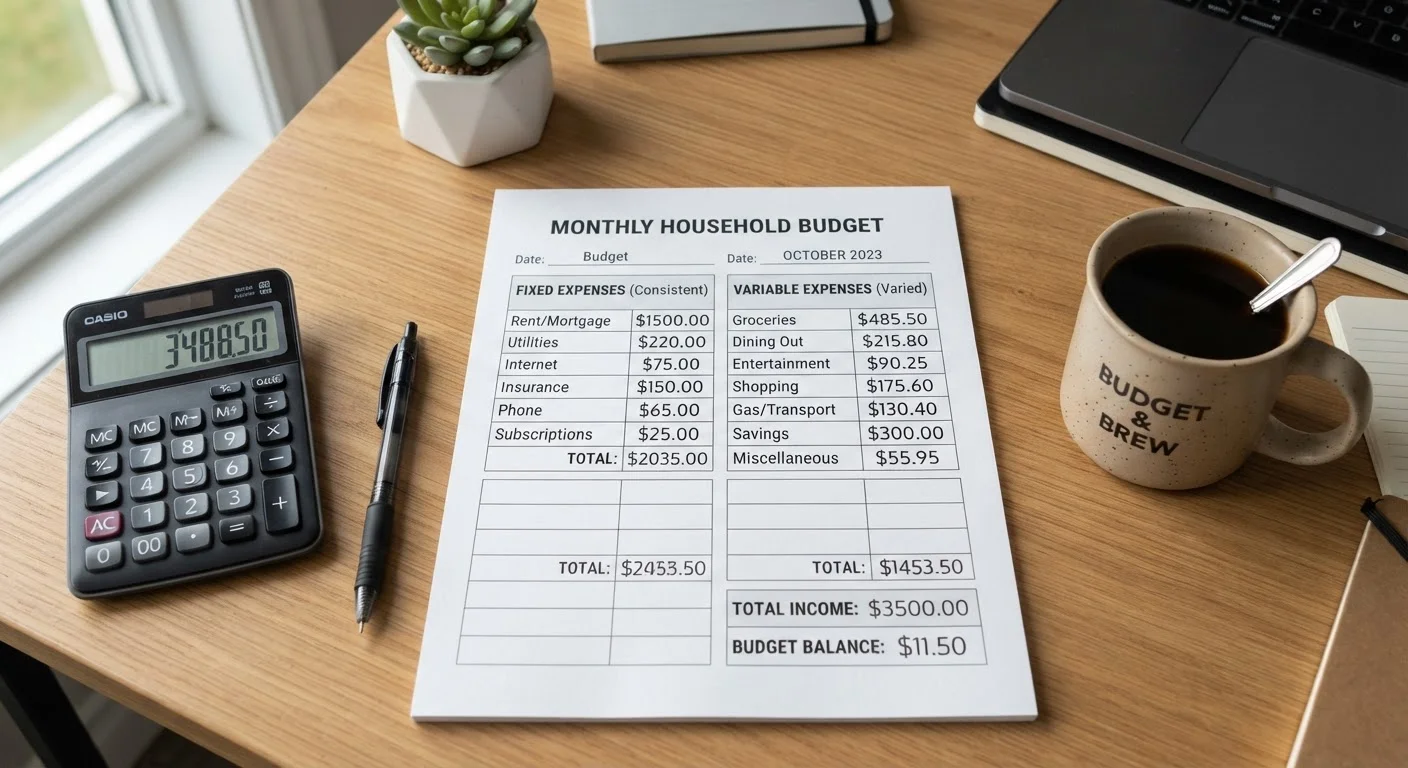
Fixed expenses are predictable. They show up at the same time, for the same amount, every cycle. You can schedule them in your budget once and essentially trust that number until something major changes - a lease renewal, a refinance, a new insurance policy. Variable expenses, by contrast, are dynamic. The amount you spend on groceries, gas, or household supplies shifts based on prices, habits, and circumstances.
When you apply a static budget to a dynamic expense, you're setting yourself up for constant drift. That's not a discipline problem - it's a system design problem. Getting clear on which type each expense belongs to lets you apply the right tool to the right job. For a broader vocabulary around these concepts, see budgeting terms every beginner should know.
Fixed Expenses: Budget Once, Monitor Occasionally
A fixed expense is any recurring cost that stays constant from one billing period to the next. The defining characteristic is predictability - you know the amount before the bill arrives.
Common examples include:
- Rent or mortgage payment
- Car loan or lease payment
- Health, auto, or renters insurance premiums
- Fixed-rate loan repayments (student loans, personal loans)
- Set-fee subscriptions
Because these amounts don't change, they're the easiest category to plug into a budget accurately. The practical approach is to list each one with its due date and amount, then automate payment where possible. Your main job with fixed expenses is to periodically review them - contract renewals, rate changes, and service adjustments can shift the amount without much fanfare.
Audit Your Fixed Expenses Annually
Set a recurring calendar reminder once a year to review every fixed expense on your list. Insurance premiums, subscription services, and loan rates can all change at renewal - and you may qualify for better terms without realizing it. A one-hour review can sometimes unlock hundreds of dollars in annual savings.
It's also worth examining your fixed expenses once or twice a year to see whether any can be renegotiated or eliminated. A lower insurance premium after a clean driving record or a renegotiated subscription price can free up meaningful room in your budget without affecting your daily habits.
Variable Expenses: Track Actively, Adjust Regularly
Variable expenses are the part of your budget that requires genuine attention throughout the month. The amounts shift based on consumption, prices, and choices - which means a number set on the first of the month can easily be wrong by the fifteenth.
Typical variable expenses include:
- Groceries and household supplies
- Gasoline and transportation costs
- Dining out and takeout
- Clothing and personal care
- Entertainment and recreation
- Utilities (electricity, water, gas)
The most effective way to budget for variable expenses is to use historical averages. Pull three to six months of actual spending in each category - from bank statements or a spending tracker - and calculate a realistic monthly target. That figure will be far more accurate than an estimate made from memory.
~$6,000
Average annual U.S. household food spending
According to the U.S. Bureau of Labor Statistics Consumer Expenditure Survey, food is one of the largest and most variable household expense categories.
30%+
Income share spent on housing for many renters
The U.S. Department of Housing and Urban Development considers households spending more than 30% of income on housing to be cost-burdened - a fixed expense with outsized budget impact.
3-6 months
Recommended look-back period for variable expense averages
Personal finance practitioners widely recommend reviewing at least three to six months of transaction history to set realistic variable expense targets.
Active tracking is non-negotiable here. Checking in on variable spending weekly - not just at month's end - lets you course-correct before a category is blown entirely. For a deeper look at how tracking spending fits alongside formal budgeting, see spending tracker vs. full budget.
Semi-Variable Expenses: The Category That Trips People Up
A third category sits between the two: semi-variable expenses (sometimes called mixed costs). These have a predictable base amount plus a usage-driven portion that fluctuates. Your internet bill might be $60 flat each month - fully fixed. But a cell plan with data overage fees has a fixed floor and a variable ceiling depending on usage.
Other semi-variable examples include utilities with tiered pricing and gym memberships with optional add-on classes. Budget for these by treating the base as a fixed cost and building a small buffer for the variable portion. This prevents both under-budgeting (if usage spikes) and over-budgeting (if you consistently use less).
Semi-Variable Expenses Need a Hybrid Approach
Don't force semi-variable costs into a purely fixed or purely variable bucket - doing so causes either chronic over-budgeting or regular shortfalls. Instead, identify the guaranteed base amount, budget that as fixed, and add a reasonable variable buffer on top. Over time, your actual usage history will help you calibrate that buffer more accurately.
Applying This Framework to Your Budget
Once you've categorized your expenses, the budgeting logic becomes straightforward:
- List your fixed expenses first. These form your non-negotiable baseline. Subtract the total from your monthly take-home income before allocating anything else.
- Set targets for variable expenses using historical data. Assign realistic amounts based on past behavior, not aspirational ones based on how you wish you spent money.
- Track variable spending actively throughout the month and compare to your targets.
- Revisit fixed expenses periodically - at least once or twice a year - to catch rate changes and renegotiation opportunities.
This structure maps naturally onto most popular budgeting frameworks. If you're ready to choose a system, budgeting strategies compared walks through the trade-offs of envelope budgeting, 50/30/20, pay-yourself-first, and more. The expense-type framework covered here applies inside any of them.
A renter pays $1,450 in rent, $320 for car insurance, and $200 for a fixed-rate student loan every month - the same amounts every cycle.
A household spends between $480 and $720 on groceries each month depending on meal planning, sales, and how often they cook at home.
A freelancer's electricity bill is roughly $70 in mild weather months but climbs to $160 in summer when air conditioning runs constantly.
A couple planning a road trip recognizes that their hotel bookings (fixed, pre-paid) and daily fuel and food costs (variable) need different planning approaches.
This article is for general informational and educational purposes only and does not constitute personalized financial advice. Consult a qualified financial professional for guidance specific to your situation.
Frequently Asked Questions
Common fixed expenses include rent or mortgage payments, car loan payments, insurance premiums, and subscription services with a set monthly fee. These amounts stay the same each billing cycle regardless of how much you use the service or product.
Variable expenses are costs that change month to month based on consumption or choices. Groceries, fuel, utilities, dining out, entertainment, and clothing are typical examples. Because they fluctuate, they require regular tracking rather than simple scheduling.
The most reliable method is to review three to six months of past spending in each category and calculate a realistic average. Set that average as your monthly target, then track actual spending throughout the month and adjust before you overspend.
Most utility bills are variable because the amount changes with usage - higher electricity bills in summer, larger heating costs in winter. Some households place utilities in a separate semi-variable category since there is always a baseline cost regardless of usage.
Variable expenses are typically faster to reduce because many involve daily discretionary choices you can adjust immediately, such as eating out less or cutting back on shopping. Reducing fixed expenses usually requires renegotiating contracts, refinancing, or making major lifestyle changes.
It changes your approach: fixed expenses can be scheduled in advance with confidence, while variable expenses need ongoing monitoring. Applying the right strategy to each type prevents both over-budgeting and unpleasant surprises.
The content on this site is provided for informational purposes only and should not be considered a substitute for professional advice. While we strive to provide accurate and up-to-date information, we make no guarantees regarding its completeness or accuracy. Always consult a qualified professional for advice specific to your circumstances before making any decisions