

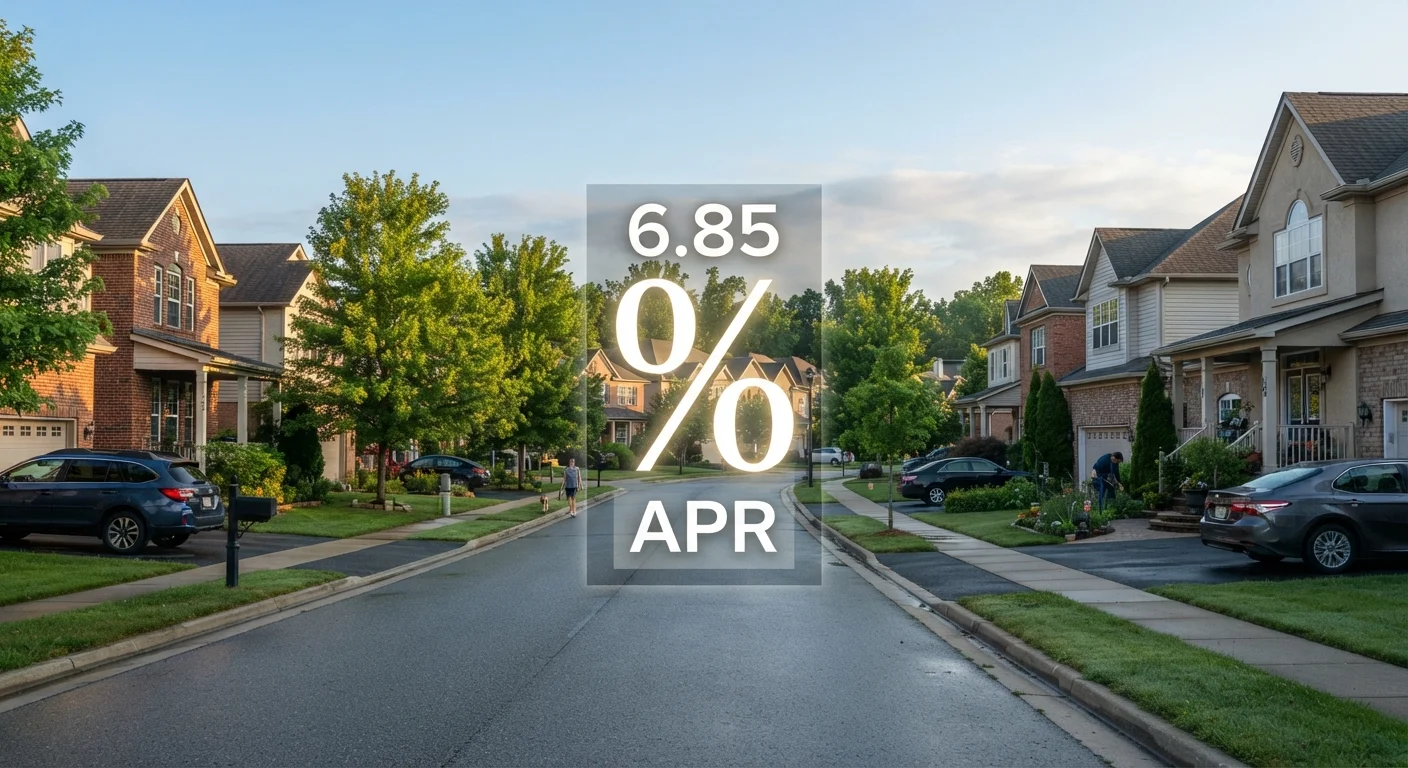
The Chain Reaction: From Fed Policy to Your Monthly Payment
Interest rates don't move in isolation. They travel through a chain of financial relationships before landing in a homebuyer's monthly budget. At the start of that chain sits the Federal Reserve, which sets the federal funds rate - the rate at which banks lend money to each other overnight. While the Fed doesn't control mortgage rates directly, its policy decisions send clear signals to bond markets, where mortgage pricing is effectively determined.
Lenders price 30-year fixed mortgages in close relationship with the 10-year U.S. Treasury yield. When investors expect inflation or economic tightening, Treasury yields rise, and mortgage rates follow. By the time that shift reaches a homebuyer's loan estimate, even a half-percentage-point increase can meaningfully reduce purchasing power. For context, moving from a 6.5% to a 7% rate on a $350,000 loan raises the monthly principal-and-interest payment by approximately $115 - money that buyers must either absorb or offset by targeting a lower-priced home.
~$230
Monthly payment increase per 1% rate rise
Estimated additional monthly cost on a $400,000 30-year fixed-rate mortgage when the interest rate increases by one percentage point.
60%+
Homeowners with sub-4% mortgage rates
According to analysis by Redfin, a majority of U.S. mortgaged homeowners held rates below 4% as of 2023, fueling the lock-in effect on housing supply.
10-yr Treasury
Primary benchmark for 30-year mortgage pricing
Mortgage lenders conventionally price 30-year fixed loans at a spread above the 10-year U.S. Treasury yield, making bond market movements a leading indicator for rate watchers.
Understanding these connections is foundational to reading any housing market data with clarity. See key housing market metrics every homebuyer should know to pair rate awareness with the broader indicators shaping local conditions.
How Rates Shape Buyer Demand and Seller Behavior
Buyer demand is exquisitely sensitive to rate movements. When mortgage rates fall, more households can qualify for loans and afford higher-priced homes, intensifying competition for available listings. When rates rise sharply, the opposite occurs: some buyers exit the market entirely, others downsize their target price range, and bidding wars become less common.
Seller behavior is equally affected - and in a less intuitive way. The rate lock-in effect describes homeowners who secured mortgages at historically low rates (common in 2020-2021) and now face the prospect of selling and taking on a new mortgage at a significantly higher rate. Many choose to stay put rather than trade their low-cost loan for an expensive one, even if their housing needs have changed. The result is a compressed supply of resale homes that can keep prices elevated even as demand weakens.
A family in suburban Ohio qualifies for a $320,000 home when rates are at 6%. When rates rise to 7.5%, the same monthly budget only supports a $275,000 purchase.
A couple in Austin, Texas, who refinanced their home at 2.9% in 2021 decides not to sell when rates climb above 7%, even though they have a new baby and need more space.
A landlord who purchased a rental property in Denver with a 7.2% investment loan raises rent 12% upon lease renewal to cover higher financing costs.
This dynamic helps explain why the housing market doesn't always follow the intuitive logic that higher rates equal lower prices. Supply and demand forces in real estate interact in ways that often surprise first-time observers.
Rates, Inventory, and Price: Reading the Market Signals
The relationship between interest rates, housing inventory, and home prices operates as a system of competing pressures. Rates influence demand; demand - combined with supply - determines price movement. When both rates and inventory are high, buyers hold more negotiating leverage. When rates are high but inventory remains low (as the lock-in effect can cause), prices are more likely to hold steady rather than fall.
This is why tracking rates in isolation gives an incomplete picture. Savvy observers watch rates alongside inventory levels, days on market, and price-to-income ratios to draw more accurate conclusions about where a local market stands. Signals worth watching before you enter the housing market explores how to read those indicators together.
It's also worth noting that rate effects play out differently by market type. In high-cost coastal metros, even a moderate rate increase can sharply reduce the pool of qualified buyers. In lower-cost Midwest or Southern markets, the same rate change may have a more muted effect because underlying home prices leave more room for buyers to absorb payment increases.
For a broader view of how these pressures fit into longer-term patterns, housing market cycle dynamics provide useful context. And if you're actively planning a purchase, our homebuying guidance walks through how to navigate these conditions practically.
This article is for general informational and educational purposes only and does not constitute financial, investment, or legal advice. Readers should consult a qualified financial or real estate professional regarding decisions specific to their circumstances.
Frequently Asked Questions
Not directly, but there is a strong connection. The Fed sets the federal funds rate - what banks charge each other for overnight loans. Mortgage rates are more closely tied to the yield on 10-year U.S. Treasury bonds, but Fed policy signals heavily influence those yields. When the Fed raises rates to fight inflation, mortgage rates typically climb in response.
The impact is substantial. On a $400,000 30-year fixed-rate mortgage, a 1 percentage point increase in the rate adds roughly $230-$250 per month to the payment. Over 30 years, that translates to tens of thousands of dollars in additional interest costs. This is why even modest rate changes meaningfully shift buyer purchasing power.
The rate lock-in effect describes a situation where homeowners who secured mortgages at low rates are reluctant to sell because doing so would require them to buy a new home at a much higher current rate. This reduces the number of homes available for sale, tightening supply even when demand softens.
High rates can slow price growth or cause modest declines in some markets, but national home prices rarely fall sharply unless supply increases dramatically or the broader economy weakens significantly. Structural housing undersupply in many U.S. markets has historically acted as a floor beneath prices even during rate-driven slowdowns.
Yes. When financing costs are high, some would-be buyers remain renters longer, increasing rental demand. Landlords who purchased investment properties at higher rates may also pass those costs through in the form of higher rents. Both forces can push rental prices upward in high-rate environments.
The content on this site is provided for informational purposes only and should not be considered a substitute for professional advice. While we strive to provide accurate and up-to-date information, we make no guarantees regarding its completeness or accuracy. Always consult a qualified professional for advice specific to your circumstances before making any decisions