

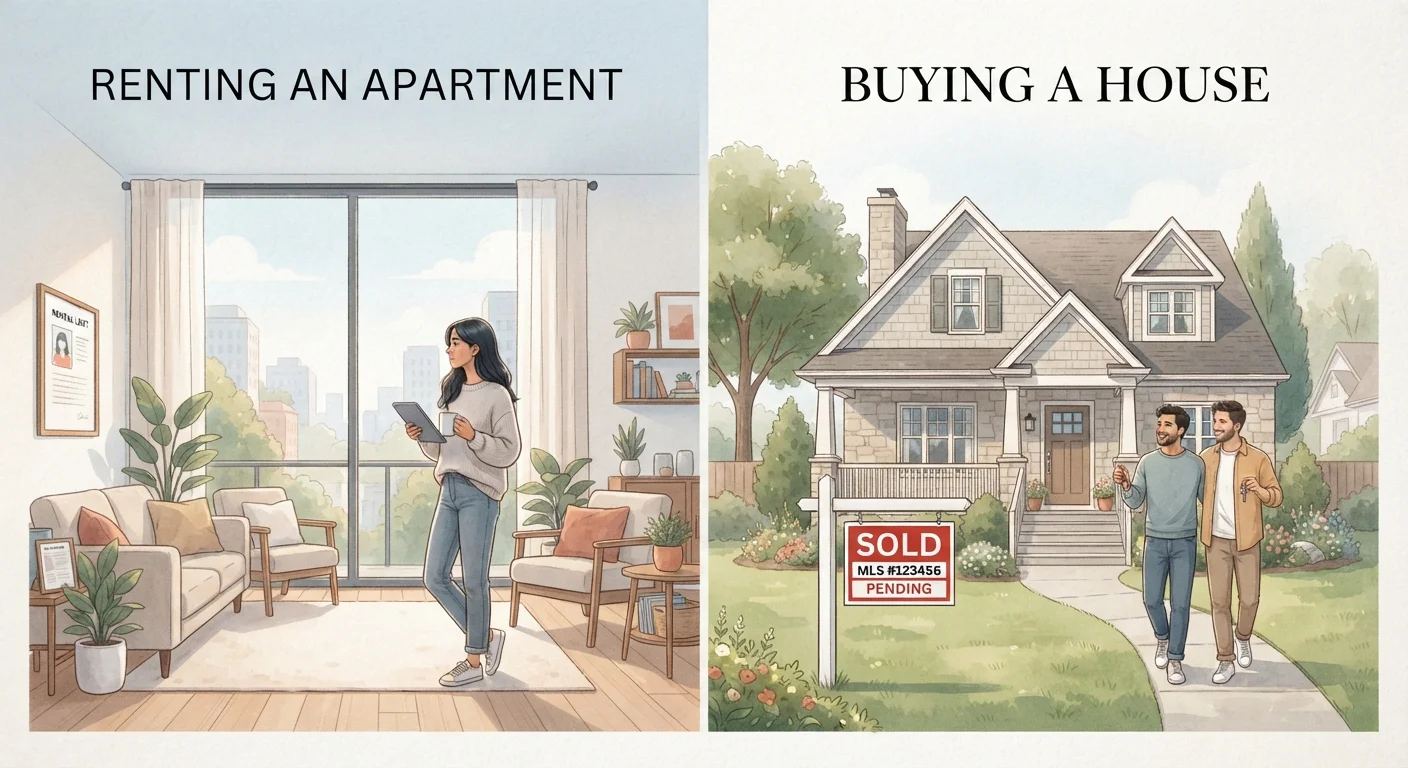
Our Verdict
Buying a home can build long-term wealth and stability, but the upfront costs, maintenance obligations, and reduced flexibility make it a poor fit for everyone. Renting preserves cash flow and mobility, though it offers no ownership stake. The strongest decision comes from honestly weighing your timeline, finances, and lifestyle needs rather than defaulting to the cultural assumption that owning is always the goal.
Buyers who plan to stay in place for at least five to seven years and have stable income, adequate savings, and a solid credit profile are generally better positioned to benefit from ownership; renters who prioritize flexibility, are still building savings, or live in high-cost markets may find renting the more practical path.
Why This Decision Deserves More Than a Simple Answer
The question of whether to rent or buy a home is one of the most consequential financial decisions most Americans will ever face - and one of the most frequently oversimplified. Conventional wisdom says owning a home is always better, that rent is "throwing money away." The reality is considerably more nuanced.
Both paths carry genuine advantages and real drawbacks. Which one makes more sense for you depends on your financial situation, how long you plan to stay in a given area, the local housing market, and what you actually want from your living situation. For a structured framework to work through those variables, see our full decision framework.
This article focuses on the core trade-offs - the ones that matter most and that are most often glossed over.
Ownership builds equity with each mortgage payment
Every principal payment reduces what you owe and increases your ownership stake - a forced savings mechanism that renting does not replicate directly.
Fixed-rate mortgages lock in predictable housing costs
Unlike rent, which a landlord can increase at lease renewal, a fixed-rate mortgage principal and interest payment stays constant for the loan's life, offering long-term cost stability.
Renting provides genuine flexibility and mobility
Leases typically end in 12 months or less, making it far easier to relocate for work, family, or lifestyle changes without the financial friction of a home sale.
Renters face no major repair or maintenance liability
Structural repairs, appliance replacements, and system failures are generally the landlord's responsibility, shielding renters from unexpected large expenses.
Homeownership allows customization and long-term stability
Owners can renovate, paint, landscape, and modify their property as they choose - and cannot be asked to leave at a landlord's discretion.
Renting preserves capital for other investments
Down payments on homes can run tens of thousands of dollars; renters who invest that capital elsewhere may build comparable or greater wealth depending on market conditions.
The Real Costs on Both Sides
One of the most persistent myths in housing is that renting costs more than owning over time. Whether that's true depends almost entirely on local conditions, how long you stay, and what you do with capital you don't tie up in a down payment.
5-10%
Typical home sale transaction costs
Agent commissions and closing costs commonly consume five to ten percent of a home's sale price, making short-term ownership financially risky for those who may need to move.
1-2%
Annual maintenance cost estimate
A widely cited industry guideline suggests homeowners budget one to two percent of their home's value each year for routine maintenance and repairs.
5-7 years
Minimum stay to favor buying financially
Housing economists generally suggest that owning a home tends to make stronger financial sense when buyers plan to remain in the property for at least five to seven years.
Homeownership carries costs that extend well beyond a monthly mortgage payment. Property taxes, homeowner's insurance, HOA fees where applicable, and routine maintenance - industry estimates typically place maintenance alone at one to two percent of a home's value annually - add up quickly. A $400,000 home could realistically require $4,000 to $8,000 per year just in upkeep, before any major system replacements.
Renters, by contrast, pay a monthly amount that typically covers housing costs without exposure to repair bills or market-value fluctuations. That predictability has real value, especially in markets where home prices and property taxes have climbed sharply. If you're exploring what ownership costs look like before you commit, our homebuyer guidance hub walks through the full purchase process.
Buying requires substantial upfront capital
Down payments, closing costs, home inspection fees, and moving expenses mean buyers often need tens of thousands of dollars before they turn a key. This barrier excludes many otherwise financially stable households.
Homeowners absorb all maintenance and repair costs
Roof replacements, HVAC failures, plumbing issues, and general upkeep fall entirely to the owner - costs that are unpredictable in timing and can be significant in scale.
Renting builds no direct ownership stake
Monthly rent payments do not translate into equity or asset appreciation, meaning renters do not directly benefit if the local property market rises.
Ownership reduces financial and geographic flexibility
Selling a home takes time and carries transaction costs that can reach five to ten percent of the sale price, making relocation considerably more complex and expensive than ending a lease.
Renters face lease non-renewal and rent increase risk
Landlords can raise rents at renewal or decline to renew leases altogether, leaving renters vulnerable to housing instability they cannot fully control.
Home values are not guaranteed to rise
Markets can decline, stagnate, or be slow to recover - buyers who need to sell within a few years may recoup less than their total costs, particularly after accounting for transaction fees.
Flexibility, Stability, and the Question of Timeline
One of renting's clearest advantages is mobility. If your job changes, your family situation shifts, or you simply want to live somewhere new, ending a lease is far simpler than selling a home. Transaction costs on a home sale - agent commissions, closing costs, and potential capital gains considerations - can run five to ten percent of the sale price, which means owners who move within a few years may not recoup what they spent getting in.
The general rule of thumb among housing economists is that buying typically begins to make financial sense when you plan to stay in a home for at least five to seven years. Below that threshold, the math often favors renting - particularly in high-cost metro areas where price-to-rent ratios are elevated. A market-specific framework can help you assess what those ratios look like where you live.
Ownership, on the other hand, provides stability that renters don't always have. Landlords can raise rents, decline to renew leases, or sell properties. Fixed-rate mortgage holders lock in their principal and interest payment for the life of the loan - a meaningful hedge against housing cost inflation over time. Understanding mortgage structures matters here; comparing fixed and adjustable-rate options is a useful next step for anyone moving toward a purchase.
Lease Type Also Shapes Your Flexibility
Not all rental arrangements offer the same level of flexibility. Month-to-month leases allow faster exits but often come with higher monthly costs and less security. Fixed-term leases lock in your rate but restrict when you can leave without penalty. Comparing lease structures is a useful step for renters trying to match their housing arrangement to their actual life plans.
Equity, Wealth-Building, and What Renters Can Do Instead
The strongest argument for buying is the potential to build equity - the portion of the home's value you actually own - over time. As you pay down a mortgage and if the property appreciates, your net worth can grow in a way that paying rent does not directly produce.
That said, equity is not guaranteed. Home values can stagnate or decline. Owners who sell during downturns or after short holding periods may recover less than they put in. And equity is illiquid - it cannot be accessed without refinancing, taking out a home equity loan, or selling the property.
Renters who invest their down payment savings and the difference between renting and owning costs into diversified financial accounts may also build meaningful wealth, depending on market returns and personal discipline. This is a genuine trade-off, not a foregone conclusion in either direction. Anyone weighing this should consult a qualified financial adviser to model their specific situation rather than rely on general assumptions.
If you're currently renting and want to make the most of that phase, avoiding common missteps matters - see apartment hunting mistakes that cost renters time and money for practical guidance.
This article is for general informational purposes only and does not constitute financial, legal, or real estate advice. Readers should consult qualified professionals before making housing or financial decisions.
The content on this site is provided for informational purposes only and should not be considered a substitute for professional advice. While we strive to provide accurate and up-to-date information, we make no guarantees regarding its completeness or accuracy. Always consult a qualified professional for advice specific to your circumstances before making any decisions