

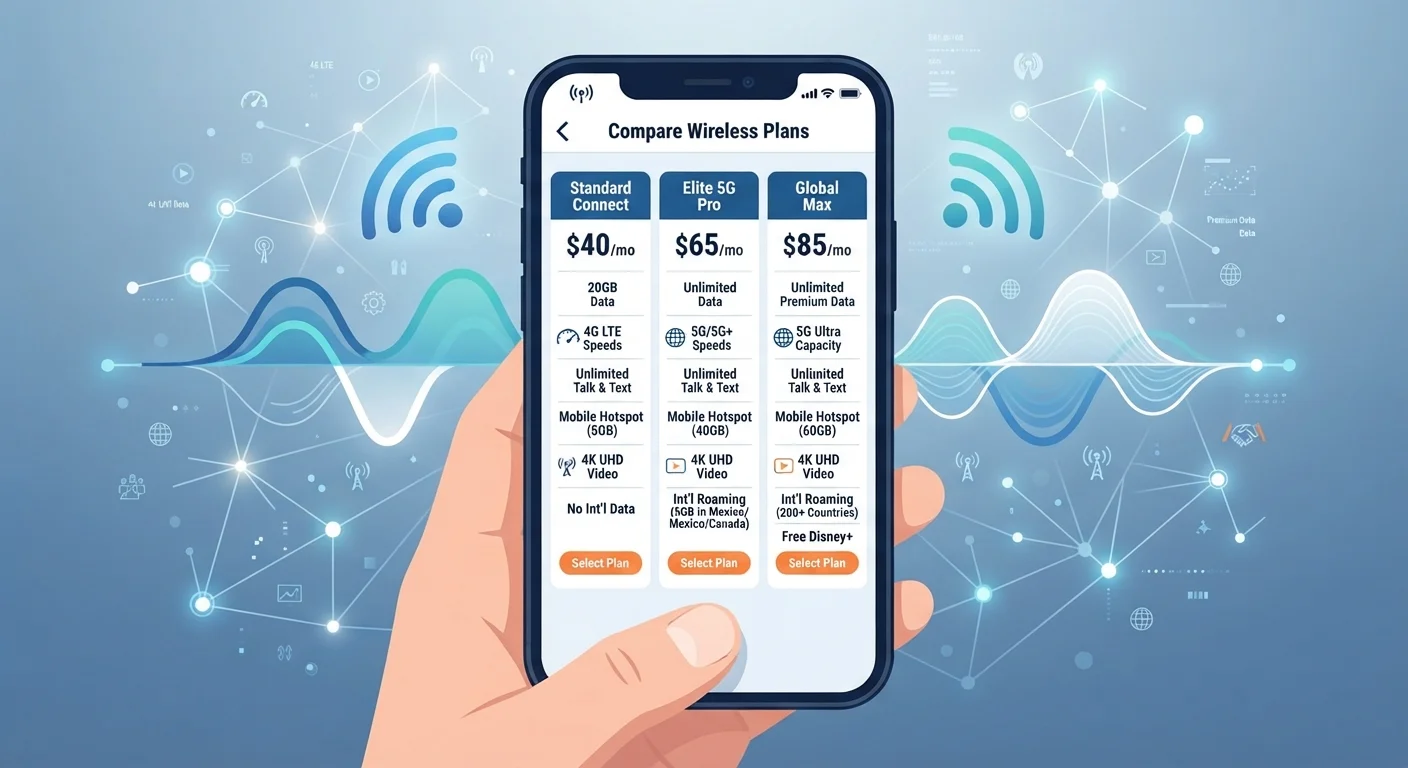
Why Carrier Language Is Confusing by Design
Phone plan marketing leans heavily on terms like "unlimited," "premium data," and "nationwide 5G" - phrases that sound simple but carry important asterisks. Understanding what carriers actually mean when they use this language is the fastest way to avoid bill shock and plan mismatches.
This reference decodes the terms you'll encounter most often when shopping for or managing a wireless plan. For a broader overview of how U.S. wireless plans are structured, see our complete guide to understanding wireless plans.
Unlimited data
A plan marketed as having no hard data cap, but almost always subject to throttling, deprioritization, or speed caps after a threshold. True uncapped, unthrottled data at full speed is rare at consumer price points.
Deprioritization
A temporary slowdown applied to certain customers when a cell tower is congested. It is conditional - speeds return to normal when congestion clears - and typically affects prepaid or MVNO customers before postpaid premium subscribers.
MVNO
Mobile Virtual Network Operator. A wireless carrier that doesn't own its own towers but resells capacity leased from a major network. MVNOs often charge less but may have lower priority during network congestion.
Data throttling
A deliberate speed reduction imposed by the carrier, either after a set data threshold is reached in a billing cycle or as a permanent ceiling on a particular plan tier. Unlike deprioritization, it applies regardless of network load.
Hotspot data
A defined portion of a wireless plan's data allowance designated for tethering - sharing your phone's internet connection with other devices via Wi-Fi. Often subject to separate, lower speed caps than on-device data.
Bill credit
A promotional discount applied to your monthly bill over a fixed term, usually 24-36 months. Credits are contingent on maintaining the qualifying plan; switching plans or carriers early typically forfeits remaining credits.
LTE
Long-Term Evolution, the fourth-generation (4G) cellular standard. Still widely used across the U.S., it delivers reliable speeds for most everyday tasks. Most modern plans operate on a mix of LTE and 5G depending on location.
Port-in
The process of transferring your existing phone number from one carrier to another when switching. Many promotional offers are available only to customers who port in their number rather than getting a new one.
Data and Speed Terms You Need to Know
Data-related language is where carriers do some of their heaviest wordsmithing. Three terms in particular are frequently conflated but describe distinct situations:
- Data throttling is a carrier-imposed speed reduction that kicks in automatically - either after you've used a set amount of data in a billing cycle or as a permanent cap on certain plan tiers.
- Deprioritization is a temporary slowdown that only occurs when a cell tower is congested. If network traffic is light, your speeds are unaffected. Customers on lower-tier or prepaid plans are usually deprioritized before those on premium plans.
- Speed caps are hard limits baked into specific plan tiers - for example, video streaming capped at 480p or hotspot data capped at 600 Kbps regardless of network conditions.
These distinctions matter practically. A plan with deprioritization may deliver full speeds most of the time; a plan with a hard speed cap will always deliver slower performance. A deeper look at these three mechanisms explains how to identify which applies to your plan.
| "Unlimited" plans with speed caps | Extremely common - check plan details (FTC and FCC consumer guidance on data plan disclosures) |
| Typical premium data threshold before deprioritization | 22-100 GB, varies by carrier and tier (Carrier plan disclosures, varies by provider) |
| Standard device payment plan length | 24-36 months (Common across major U.S. carriers) |
| MVNO network dependency | 100% reliant on host network coverage (Industry standard MVNO operating model) |
| Low-band 5G vs. mmWave coverage | Nationwide vs. select dense urban areas (Carrier network deployment maps) |
| AutoPay discount range | Typically $5-$10 per line per month (Common carrier promotional structures) |
Plan Structure and Network Terms
The infrastructure and business model behind your plan affects both coverage and price in ways that aren't always obvious at the point of sale.
MVNO (Mobile Virtual Network Operator) - Companies that sell wireless service without owning the underlying cell towers. They lease capacity wholesale from the major networks (AT&T, T-Mobile, Verizon) and typically offer lower prices, though their customers are usually deprioritized during congestion. MVNOs explained in detail covers the tradeoffs in depth.
5G vs. LTE - 5G is the current generation of cellular network technology; LTE (Long-Term Evolution) is the previous generation, still widely deployed. "Nationwide 5G" typically refers to low-band 5G, which offers modest speed improvements. "Ultra-wideband" or "mmWave" 5G delivers much higher speeds but covers a far smaller geographic footprint, mostly dense urban areas.
Hotspot data - The portion of your plan that lets you share your phone's cellular connection with other devices (laptops, tablets). Carriers often throttle or cap hotspot data separately from on-device data, even on "unlimited" plans.
AutoPay discount - A per-line monthly discount applied when you enroll in automatic bill payment. Removing AutoPay typically reinstates the full, higher price. Always confirm what the price is without AutoPay before committing.
For guidance on reading the fine print before you sign, see how to read a wireless carrier's fine print. If you're new to comparing plans generally, this starting point for first-time shoppers lays out the right questions to ask first.
Billing and Contract Terms Worth Watching
Monthly pricing on carrier websites rarely reflects what most customers actually pay. Here are the terms that most commonly create surprise charges:
- Device payment plan (DPP) - The cost of a phone split into monthly installments (typically 24-36 months) and added to your service bill. The phone is not free; it's financed, and leaving early may require paying off the remaining balance.
- Bill credits - Promotional discounts applied as monthly credits over a set period (often 24-36 months), contingent on keeping the plan active. Switching carriers before the credit period ends forfeits remaining credits.
- Port-in offer - A promotional price or bonus available only to customers switching from another carrier and bringing their phone number with them.
- Roaming - Charges or policies that apply when your phone connects to a partner network outside your carrier's coverage area. Domestic roaming is typically included in most plans; international roaming costs vary significantly and should be verified before travel.
Understanding these terms in combination - especially device payment plans stacked with bill credits - is key to calculating the true cost of switching or signing up. Wi-Fi calling capabilities are another feature worth checking before committing to a plan, particularly if you're in an area with spotty cellular coverage.
The content on this site is provided for informational purposes only and should not be considered a substitute for professional advice. While we strive to provide accurate and up-to-date information, we make no guarantees regarding its completeness or accuracy. Always consult a qualified professional for advice specific to your circumstances before making any decisions