

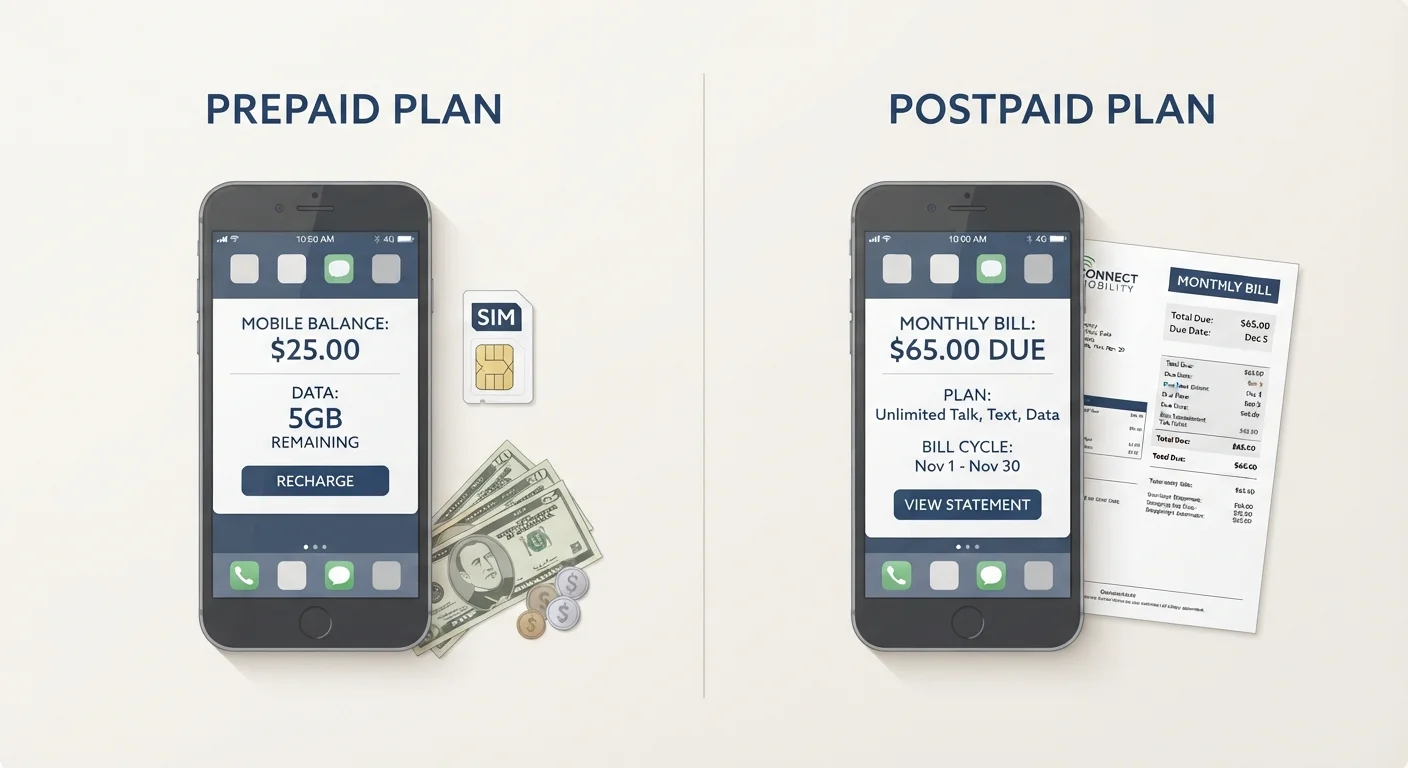
Option A
Prepaid Wireless
Pay before you use - no surprises, no commitments.
Best for: Budget-conscious consumers, light users, or anyone who wants full control over monthly spending without a long-term contract.
Option B
Postpaid Wireless
Pay after you use - more features, more flexibility on devices.
Best for: Heavy data users, families sharing multiple lines, or people who want device financing and premium network priority built into their plan.
The Core Difference: When You Pay
The most fundamental distinction between prepaid and postpaid wireless is timing. With prepaid, you load money onto an account - or pay a flat monthly fee - before service begins. When that balance runs out or the period ends, service stops until you reload. With postpaid, you use service throughout the month and receive a bill afterward, often with a contract or ongoing account commitment.
That timing difference ripples into almost everything else: how your credit is handled, whether you can finance a phone through the carrier, how your data is prioritized during network congestion, and how easy it is to switch or cancel. For a plain-language breakdown of terms like deprioritization, throttling, and MVNOs, see Phone Plan Terminology, Decoded.
| Criterion | Prepaid Wireless | Postpaid Wireless |
|---|---|---|
| Payment timing | Pay before service begins | Pay after the billing period |
| Credit check required | No | Typically yes |
| Contract or commitment | None | Often monthly or device-tied |
| Device financing | Rarely available | Commonly available |
| Network priority | Lower during congestion | Higher during congestion |
| Per-line cost (single line) | Often lower | Often higher |
| Multi-line discounts | Limited | Common and meaningful |
| Ease of cancellation | Stop anytime, no penalty | May involve device payoff |
Cost Structure: More Than Just the Monthly Rate
Prepaid plans generally carry lower advertised prices per line - sometimes significantly so - but the comparison isn't always apples-to-apples. Postpaid plans often bundle perks like streaming subscriptions, international texting, or device protection. Whether those extras have value to you is a personal calculation.
Postpaid plans also enable device financing, which spreads the cost of a phone over 24 or 36 monthly installments. On the surface, this makes an expensive device feel affordable. In practice, it ties you to a carrier for the length of the installment agreement. Paying off the device early may or may not release the account penalty-free - terms vary. That kind of contract detail is worth reading before signing. For a fuller look at what to watch for, common assumptions that lead to overpaying is a useful reference.
~40%
U.S. wireless subscribers on prepaid plans
Industry estimates have consistently shown prepaid accounts represent a substantial minority of total U.S. wireless subscribers, reflecting its mainstream but not dominant position.
24-36 months
Typical postpaid device installment length
Most major carrier device financing agreements in the U.S. run between two and three years, tying customers to an account for that period.
Family or multi-line postpaid accounts can sometimes beat prepaid pricing per line once per-line discounts are applied. Run the actual numbers for your household size rather than relying on per-line list prices alone.
Network Priority and Coverage: Not Always What the Label Suggests
A common misconception is that prepaid means a different, inferior network. In reality, many prepaid plans - particularly those sold by MVNOs - operate on the same towers as the major carriers. The physical coverage map is often identical.
Where a real difference can emerge is network priority. During periods of heavy congestion, carriers are permitted to deprioritize prepaid and MVNO customers in favor of postpaid subscribers. In practice, most users in most locations never notice this. But in dense urban areas or during high-traffic events, prepaid users may experience slower speeds before postpaid users on the same tower do.
If you're building out your broader home connectivity picture, the Home Internet hub covers how wireless and fixed broadband compare for everyday use.
Flexibility, Credit, and Switching
Prepaid is the more flexible structure by design. No credit check is required to open an account, no early termination fee applies if you leave, and your monthly commitment is exactly what you paid upfront. This makes prepaid accessible to people building credit, managing a variable budget, or simply unwilling to lock in.
Postpaid accounts require a credit check and - if you're financing a device - an ongoing financial obligation. Switching carriers mid-installment usually means paying off the remaining device balance or returning the phone. Before making any switch, it's worth working through the key considerations: number porting, device compatibility, and coverage gaps are covered in detail in what to check before switching wireless carriers.
New to all of this? A practical starting point for first-time shoppers explains plan types and key questions before you commit. And for a comprehensive look at how U.S. wireless plans are structured from networks to data policies, the complete guide to understanding wireless plans goes deeper on every dimension covered here.
The content on this site is provided for informational purposes only and should not be considered a substitute for professional advice. While we strive to provide accurate and up-to-date information, we make no guarantees regarding its completeness or accuracy. Always consult a qualified professional for advice specific to your circumstances before making any decisions