

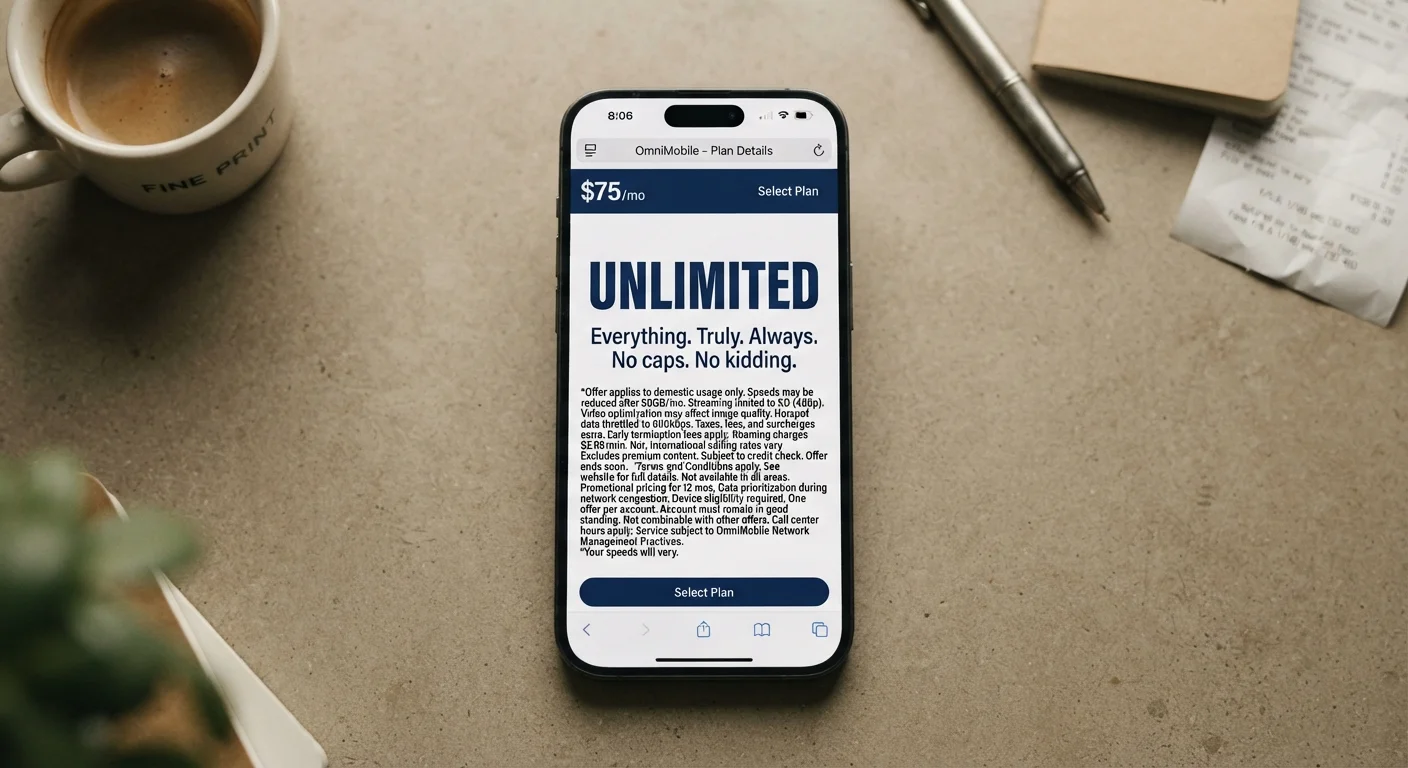
What 'Unlimited' Actually Means in Carrier Terms
The term "unlimited" is one of the most effective - and misleading - words in wireless marketing. Legally, carriers can use it as long as data access is never fully cut off. What that leaves room for is a wide range of speed restrictions, quality caps, and conditional slowdowns that reshape the real-world experience of using your plan.
Understanding these restrictions starts with knowing the vocabulary. Terms like premium data, deprioritization threshold, and video optimization appear in plan disclosures but rarely in ads. For a plain-language breakdown of these terms, see our phone plan terminology guide.
Myth
An unlimited plan means I can use as much high-speed data as I want, with no restrictions.
Fact
Every major carrier's unlimited plan includes a threshold - often called a "premium data" allotment - after which your speeds can be dramatically reduced.
Carriers are legally permitted to label a plan "unlimited" even when it includes speed reductions after a set data threshold. The Federal Communications Commission (FCC) has historically required only that carriers disclose these restrictions, not that they remove them. Once you hit the threshold - which varies by plan tier, commonly ranging from around 25 GB to 100 GB per month - your connection may slow enough to make video streaming or navigation noticeably degraded. The plan doesn't cut off your data entirely, which is why the "unlimited" label survives scrutiny, but high-speed access is very much limited.
Myth
My unlimited plan's mobile hotspot works the same as my phone's regular data.
Fact
Hotspot data is almost always governed by a separate, lower cap - and once exhausted, hotspot speeds typically drop to around 600 Kbps or less.
Carriers treat hotspot usage differently from on-device data because it allows other devices - laptops, tablets, gaming consoles - to consume data through your phone. On most mid-tier unlimited plans, hotspot data is capped at a specific amount of high-speed access (often 15 GB to 50 GB depending on the tier), after which speeds fall to a level that's barely functional for anything beyond basic web browsing. Even premium plans that advertise generous hotspot allowances frequently cap the speed at a lower ceiling than your phone's own connection. If you rely on hotspot for work or travel, checking the plan's hotspot terms specifically - not just the headline data figure - is essential.
Myth
Deprioritization and throttling are just two words for the same thing.
Fact
Throttling is a speed reduction applied automatically after a data threshold; deprioritization is a conditional slowdown that only occurs when a cell tower is congested.
These are meaningfully different experiences. Throttling is deterministic: you hit a data cap, and your speed drops - full stop, regardless of how busy the network is. Deprioritization is network-dependent: your speeds are only affected when a specific tower is handling heavy traffic from higher-priority users. In practice, deprioritization on a lightly used tower may have no impact at all, while throttling always has an impact once the threshold is crossed. Understanding which restriction applies to your plan helps set realistic expectations. Our guide to throttling vs. deprioritization vs. speed caps breaks down each mechanism in plain terms.
Myth
Video streams at full HD quality on any unlimited plan.
Fact
Most entry-level and mid-tier unlimited plans cap video resolution by default, often at 480p or 720p.
Carriers use a practice called video optimization - or video throttling, depending on perspective - to reduce bandwidth consumed by streaming. On base-tier unlimited plans, this cap is frequently around 480p (DVD quality), which is noticeably softer than the 1080p or 4K displays on modern smartphones. Some carriers cap mid-tier plans at 720p. Users typically have to upgrade to the most expensive plan tier, or manually toggle a setting, to stream at full resolution. This is disclosed in plan terms but rarely featured in advertising. If video quality matters to you, look specifically for the video streaming resolution listed under plan details - not just the data amount.
Myth
All lines on a family unlimited plan get the same priority and speed.
Fact
On shared plans, carriers often prioritize lines differently depending on which tier each line is subscribed to.
Family plans frequently offer multiple tier options at different price points per line. A line subscribed to the premium tier may receive higher-priority data and a larger premium data allotment than a line on a basic tier within the same account. During network congestion, those differences become tangible - the lower-tier line may slow significantly while the premium-tier line maintains faster speeds. If family members have different usage habits, it's worth reviewing whether each line is on the appropriate tier rather than assuming all lines share equal standing. The full picture of what a phone plan actually includes often extends well beyond the per-line advertised rate.
How These Restrictions Show Up in Everyday Use
Most consumers only discover these limits when they hit them - streaming buffers during a commute, a hotspot connection crawls during a work trip, or video suddenly looks blurry after the first week of a billing cycle. By that point, switching plans mid-month typically isn't an option.
600 Kbps
Typical hotspot speed after cap is reached
Many US carriers reduce mobile hotspot speeds to approximately 600 Kbps once the high-speed hotspot allotment is exhausted, per plan disclosures from major carriers.
480p
Default video cap on many base-tier unlimited plans
Entry-level unlimited plans from several major US carriers default to 480p video streaming, a restriction disclosed in plan fine print.
The practical impact depends heavily on how you use data. Heavy video streamers and hotspot-dependent users are most affected by speed caps and hotspot limits. Light users who primarily check email and browse may never notice a deprioritization threshold. If you're in the latter group, a plan designed for light users may deliver better value than a premium unlimited tier.
Before your next plan renewal, pull up the full plan details page - not the marketing summary - and look for the specific numbers: the premium data threshold, hotspot cap, video resolution limit, and deprioritization policy. Those four figures tell you far more about what you're actually buying than the monthly price does.
Don't Rely on the Plan Name Alone
Plan names like "Unlimited Plus" or "Unlimited Premium" vary by carrier and can change without notice. The name itself communicates nothing reliable about data thresholds, hotspot limits, or video caps. Always read the specific plan details page - particularly the section labeled something like "network management" or "plan details" - before signing up or switching tiers.
The content on this site is provided for informational purposes only and should not be considered a substitute for professional advice. While we strive to provide accurate and up-to-date information, we make no guarantees regarding its completeness or accuracy. Always consult a qualified professional for advice specific to your circumstances before making any decisions