

Why Maintenance Costs Change as a Vehicle Ages
Most drivers think of vehicle ownership costs as relatively stable - fuel, insurance, and the occasional oil change. In reality, the financial demands of keeping a car on the road tend to follow a recognizable pattern: low in the early years, rising steadily through mid-life, and accelerating in high-mileage territory. Understanding this curve helps you plan, budget, and make smarter decisions about repair versus replacement.
The core driver is wear. Rubber seals dry out, metal components develop friction, and fluids degrade. These changes happen gradually and predictably, which means they are also largely manageable - as long as owners stay ahead of the schedule rather than reacting after something fails.
$1,000+
Average annual repair cost for older vehicles
Consumer automotive research organizations commonly cite repair costs exceeding $1,000 per year for vehicles in the 80,000-150,000 mile range, though actual costs vary significantly by model and maintenance history.
3-5 years
Typical car battery lifespan
Most automotive batteries have a functional lifespan of three to five years under normal driving conditions, according to general industry guidance.
60,000-105,000 mi
Common timing belt replacement interval
Manufacturer-recommended timing belt replacement intervals typically fall within this range, though drivers should always consult their owner's manual for the exact figure for their vehicle.
The Early Years: Routine Services and Warranty Coverage
For most vehicles, the first three to five years - roughly the first 30,000 to 45,000 miles - represent the lowest-cost ownership window. Factory warranties typically cover powertrain and comprehensive defects during this period, limiting out-of-pocket exposure to scheduled maintenance items.
Common services during this phase include oil and filter changes, tire rotations, cabin and engine air filter replacements, and multi-point inspections. These are relatively inexpensive when performed on schedule. The maintenance schedule in your owner's manual lays out exactly which services are due and when - it is the most authoritative source for your specific vehicle, not general rules of thumb.
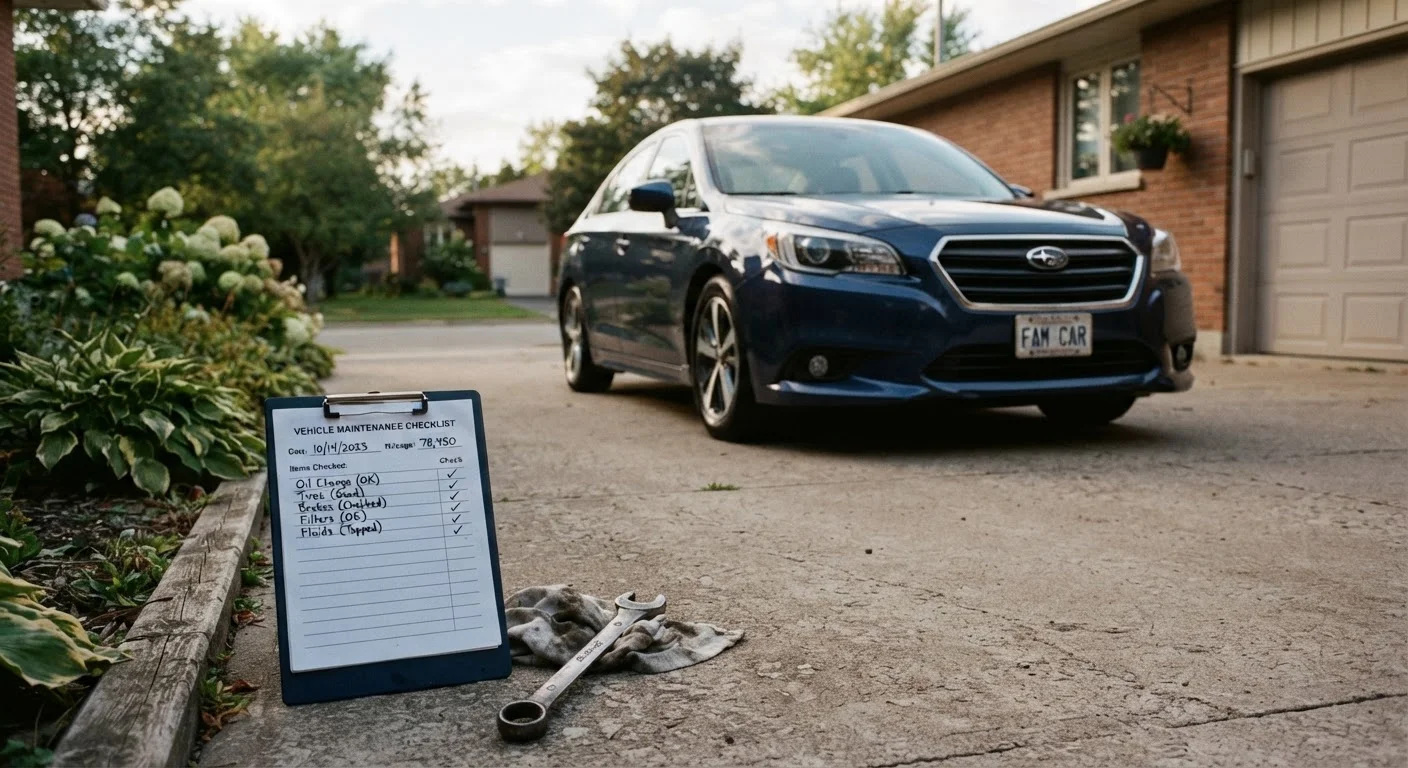
Cross-reference your owner's manual with your actual odometer reading at every oil change - not just annually. Many drivers miss interval-based services simply because they track time but not mileage.
Maintenance intervals are defined by whichever threshold comes first - time or mileage. Checking both at every service prevents costly oversights, particularly for drivers with variable annual mileage.
When a mid-life service like a timing belt is due, ask your mechanic to inspect the water pump and idler pulleys at the same time. Replacing them together often costs less in labor than scheduling separate visits.
These components share the same service area as the timing belt. Addressing them simultaneously is a widely recommended practice among professional technicians because the incremental parts cost is low relative to the labor already being performed.
Mid-Life Milestones: What to Expect Between 60,000 and 100,000 Miles
The 60,000-100,000 mile range is where maintenance costs begin to climb more noticeably. This is the phase when several major service intervals converge. Depending on the vehicle, owners may encounter:
- Brake pad and rotor replacement - pads typically wear within 30,000-70,000 miles depending on driving habits.
- Spark plug replacement - conventional plugs often need replacement around 30,000-60,000 miles; iridium or platinum plugs may extend to 100,000 miles.
- Timing belt service - if your vehicle uses a timing belt rather than a chain, replacement is commonly recommended between 60,000 and 105,000 miles. This is a high-stakes item: a failed timing belt can cause severe engine damage on interference engines.
- Coolant and transmission fluid flushes - these fluid services protect components that are expensive to replace.
- Battery replacement - average battery life spans roughly three to five years, often placing replacement squarely in this window.
None of these are emergencies if addressed on schedule. Together, however, they can total several hundred to over a thousand dollars in a single year. Treating this as a predictable expense - not a surprise - is the key mindset shift.
High-Mileage Ownership: Managing Costs Beyond 100,000 Miles
Crossing 100,000 miles is a milestone many drivers treat with apprehension, but modern vehicles that have been properly maintained frequently remain reliable well beyond this point. The nature of maintenance does shift, however. Components like suspension bushings, CV axle boots, power steering components, and oxygen sensors may require attention. Water pumps and alternators have finite service lives and can become candidates for replacement.
The critical differentiator at this stage is service history. A vehicle with thorough, documented maintenance is a fundamentally different mechanical proposition than one with gaps. Keeping complete maintenance records helps mechanics diagnose problems faster, and it protects resale value if you decide to sell.
If you are considering purchasing a high-mileage used vehicle, reading the vehicle history report carefully can reveal whether routine services were performed consistently - a meaningful predictor of what you may face going forward.
Budgeting for the Long Haul
Industry estimates for average annual vehicle maintenance and repair costs vary depending on the source, vehicle type, and driving environment, but figures commonly cited by consumer automotive organizations suggest owners should set aside several hundred dollars per year in early ownership, rising to potentially $1,000 or more annually in the 80,000-150,000 mile range. These are general reference points, not guarantees - actual costs depend on make, model, geography, and driving conditions.
A practical approach is to treat vehicle maintenance as a recurring line item in your monthly budget rather than a lump-sum emergency. Setting aside a modest amount each month creates a buffer that absorbs the predictable mid-life services without financial stress. For drivers weighing long-term ownership against leasing, understanding this cost arc matters - see our overview of how leasing compares to ownership in practice.
The Cost of Skipping Maintenance
Deferred maintenance rarely saves money. What appears to be a $100 service avoided today has a way of becoming a $900 repair six months later. A neglected coolant flush can allow corrosion to develop inside the cooling system; a skipped transmission service accelerates internal wear. As explored in depth in our article on how deferred maintenance compounds over time, these chains of failure are well-documented and largely preventable.
It is also worth addressing some of the assumptions that lead drivers to defer service. Many common beliefs - about oil change intervals, fuel grades, and what inspections are truly necessary - do not hold up to scrutiny. Our piece on popular car maintenance myths separates fact from habit.
Long-term vehicle ownership rewards consistency. Drivers who follow the manufacturer schedule, track their service history, and address minor issues before they escalate tend to extend vehicle life significantly and spend less per mile than those who take a reactive approach. The goal is not to spend more - it is to spend predictably, and to avoid the larger bills that skipped maintenance almost inevitably produces.
This article provides general informational guidance on vehicle maintenance costs and is not a substitute for advice from a qualified mechanic familiar with your specific vehicle.
The content on this site is provided for informational purposes only and should not be considered a substitute for professional advice. While we strive to provide accurate and up-to-date information, we make no guarantees regarding its completeness or accuracy. Always consult a qualified professional for advice specific to your circumstances before making any decisions