

Why the Owner's Manual Is Your Most Reliable Source
Most drivers keep their owner's manual in the glove box and open it only when a warning light appears. That's a missed opportunity. The maintenance schedule section - typically found near the back of the manual - is one of the most practical documents you own. It was written by the engineers who designed your specific engine, transmission, and drivetrain, and it reflects exactly how those components behave under real operating conditions.
Generic maintenance advice - like the often-cited 3,000-mile oil change rule - is frequently outdated or simply wrong for modern vehicles. Manufacturer intervals vary widely depending on the engine type, oil specification, and intended use. The common car maintenance myths around universal service intervals persist largely because drivers don't consult the source document that would clarify things immediately.
If you've misplaced your manual, most manufacturers publish digital versions through their official websites, searchable by year, make, and model.
How to Read the Maintenance Schedule
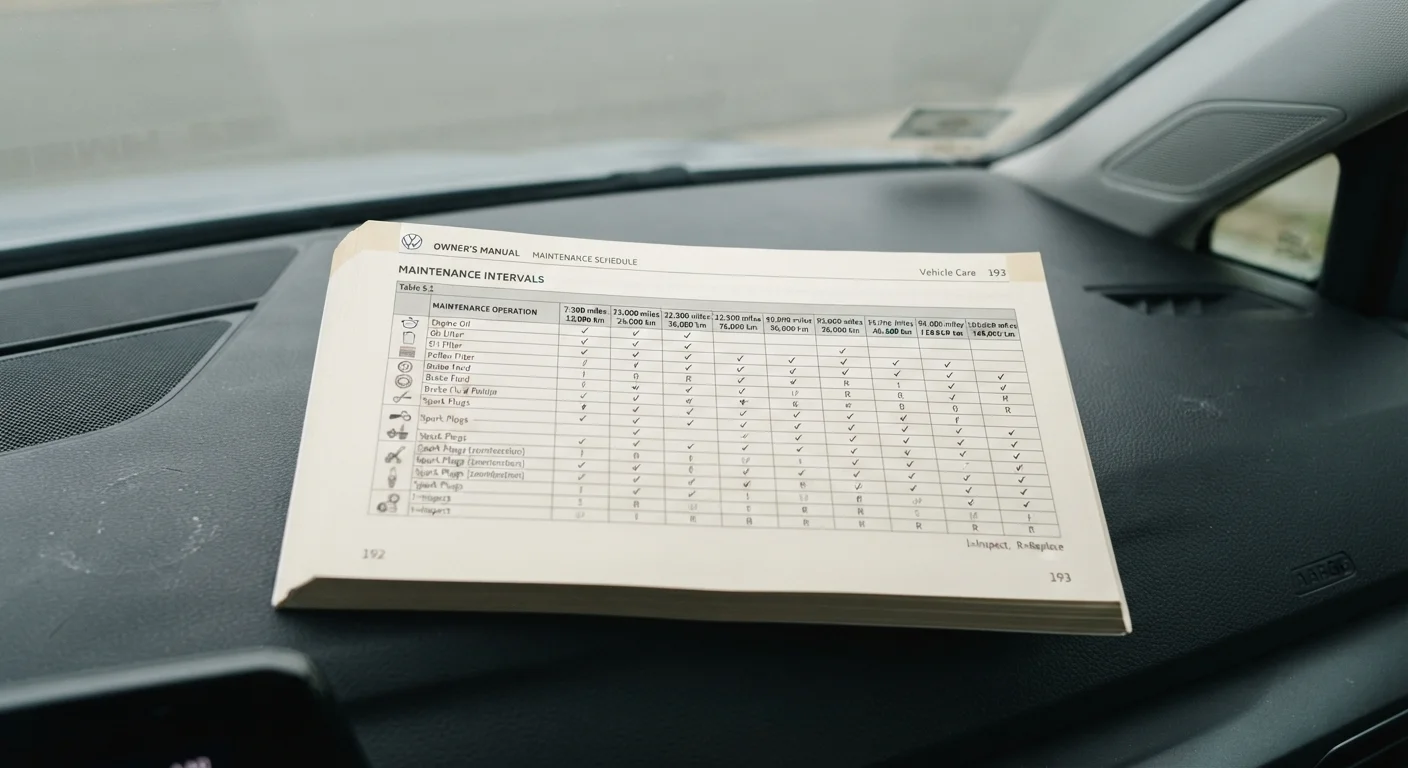
The schedule is usually presented as a table or a series of tables, with services listed down one axis and mileage or time intervals along the other. Here's what the key elements mean:
- Dual intervals (mileage and time): You'll see entries like "every 7,500 miles or 12 months, whichever comes first." Both conditions matter. A driver who puts on only 5,000 miles per year still needs to change their oil annually because fluids degrade with time, not just use.
- Normal vs. severe duty: Almost every manual includes two schedules. Normal conditions assume highway-heavy driving in moderate climates. Severe duty - which actually applies to many everyday drivers - covers frequent short trips, stop-and-go traffic, towing, dusty environments, or extreme temperatures. Check the definitions carefully; you may qualify for the shorter severe-duty interval.
- Service codes: Some manuals use letter codes (e.g., "A," "B," "1," "2") that correspond to service bundles explained in a key nearby. Don't skip that key - a single letter can represent multiple tasks.
- Inspection vs. replacement: The schedule distinguishes between items that need periodic inspection and those that require outright replacement. Brake pads, for example, are typically inspected at certain intervals but replaced only when worn to a specified thickness.
Time Intervals Matter as Much as Mileage
Fluids like brake fluid and coolant degrade chemically over time, even if the vehicle sits unused. Always apply whichever trigger - time or mileage - comes first. A car driven sparingly still needs annual or biennial fluid checks per the manufacturer's guidance.
For a broader view of how maintenance costs evolve as your car ages, see long-term vehicle ownership costs.
Step-by-Step: Working Through Your Schedule
Follow these steps to translate your manual's maintenance table into an actionable plan for your vehicle.
Locate the maintenance schedule section
Open your owner's manual and look for a chapter titled "Maintenance," "Scheduled Maintenance," or "Service Schedule." In many manuals this appears in the final third of the document. Some manufacturers also include a separate, shorter maintenance booklet in the same glove box packet.
Note your current mileage and last service date
Before reading the schedule, write down your odometer reading and, if you know it, the date and mileage of your most recent service. This gives you a baseline so you can calculate when each upcoming service falls due.
Determine whether you drive under normal or severe conditions
Find the definitions section in your manual - it explains what qualifies as severe-duty driving. Common severe-condition triggers include: trips of under five miles in normal temperatures, trips of under ten miles in below-freezing temperatures, sustained highway driving above 90°F ambient temperature, regular towing or hauling, and driving in dusty or muddy environments. If several of these apply to your routine, use the severe-duty schedule.
Map out upcoming service milestones
Using the appropriate schedule column (normal or severe), list every service item and its next due mileage or date, whichever comes first. Group items that fall due at the same interval - for example, oil change, tire rotation, and cabin air filter inspection may all align at the same mileage marker, allowing you to address them in a single shop visit.
Clarify any unfamiliar service terms
If the schedule lists services you don't recognise - such as a differential fluid service, fuel induction cleaning, or PCV (positive crankcase ventilation) valve replacement - use the manual's index or glossary to find an explanation. Understanding what each item does helps you prioritise and ask informed questions when speaking with a mechanic.
Schedule appointments around your milestones
Once you have your service list, book appointments proactively rather than waiting for a warning light or a noticeable problem. For tasks within your skill level, review when to DIY vs. use a shop to decide the appropriate approach for each item.
Putting the Schedule to Work Long-Term
Reading the schedule is only useful if you act on it consistently. Keeping thorough maintenance records is the logical next step - logging each completed service with the date, mileage, and shop or DIY notation. This documentation supports resale value and helps any mechanic diagnose problems faster.
If you're new to managing your own car's upkeep, the car maintenance guide for new drivers offers a practical overview of which tasks are manageable at home and which warrant professional attention. For anything involving brakes, suspension, or fluid systems, consult a qualified mechanic - some maintenance tasks carry real safety implications if performed incorrectly.
Deferring services rarely saves money. As detailed in our look at how skipping maintenance compounds into larger repairs, a missed service today can quietly accelerate wear across multiple connected systems, turning a modest maintenance cost into a significant repair bill.
The content on this site is provided for informational purposes only and should not be considered a substitute for professional advice. While we strive to provide accurate and up-to-date information, we make no guarantees regarding its completeness or accuracy. Always consult a qualified professional for advice specific to your circumstances before making any decisions