

The Hidden Cost of Ignoring PSI
Tire pressure is one of the most frequently neglected aspects of routine vehicle care - and one of the most consequential. Unlike a warning light or an unusual noise, incorrect pressure is invisible until it causes a problem. By then, you may already be dealing with uneven tread wear, reduced fuel economy, or a roadside emergency.
Under-inflated tires flex more than designed, building up heat and wearing down the outer tread edges faster. Over-inflated tires ride on a smaller center contact patch, wearing the middle of the tread prematurely and reducing grip. Either scenario shortens tire life measurably - and tires are not a cheap replacement.
~1 PSI
Pressure lost per 10°F temperature drop
The U.S. Department of Energy cites this relationship as a key reason to check tire pressure seasonally, not just annually.
25%
Pressure drop required to trigger TPMS alert
Federal regulations set the TPMS warning threshold at 25% below recommended PSI, meaning the system responds to significant loss, not gradual drift.
Up to 0.5%
Fuel economy improvement per PSI gained
The U.S. Department of Energy estimates that keeping tires properly inflated can improve fuel economy by up to 0.5% per PSI added when tires are collectively under-inflated.
Beyond wear, pressure directly affects fuel efficiency. An under-inflated tire creates more rolling resistance, meaning your engine works harder to maintain speed. The U.S. Department of Energy has noted that proper tire inflation can improve fuel economy by a meaningful margin - a benefit that compounds over tens of thousands of miles.
For a broader look at how neglected maintenance compounds over time, see how deferred maintenance snowballs into costly repairs.
Understanding Your TPMS Warning Light
Since 2008, all new passenger vehicles sold in the United States are required to include a Tire Pressure Monitoring System (TPMS). The system uses sensors inside each wheel to track pressure in real time and alerts you - via a dashboard warning light - when pressure drops significantly.
The key word is significantly. TPMS activates when a tire falls 25% or more below the vehicle's recommended PSI. That's a substantial pressure loss, meaning by the time the light comes on, the tire is already meaningfully under-inflated. TPMS is a safety net, not a substitute for routine pressure checks.
Check Pressure Monthly, Not Just When the Light Appears
TPMS is a safety alert system, not a routine monitoring tool. By the time it triggers, pressure is already significantly low. Building a monthly pressure check into your routine - paired with seasonal adjustments - keeps you ahead of the warning light entirely.
A steady TPMS light typically means one or more tires are low. A flashing TPMS light often signals a sensor malfunction rather than a pressure issue - worth having inspected by a qualified mechanic. Don't confuse the two.
After inflating tires to the correct PSI, the TPMS light should extinguish within a few minutes of driving. If it doesn't, a sensor fault or a slow leak may need professional attention. This falls into the category of tasks where knowing when to take it to a shop matters most.
Temperature, Seasons, and Pressure Changes
Tire pressure is not static. For roughly every 10°F change in ambient temperature, tire pressure shifts by approximately 1 PSI. In practical terms: a tire properly inflated in summer can become noticeably under-inflated when temperatures drop in the fall - without any slow leak or damage involved.
This is why seasonal transitions are a natural prompt to check all four tires. Drivers who set their pressure correctly in warm weather and don't revisit it through autumn often find their TPMS light appearing during the first cold snap of the year. It's a physics problem, not a mechanical failure.
For a complete seasonal maintenance checklist - including what temperature swings mean for batteries, fluids, and tires - see seasonal vehicle prep for summer and winter driving.
Cold Tires Give the Most Accurate Readings
Heat from driving temporarily increases the air pressure inside tires, which can make an under-inflated tire appear correctly inflated when checked immediately after a trip. Always check pressure before driving or after at least three hours of rest for a reliable reading.
Always check pressure when tires are cold - before driving or after the car has been parked for at least three hours. Driving heats the air inside the tire and temporarily raises the reading, which can produce a falsely reassuring number.
How to Check and Adjust Tire Pressure Correctly
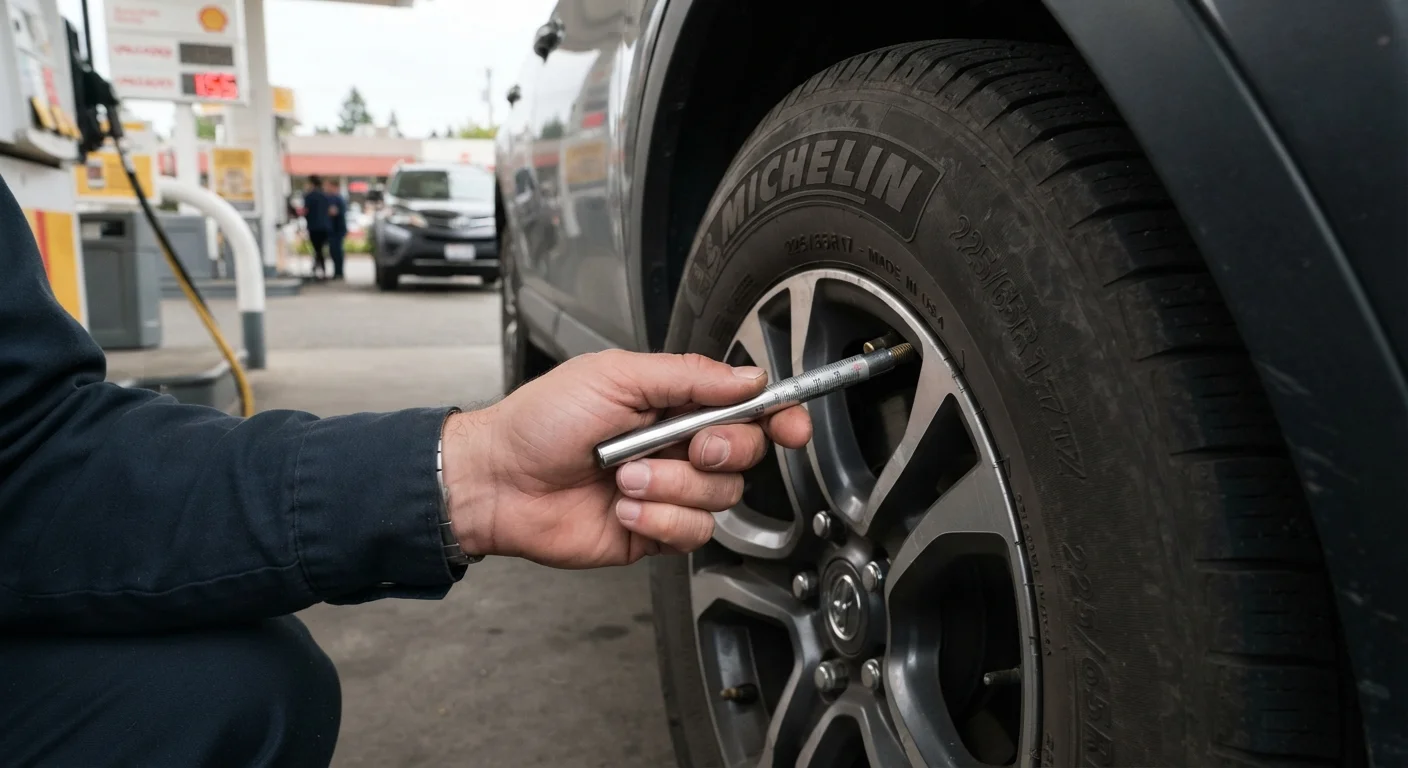
Checking tire pressure is a straightforward task requiring only a tire pressure gauge - a tool available at most auto parts retailers for a modest cost. Digital gauges tend to be easier to read accurately than dial or stick-type gauges, but all three types work.
- Find the recommended PSI on the sticker inside the driver's door jamb or in your owner's manual.
- Check tires cold - before the first drive of the day or after three hours of rest.
- Remove the valve cap from each tire and press the gauge firmly onto the valve stem.
- Compare the reading to the recommended PSI. Add air if low; release air with the gauge's bleed valve or a small tool if over-inflated.
- Replace all valve caps after checking - they keep debris out of the valve stem.
Note that front and rear tires may have different recommended pressures on some vehicles, particularly trucks and SUVs. Check your door jamb sticker rather than assuming one number applies to all four tires.
Integrating this into a regular pre-trip habit is a smart move. The pre-trip safety walkthrough outlines how a quick check before longer drives can catch problems before they escalate.
This article is for general informational purposes. For any tire damage, persistent pressure loss, or TPMS sensor issues, consult a qualified automotive technician.
Frequently Asked Questions
Look for a sticker on the inside edge of the driver's door or door jamb. Your owner's manual also lists it. The number printed on the tire sidewall is a maximum limit, not a recommended pressure.
Most mechanics recommend checking monthly and before any long trip. Because pressure drops roughly 1 PSI for every 10°F drop in temperature, checks are especially important when seasons change.
The Tire Pressure Monitoring System (TPMS) light illuminates when one or more tires drop 25% or more below the recommended PSI. By the time the light comes on, the pressure loss is already significant enough to affect handling and fuel economy.
You should address it as soon as safely possible. Short distances at low speeds may be unavoidable, but driving on significantly under-inflated tires risks tire failure, reduced braking performance, and accelerated tread damage.
No. The sidewall number is a maximum rating, not a target. Inflating to that level overinflates the tire, reducing the contact patch with the road and increasing the risk of a blowout or uneven wear.
Yes. Both under- and over-inflation alter the tire's contact patch with the road, which affects grip. Under-inflated tires in particular can increase stopping distances and reduce steering responsiveness.
The content on this site is provided for informational purposes only and should not be considered a substitute for professional advice. While we strive to provide accurate and up-to-date information, we make no guarantees regarding its completeness or accuracy. Always consult a qualified professional for advice specific to your circumstances before making any decisions