

Our Verdict
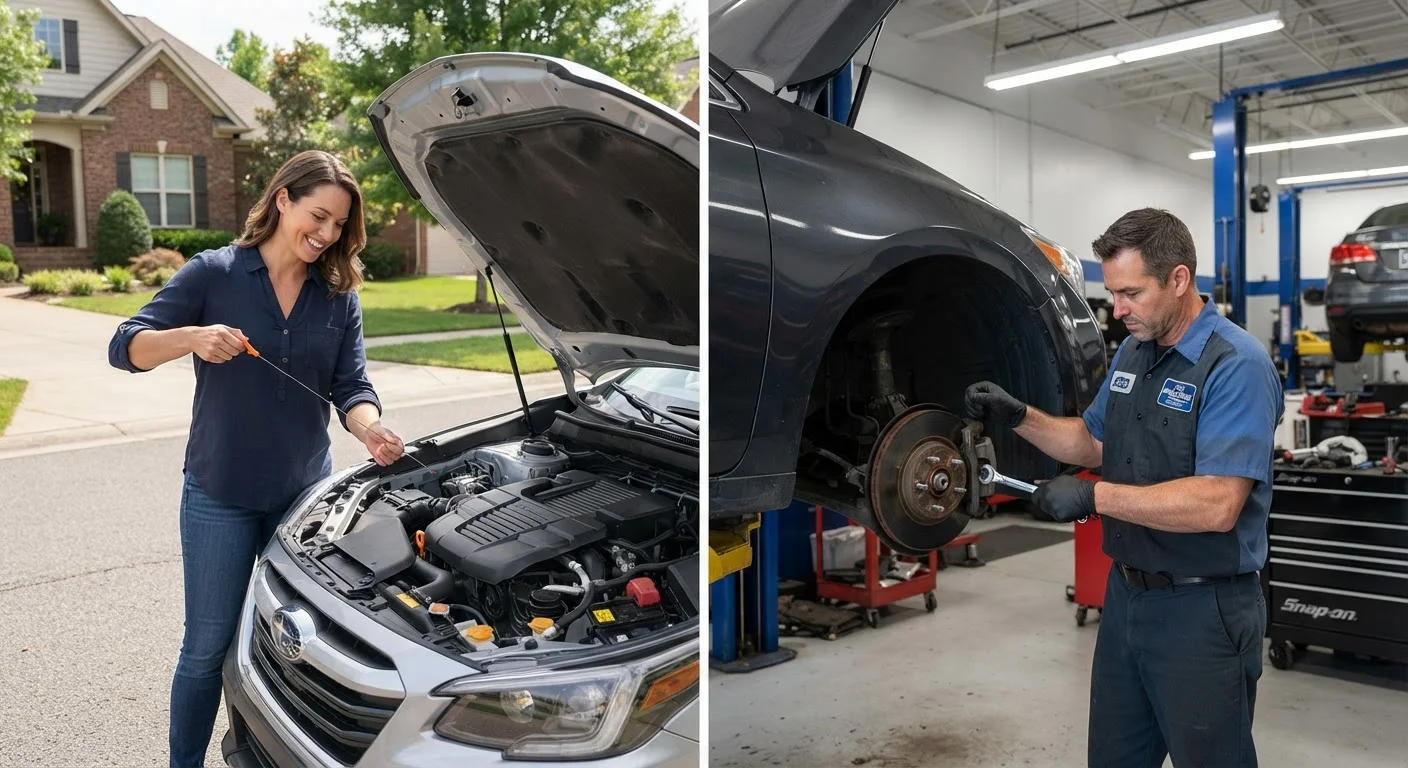
DIY maintenance makes practical sense for straightforward, low-risk tasks that require only basic tools and no specialized training. Once a job touches safety-critical systems - brakes, steering, suspension, or high-voltage components - the risk profile changes significantly and professional service is the responsible choice for most drivers.
| Best for | Recommended |
|---|---|
| Drivers comfortable with basic tools looking to reduce routine upkeep costs | DIY |
| Anyone dealing with brake, suspension, or electrical system issues | Professional Shop |
| Owners of vehicles still under manufacturer warranty | Professional Shop |
| Tasks like tire pressure checks, fluid top-offs, or cabin air filter replacement | DIY |
Why the DIY vs. Shop Question Matters
Vehicle maintenance decisions are rarely just about money. Done correctly, DIY upkeep can build driver confidence, sharpen awareness of how a vehicle is performing, and trim real costs over time. Done incorrectly, it can introduce hidden safety hazards, create problems that are more expensive to fix than the original job, or - in the case of warranty-covered vehicles - forfeit coverage that would have paid for the repair outright.
The key is understanding that not all maintenance tasks are created equal. Some are genuinely simple and well-suited to a careful home mechanic. Others involve safety-critical systems where the margin for error is narrow and the consequences of a mistake can be severe. Before consulting your owner's manual's maintenance schedule, it helps to have a clear mental map of which category each task falls into.
Tasks Most Drivers Can Handle at Home
A useful starting point: if a task requires no specialized tools, does not involve safety-critical systems, and mistakes are immediately obvious and easily corrected, it's generally reasonable for a motivated driver to attempt it. Common examples include:
- Engine oil and fluid checks: Checking oil, coolant, brake fluid, and washer fluid levels takes minutes and requires only the owner's manual for reference. Top-offs are similarly low-risk for most fluids, though always use the type specified for your vehicle.
- Air filter replacement: Engine and cabin air filters on most modern vehicles are accessible without tools or with just a screwdriver. The process is well-documented for nearly every model.
- Wiper blade replacement: Straightforward on virtually all vehicles, with blade fit and installation instructions typically printed on the packaging.
- Tire pressure monitoring: Checking and adjusting tire pressure is a habit every driver should build. See why getting tire pressure wrong costs more than you think for context on the real stakes here.
- Battery terminal cleaning: Corrosion on battery terminals can often be safely cleaned with basic supplies, though always disconnect the battery properly and consult your manual first.
Start With Your Owner's Manual
Before attempting any maintenance task, consult your vehicle's owner's manual for the manufacturer's specifications - fluid types, torque values, and service intervals. Generic advice online may not match your specific model. The manual is free, accurate, and already in your glove box.
Where to Draw the Line: Leave It to a Professional
The dividing line is clearest when a job involves systems whose failure directly affects vehicle control or occupant safety. These are not areas where a good-faith attempt gone wrong is an acceptable outcome.
| DIY at Home | Professional Shop | |
|---|---|---|
| Oil & fluid checks | Appropriate for most drivers | Not typically necessary |
| Air & cabin filter replacement | Generally straightforward | An option if preferred |
| Brake system service | Not recommended without training | Strongly recommended |
| Suspension & steering | Requires specialized tools; high risk | Recommended |
| Hybrid/EV high-voltage systems | Do not attempt | Certified technician required |
| Warranty implications | Must document carefully; risk of voiding | Typically preserves warranty |
| Tire pressure monitoring | Every driver should do this | Not required for basic checks |
Brakes: Brake pad and rotor replacement may look approachable in tutorial videos, but incorrect installation - improperly torqued caliper bolts, contaminated rotors, reversed hardware - can result in brake fade or failure. Most certified mechanics treat brake work as non-negotiable professional territory for home mechanics without prior hands-on training.
Suspension and steering components: Worn ball joints, tie rod ends, and wheel bearings require precise torque specs and, in many cases, specialized tools like a ball joint press. Errors here affect vehicle handling at speed.
Fuel system work: Any repair involving fuel lines, fuel injectors, or the fuel pump involves flammable materials under pressure. This work should be handled by a qualified technician with proper equipment.
High-voltage systems (hybrid and electric vehicles): HV battery packs and associated wiring in hybrid and electric vehicles operate at voltages that are potentially lethal. Always defer to trained, certified technicians for any work involving these systems.
It's also worth noting that many common maintenance myths lead drivers to tackle jobs they believe are simple when the reality is more nuanced.
Safety-Critical Systems Are Not the Place to Learn
Brake, suspension, steering, and high-voltage components directly govern your ability to control the vehicle. A task that appears straightforward in an online tutorial may omit important steps or assume prior mechanical experience. If you are uncertain about any aspect of a safety-critical repair, the responsible choice is to have it inspected and completed by a qualified mechanic.
Practical Factors to Weigh Before You Start
Even for tasks that fall into the DIY-friendly category, a few honest self-assessments are worth making before picking up a wrench:
- Do you have the right tools?
- Some jobs require torque wrenches, jack stands rated for your vehicle's weight, or specialty sockets. Improvising with the wrong tools increases the risk of injury and damage.
- Is your vehicle still under warranty?
- Manufacturer and extended warranties vary in how they handle owner-performed maintenance. Confirm what documentation - receipts, records, parts specifications - is required to protect coverage.
- Can you verify the result?
- A correctly replaced cabin air filter is visually obvious. A correctly torqued suspension component is not. If you cannot confirm the job was done right, factor that uncertainty into your decision.
For a broader look at how this same logic applies in other areas of home upkeep, the framework explored in knowing where to draw the line on home repairs maps closely onto automotive decisions. The underlying principle - that some tasks carry risk profiles that change the calculation entirely - holds in both contexts.
Ultimately, the goal of DIY vehicle care should be informed confidence, not just cost savings. Understanding the limits of safe home maintenance is itself a form of good driver safety practice.
The content on this site is provided for informational purposes only and should not be considered a substitute for professional advice. While we strive to provide accurate and up-to-date information, we make no guarantees regarding its completeness or accuracy. Always consult a qualified professional for advice specific to your circumstances before making any decisions