

Option A
Posted Speed Limit
The legal maximum under ideal, standard conditions.
Best for: Establishing a consistent, enforceable traffic law that applies across all drivers on a given road segment.
Option B
Safe Speed
The appropriate speed for actual, real-world conditions at that moment.
Best for: Drivers who want to calibrate their speed to weather, visibility, traffic, and road geometry rather than just the sign on the post.
What a Speed Limit Actually Represents
Speed limits are set through an engineering and legal process that considers factors like road design, lane width, sight distance, and typical traffic flow. They represent the maximum lawful speed under favorable conditions - generally dry pavement, good visibility, and normal traffic density.
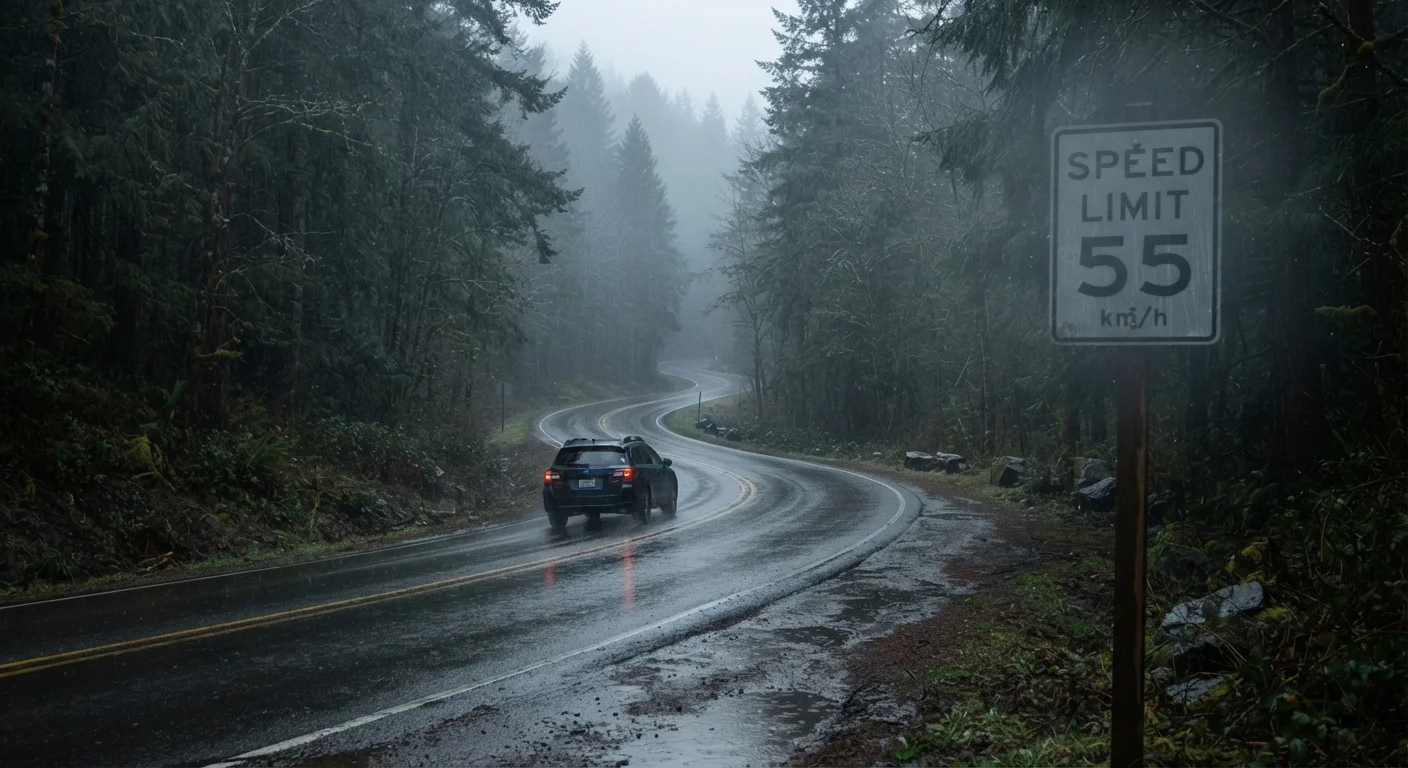
What they do not account for is what's happening on that road right now. A posted 55 mph rural highway doesn't change its sign when rain begins falling or a deer crossing zone becomes active at dusk. The sign is static; conditions are not.
Most U.S. states also have what is commonly called a basic speed law (sometimes called the prima facie standard), which holds that a driver must operate at a speed that is reasonable and prudent given actual conditions - even if that speed is below the posted limit. In practice, this means a driver traveling at exactly the posted speed limit in dangerous conditions could still be found negligent if a crash occurs.
Basic Speed Laws Vary by State
While most U.S. states have some form of a basic speed law, the specific language, enforcement standards, and legal consequences differ. In some states, exceeding a 'prima facie' speed limit is treated as a rebuttable presumption of unsafe driving rather than an absolute violation. Drivers should familiarize themselves with the traffic statutes specific to their state, especially when traveling across state lines.
When Conditions Demand a Lower Speed
Several real-world factors can make the posted limit genuinely unsafe, regardless of its numerical value:
- Wet or icy roads: Stopping distances increase dramatically on slick surfaces. A vehicle traveling at 60 mph on dry pavement might require roughly 270 feet to stop - on ice or packed snow, that figure can more than double depending on tire condition and vehicle type.
- Reduced visibility: Fog, heavy rain, glare, or driving at night all shrink the window of time a driver has to react. Driving faster than your ability to stop within your visible range is sometimes called "overdriving your headlights" - and it applies in daylight fog conditions too.
- Curves and elevation changes: Speed limits on straightaways don't translate cleanly to winding mountain roads or on-ramps. Advisory speed signs on curves exist precisely because the posted roadway limit doesn't reflect curve-specific safety thresholds.
- Heavy or unpredictable traffic: Dense traffic compresses the gap between vehicles, leaving less room for error. Following too closely is a compounding risk that becomes even more dangerous when vehicles are moving quickly through congestion.
- Construction zones: Reduced lane widths, workers present, and uneven pavement all justify slower speeds - which is why reduced construction zone limits are legally mandated in most states.
~29%
Of fatal crashes involving speeding
According to the National Highway Traffic Safety Administration (NHTSA), speeding - including driving too fast for conditions - is a factor in roughly 29% of all traffic fatalities in the United States.
2-4×
Stopping distance increase on ice vs. dry pavement
Engineering and safety research consistently shows that stopping distances on icy roads can be two to four times longer than on dry pavement at equivalent speeds, depending on tire type and temperature.
45%
Of drivers who admit speeding in rain
Surveys conducted by road safety organizations have found that a significant share of drivers report traveling at or near the posted limit even during active rainfall, despite the increased stopping risk.
The Comparison: Speed Limit vs. Safe Speed
Understanding the distinction between these two concepts can meaningfully change how you approach daily driving decisions.
| Criterion | Posted Speed Limit | Safe Speed |
|---|---|---|
| Defined by | Traffic engineers and state law | Real-time road and weather conditions |
| Changes with weather | No - static sign | Yes - must be actively adjusted |
| Legal standing | Enforceable maximum | Basis for negligence under basic speed laws |
| Accounts for traffic density | Partially (at time of engineering study) | Yes - driver must assess current flow |
| Applies to curves and hills | Straightaway limits may not transfer | Must be reduced for geometry and grade |
| Who sets it | Government transportation authority | The driver, in real time |
| Visibility considerations | Based on standard daylight conditions | Adjusted for fog, night, glare, or rain |
The key insight is that the posted limit and the safe speed are sometimes identical - but not always. Experienced drivers treat the limit as a ceiling to stay under while continuously adjusting downward based on what conditions require. As explored in our guide on safe highway driving habits, this kind of proactive, condition-aware adjustment is one of the clearest markers that separates low-risk drivers from high-risk ones.
Making the Habit Work in Practice
Adjusting your speed to conditions isn't about being overly cautious or impeding traffic - it's about applying accurate judgment. A few practical principles help:
- Scan ahead, not just immediately in front. Looking farther down the road gives you more time to identify developing hazards and reduce speed gradually rather than abruptly.
- Use following distance as your real-time gauge. If you find yourself closing in on the vehicle ahead despite no speed change on your part, the gap has already become a problem. Ease off the accelerator early.
- Reduce speed before curves, not during them. Braking mid-curve destabilizes the vehicle. Slowing before the turn preserves traction and control.
- Treat adverse weather as a condition change, not an inconvenience. Rain, fog, or low sun angle warrants a deliberate speed reduction - not a reluctant one after something nearly goes wrong.
This article is for general informational purposes only. Drivers should always comply with applicable traffic laws and consult local regulations, as speed laws vary by state and road type.
The content on this site is provided for informational purposes only and should not be considered a substitute for professional advice. While we strive to provide accurate and up-to-date information, we make no guarantees regarding its completeness or accuracy. Always consult a qualified professional for advice specific to your circumstances before making any decisions