

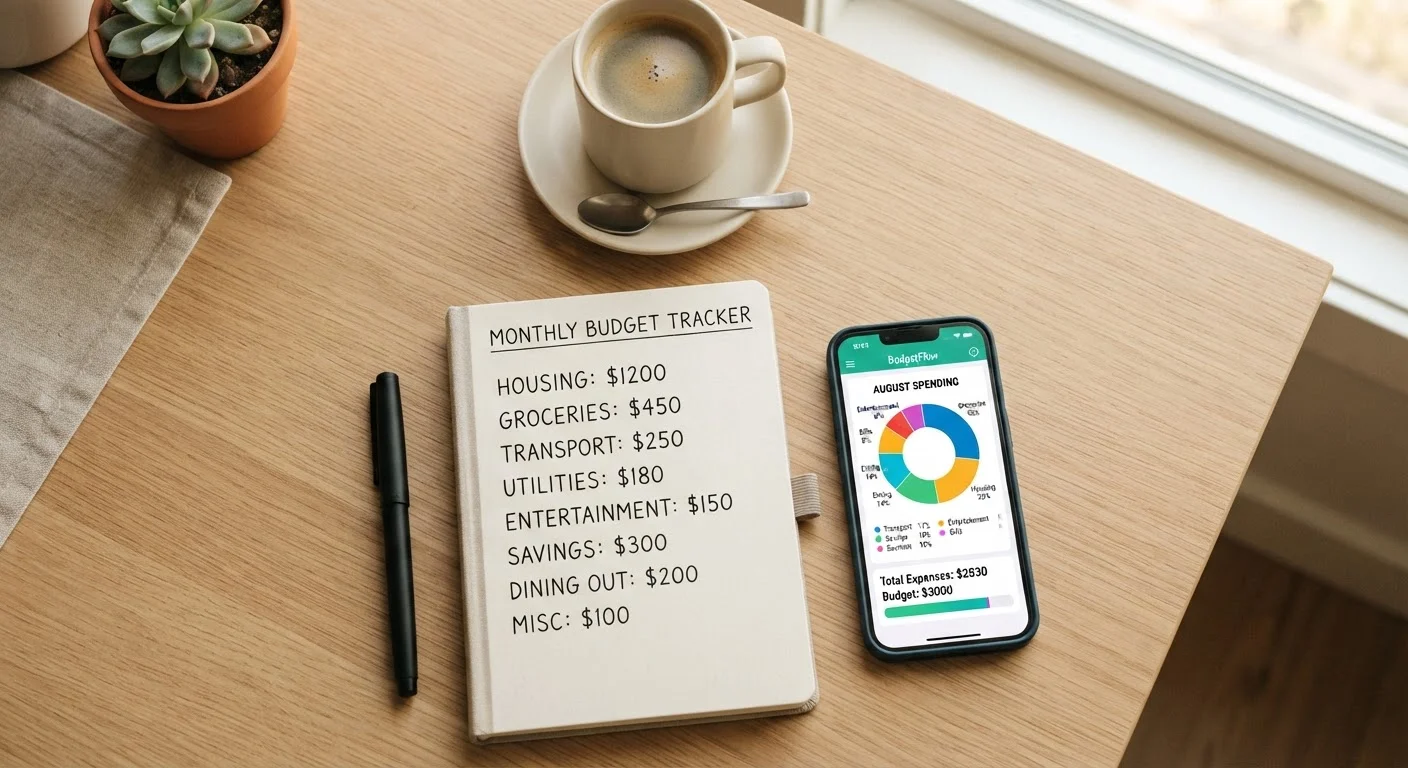
Option A
Spending Tracker
The real-time record of where your money goes.
Best for: Anyone who wants to understand their current spending habits before committing to a structured financial plan.
Option B
Full Budget
The forward-looking plan that gives every dollar a job.
Best for: People with financial goals - paying down debt, saving for a home, building an emergency fund - who need deliberate spending guardrails.
What Each Tool Actually Does
The terms are often used interchangeably, but a spending tracker and a full budget are fundamentally different instruments. Confusing them leads people to believe they're managing their finances when they're only observing them - or planning without ever checking whether the plan is working.
A spending tracker is a record. It captures what you've already spent, categorizes it, and gives you a picture of past behavior. This can be a bank statement you review each week, a dedicated app that syncs your accounts, or a simple notebook where you log purchases. The key feature is that it's backward-looking - it tells you what happened.
A full budget is a plan. It allocates your expected income across categories before the month begins, assigning spending limits to groceries, housing, transportation, savings, and so on. It's forward-looking - it tells you what should happen. Several budgeting frameworks exist, from the 50/30/20 rule to zero-based budgeting, but all share that same core logic: decide in advance how money will be used.
Neither tool is inherently superior. They answer different questions. A tracker answers, "Where did my money go?" A budget answers, "Where should my money go?" The gap between those two answers is often where financial stress lives.
The Case for Tracking First
If you've never tracked spending seriously, building a budget before you do is a bit like drawing a map of a place you've never visited. You can sketch something plausible, but it won't reflect reality - and when it doesn't, it's easy to give up entirely.
Tracking first gives you a baseline. When you can see that you spend $340 a month on dining out rather than the $150 you assumed, your budget categories become grounded in fact rather than optimism. Auditing your own spending before budgeting is a practical step many financial educators recommend precisely for this reason.
Tracking also surfaces variable expenses that are easy to overlook - irregular subscriptions, seasonal costs, or convenience purchases that accumulate quietly. Understanding the distinction between fixed and variable expenses can change how you approach both tracking and planning.
Starting Out? Try Tracking for 30 Days First
Before building any budget framework, spend one full month logging every purchase - even small ones. Many people discover that their assumed spending in key categories is off by 20-40% from reality. That honest baseline makes any budget you build afterward far more likely to stick. You can use a banking app, a spreadsheet, or even a notes app on your phone - the tool matters far less than the habit.
For people with irregular income - freelancers, gig workers, or those with commission-based pay - tracking spending minimums and patterns over several months before committing to a fixed budget is especially useful. It prevents the frustration of a budget that only works in high-income months.
Why a Budget Without Tracking Usually Fails
A budget on paper can look perfectly balanced. The numbers add up, the savings rate seems reasonable, and every category is accounted for. But without tracking actual spending against those numbers, the budget becomes an aspiration rather than a tool.
Most people overestimate how closely they follow a budget when they don't track actively. Awareness gaps - not bad intentions - are usually the issue. A grocery run here, a spontaneous purchase there, a forgotten annual fee charged mid-month: these are the cracks a tracker catches and a standalone budget misses.
| Criterion | Spending Tracker | Full Budget |
|---|---|---|
| Time orientation | Backward-looking (records past) | Forward-looking (plans future) |
| Primary question answered | Where did my money go? | Where should my money go? |
| Best starting point | Anyone new to monitoring finances | Those with clear financial goals |
| Reveals spending patterns | Yes - core function | Only when paired with tracking |
| Supports goal-setting | Indirectly, through awareness | Directly, through allocation |
| Effort to maintain | Low to moderate | Moderate (requires monthly planning) |
| Works without the other | Yes, but lacks direction | Yes, but lacks accuracy |
Used together, tracking and budgeting form a feedback loop. The budget sets the intention; the tracker measures execution. When you see a category running over by the third week of the month, you still have time to adjust - cut discretionary spending, defer a purchase, or consciously decide to accept the overage and reduce elsewhere. That course-correction ability is what makes the combination powerful.
If you're deciding between popular budgeting structures, it's worth comparing approaches like the 50/30/20 rule versus zero-based budgeting to find the framework that best fits your lifestyle before pairing it with consistent tracking.
This article is for general informational purposes only and does not constitute personalized financial advice. Consult a qualified financial professional for guidance specific to your situation.
The content on this site is provided for informational purposes only and should not be considered a substitute for professional advice. While we strive to provide accurate and up-to-date information, we make no guarantees regarding its completeness or accuracy. Always consult a qualified professional for advice specific to your circumstances before making any decisions