

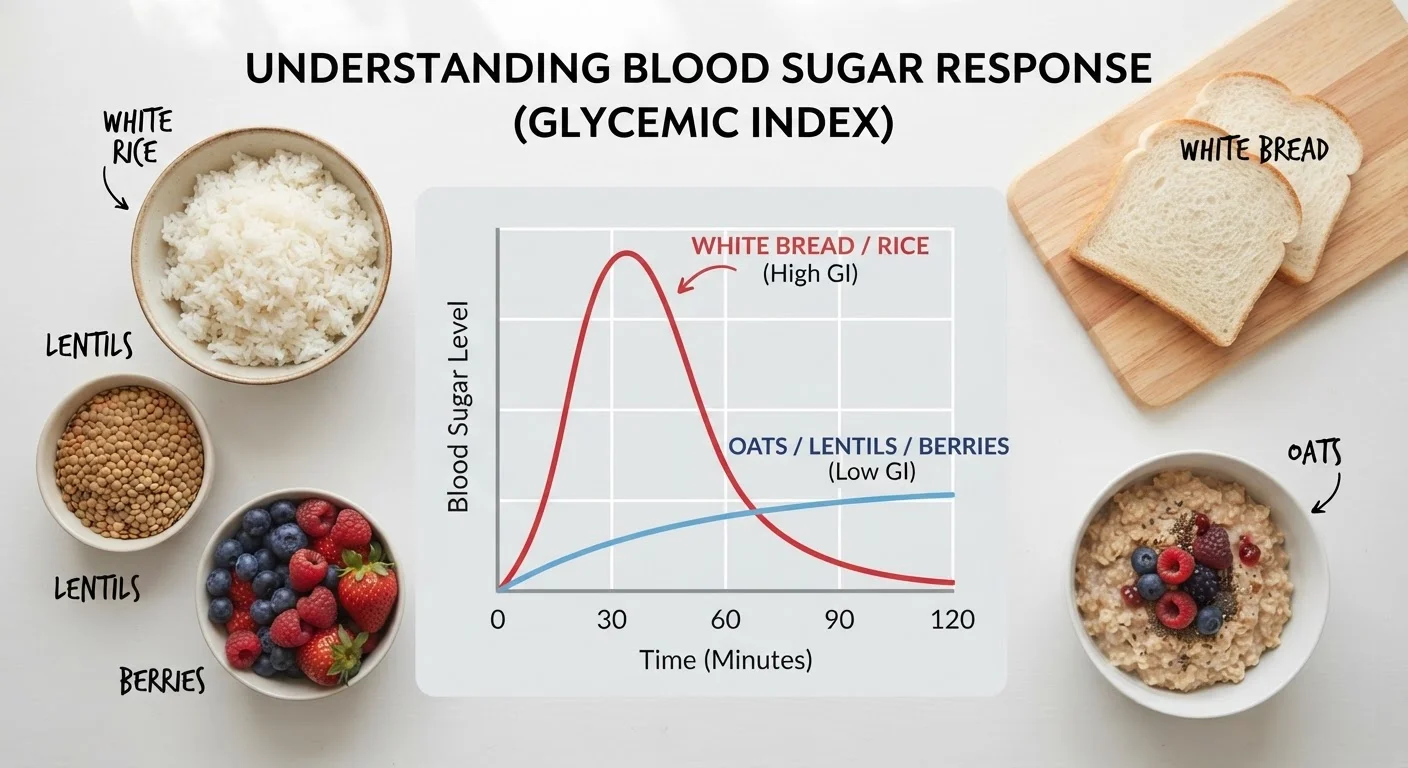
How the Glycemic Index Is Measured
The glycemic index was developed in the early 1980s by researchers looking for a systematic way to compare how different carbohydrates affect blood glucose. To assign a GI value, researchers give fasting volunteers a portion of food containing exactly 50 grams of digestible carbohydrates, then measure blood glucose at regular intervals over two hours. That response curve is compared against a reference food - typically pure glucose - assigned a value of 100.
The result is a relative score. White rice might score around 72, rolled oats around 55, and lentils around 32. But those numbers carry an important caveat: they are generated under tightly controlled laboratory conditions that rarely reflect how people actually eat.
GI Values Can Vary by Source
Different published GI databases sometimes list slightly different values for the same food, reflecting variation in how test foods were prepared, the populations tested, and reference standards used. The International GI Database (maintained by researchers at the University of Sydney) is one widely referenced source, but minor discrepancies across tables are normal. Treat GI values as approximate guides rather than fixed absolutes.
The Real-World Limitations of GI
Several variables reduce the GI's predictive reliability outside a lab setting. Ripeness matters: a ripe banana has a meaningfully higher GI than an underripe one. Cooking method matters: al dente pasta raises blood sugar more slowly than the same pasta cooked until soft. Food combinations matter: eating fat, protein, or fiber alongside a carbohydrate-rich food slows digestion and blunts the glucose spike - which is exactly how most people eat.
There is also the issue of serving size. GI is calculated from a 50-gram carbohydrate portion, which for some foods is far larger than a normal serving. Watermelon, for example, carries a high GI score of roughly 72 - but a typical slice contains so little carbohydrate per gram that its real-world blood sugar impact is modest. This is where glycemic load (GL) becomes more practical: it multiplies GI by the actual grams of carbohydrate in a realistic serving, then divides by 100, producing a figure that better reflects what happens at the dinner table.
To better understand the numbers on packaged foods alongside GI, see our guide to reading a Nutrition Facts label.
Use Glycemic Load for a More Practical Picture
When evaluating a food's likely blood sugar impact, consider glycemic load rather than GI alone. Multiply the food's GI by the grams of carbohydrate in your actual serving, then divide by 100. A glycemic load of 10 or below is generally considered low. This simple calculation accounts for realistic portion sizes and gives you a more grounded sense of real-world impact.
When GI Information Is Genuinely Useful
Despite its limitations, the glycemic index has proven clinically meaningful in specific contexts. For people with type 2 diabetes or prediabetes, choosing lower-GI carbohydrates - beans, non-starchy vegetables, whole grains - is a well-supported strategy for managing post-meal blood glucose levels. Research published in peer-reviewed journals, including systematic reviews conducted by Diabetes Care, supports low-GI dietary patterns as a complement to broader diabetes management under medical supervision.
Athletes and active individuals sometimes use GI strategically - favoring higher-GI foods for quick energy replenishment after intense exercise and lower-GI options before sustained activity. These are context-specific applications, not universal prescriptions.
For the general population without blood sugar conditions, the glycemic index is one useful data point among many - but it should not override attention to overall dietary patterns, fiber intake, micronutrient density, and total calorie balance. A food can be low-GI and still be nutritionally poor, or high-GI and still be highly nutritious.
32-72
Typical GI range for common carbohydrate foods
Lentils score approximately 32 while white rice scores approximately 72, illustrating the wide variation in blood sugar response across everyday foods, per established GI databases.
~10%
Estimated prevalence of diabetes among U.S. adults
According to the CDC, approximately 1 in 10 U.S. adults has diagnosed diabetes, making glycemic management strategies relevant for a significant portion of the population.
55 or below
GI threshold for a food to be classified low-GI
This classification threshold is used by researchers and dietitians as a general benchmark; it is not a regulated food-labeling standard in the United States.
Putting GI in Practical Context
Rather than obsessing over individual GI scores, most registered dietitians emphasize a broader framework: build meals around whole foods, include plenty of fiber-rich vegetables and legumes, choose minimally processed grains, and pair carbohydrates with protein and healthy fats. This approach naturally trends toward lower glycemic impact without requiring you to consult a GI table before every meal.
It is also worth scrutinizing food marketing carefully. Terms like "low glycemic" on packaging are not regulated under a single federal standard and may be used loosely. Our explainer on food label claims can help you evaluate what those phrases actually mean.
If you have a chronic condition, are pregnant, or are managing blood sugar through diet, consult a registered dietitian or your healthcare provider before making significant dietary changes based on glycemic index guidance. GI is a useful scientific tool - but it works best as part of a broader, individualized nutritional approach.
This article is for general informational and educational purposes only and is not a substitute for professional medical or dietary advice. Always consult a qualified healthcare provider for guidance tailored to your individual health needs.
Frequently Asked Questions
Foods scoring 55 or below on the glycemic index are classified as low-GI, which generally means they produce a slower, more gradual rise in blood sugar. However, a "good" GI score should always be considered alongside portion size, overall nutritional content, and how the food fits into your total diet.
The evidence linking low-GI diets to weight loss is mixed and inconclusive. Some studies suggest low-GI eating patterns may support satiety, but GI alone does not determine calorie content or overall diet quality. Sustainable weight management involves many factors beyond GI.
No. Glycemic index measures the quality of carbohydrate effect on blood sugar, while glycemic load also factors in the quantity of carbohydrates in a typical serving. Glycemic load (GI × grams of carbs ÷ 100) is often considered more practical for real-world eating decisions.
Yes. A food's GI can shift based on ripeness, cooking method, processing, and what other foods it is eaten with. For example, al dente pasta has a lower GI than fully cooked pasta, and eating fat or protein alongside a carbohydrate tends to blunt its blood sugar effect.
Not necessarily. Low-GI eating is most clearly beneficial for people managing blood sugar conditions such as type 2 diabetes or prediabetes. For the general population, overall dietary pattern - emphasizing whole foods, vegetables, and adequate fiber - matters more than GI scores alone.
Not automatically. Watermelon and white potatoes have high GI scores but supply important vitamins and minerals. Nutritional value, portion size, and overall diet context matter far more than a single GI number when evaluating whether a food supports your health.
The content on this site is provided for informational purposes only and should not be considered a substitute for professional advice. While we strive to provide accurate and up-to-date information, we make no guarantees regarding its completeness or accuracy. Always consult a qualified professional for advice specific to your circumstances before making any decisions