

Why pH Controls More Than You Think
Most gardeners focus on fertilizer when plants struggle. But here's the thing: if your soil pH is off, the nutrients in that fertilizer may be chemically locked away - completely unavailable to plant roots, no matter how much product you apply. Soil pH acts like a gatekeeper for nutrient absorption.
At the right pH, essential nutrients like nitrogen, phosphorus, potassium, iron, and manganese dissolve readily in soil water, where roots can take them up. When pH swings too far in either direction, chemical reactions in the soil bind those nutrients into forms roots simply can't use. The result looks like a nutrient deficiency - because it effectively is one, even if the nutrients are physically present in the ground.
This connection between pH and nutrient availability is why two identical garden beds treated with the same fertilizer can produce drastically different results. Understanding pH helps explain what fertilizer alone cannot. See our breakdown of organic vs. synthetic fertilizers to understand how fertilizer choice interacts with soil conditions.
6.0-7.0
Optimal pH range for most garden plants
Soil science guidelines consistently identify this range as the window where the broadest range of nutrients remains plant-available.
10×
Acidity difference between each pH unit
The pH scale is logarithmic - a soil at pH 5 is ten times more acidic than one at pH 6, making even small deviations significant.
~50%
U.S. soils that are naturally acidic
Much of the eastern United States has naturally acidic soils due to rainfall and organic matter decomposition, making lime application a routine practice.
How to Test Your Soil pH
You can't determine your soil's pH by looking at it or feeling it. Testing is the only way to know where you stand, and the good news is it's inexpensive and straightforward.
- Home test kits: Available at most garden centers, these kits use indicator strips or a liquid reagent to give a color-coded pH reading. They're useful for a quick check but can vary in precision.
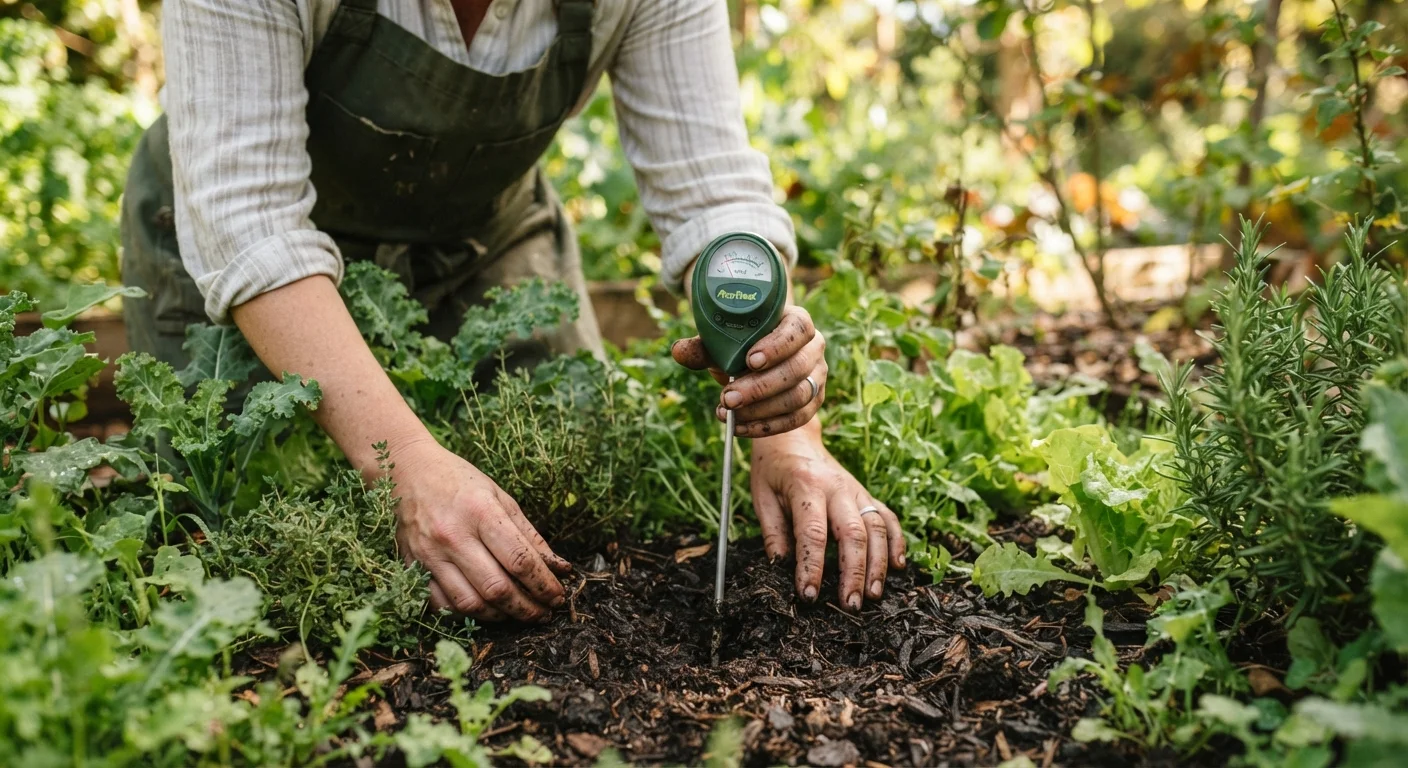
- Digital pH meters: Probe-style meters inserted directly into moist soil offer a faster reading and are reasonably accurate when properly calibrated.
- Cooperative extension lab tests: For the most reliable results, contact your local university cooperative extension service. Many offer soil testing for a modest fee. Lab results typically include pH plus recommendations for amendments specific to your region and intended plants.
When collecting a soil sample, gather small amounts from several spots in the area you're testing - mixing them gives a more representative reading than a single scoop. Sample from a depth of about 3 to 4 inches for garden beds, or 2 to 3 inches for lawns.
Test Before You Amend
Never apply lime or sulfur based on a guess. Amending soil without knowing your baseline pH can make conditions worse. A soil test takes the guesswork out and tells you exactly how much amendment to use - saving both money and plant health.
How to Adjust Soil pH
Once you know your pH, you can correct it - gradually. Soil amendment is a slow process, and patience matters here.
Raising pH (Making Soil Less Acidic)
If your soil is too acidic (pH below 6.0 for most plants), the standard solution is applying agricultural lime - typically ground limestone. Calcitic lime raises pH and adds calcium; dolomitic lime adds both calcium and magnesium, which is beneficial if your soil is also magnesium-deficient. Wood ash is a faster-acting alternative, though it should be applied sparingly.
Lowering pH (Making Soil More Acidic)
If your soil is too alkaline (pH above 7.5), elemental sulfur is the most common amendment. Soil bacteria convert sulfur into sulfuric acid over time, gradually lowering pH. This process is slow - it can take several months - and works best in warm, moist conditions. Acidifying fertilizers containing ammonium sulfate can also contribute to a modest pH decrease over time.
Always follow application rates based on your specific soil test results, your soil type (clay vs. sandy soils respond differently), and the target pH for your plants. Applying too much amendment at once can overshoot your target and create new problems. Our spring readiness checklist includes soil prep as an early-season priority.
Matching pH to What You're Growing
Different plants have different pH preferences, and knowing those ranges helps you plan more effectively.
| Plant Type | Preferred pH Range |
|---|---|
| Most lawn grasses (Kentucky bluegrass, fescue, ryegrass) | 6.0 - 7.0 |
| Vegetables (tomatoes, peppers, beans) | 6.0 - 6.8 |
| Blueberries, azaleas, rhododendrons | 4.5 - 5.5 |
| Lavender, clematis, lilac | 6.5 - 7.5 |
| Potatoes | 4.8 - 5.5 |
If you grow a mix of plants with very different pH needs, consider creating separate raised beds or defined zones rather than trying to compromise one soil to suit all. This is especially relevant if you want acid-loving shrubs alongside a vegetable garden.
pH also interacts with other soil health factors. Weed pressure, for instance, can signal imbalanced soil - see what weeds reveal about your soil for more context. And when pH is finally in range, timing your fertilizer applications correctly makes a meaningful difference - our guide on fertilizer timing explains why.
A homeowner repeatedly fertilizes a lawn that stays yellowing and thin, despite following label directions carefully.
Blueberry bushes planted in a vegetable garden bed fail to produce fruit and show yellowing between leaf veins.
A gardener adds compost every year but still sees poor growth in a clay-heavy raised bed in a rainy climate.
Frequently Asked Questions
Yellowing leaves, stunted growth, or poor results despite regular fertilizing are common signs. A soil test is the only reliable way to confirm whether pH - rather than pests, disease, or watering habits - is the root cause.
Testing every two to three years is sufficient for most home gardens and lawns. Test more frequently if you have recently applied lime or sulfur, or if plants are consistently struggling despite good care.
Significant pH shifts typically take several months to a full growing season to take effect. Applying amendments in fall gives them time to work before spring planting. Rushing the process with heavy applications can shock or damage plants.
Yes. Heavy rainfall gradually leaches calcium and magnesium from soil, making it more acidic over time. This is why gardeners in wet climates often need to apply lime periodically to maintain a healthy pH range.
Blueberries, azaleas, and rhododendrons are acid-loving plants that thrive in a pH range of roughly 4.5 to 5.5. Planting them in neutral or alkaline soil typically leads to yellowing leaves and poor growth, a condition called chlorosis.
Basic home test kits provide a reasonable ballpark and are useful for a quick check. For more precise readings - especially before making amendments - a lab test through your local cooperative extension service is more reliable and often inexpensive.
The content on this site is provided for informational purposes only and should not be considered a substitute for professional advice. While we strive to provide accurate and up-to-date information, we make no guarantees regarding its completeness or accuracy. Always consult a qualified professional for advice specific to your circumstances before making any decisions