

Option A
Fiber Internet
The newer, symmetrical-speed technology built for demanding households.
Best for: Households with multiple simultaneous users, remote workers, gamers, or anyone who uploads large files regularly.
Option B
Cable Internet
The widely available legacy option with strong download speeds.
Best for: Households in areas without fiber access, or lighter users who primarily stream and browse.
How Each Technology Actually Works
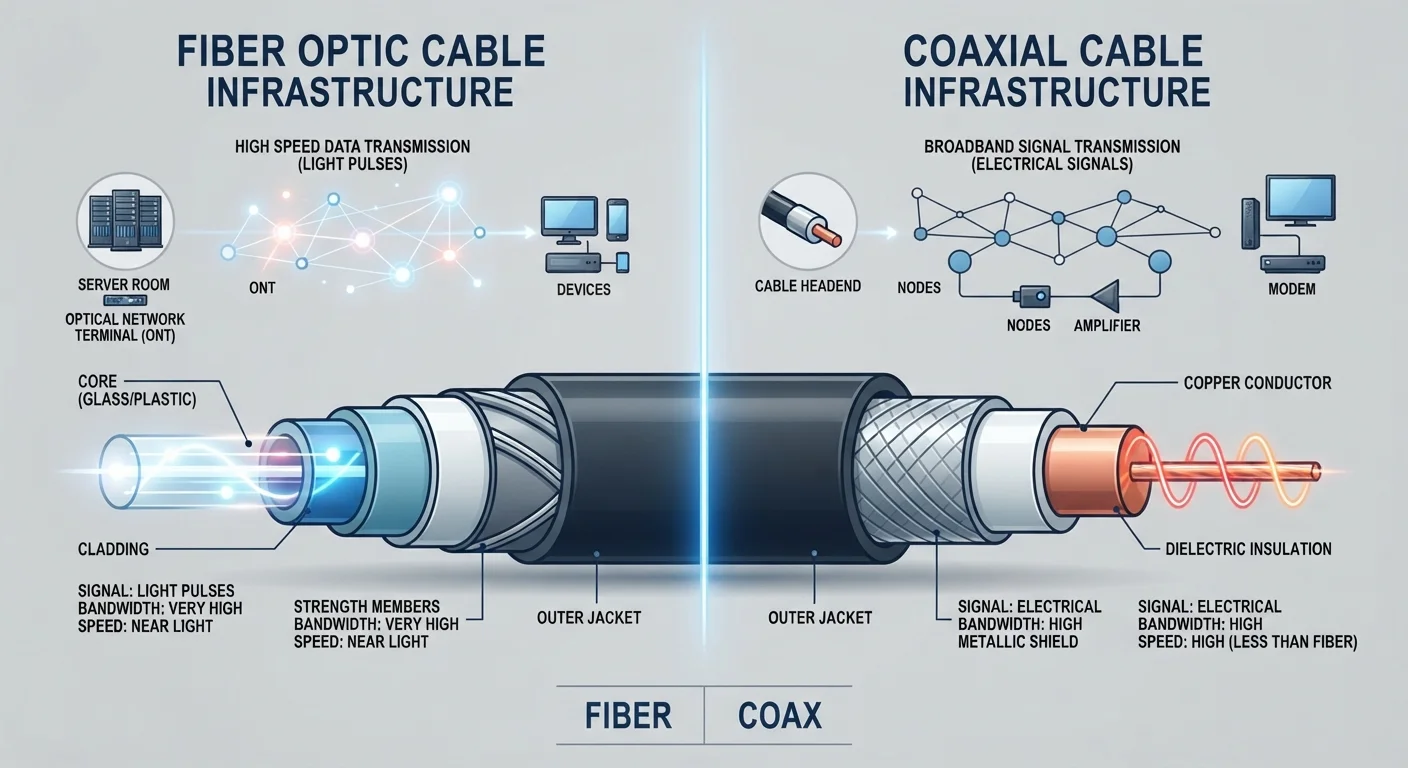
The most fundamental difference between fiber and cable internet is the physical medium carrying your data - and that distinction drives nearly every other difference between the two.
Fiber optic internet transmits data as pulses of light through ultra-thin strands of glass or plastic. Because light can travel long distances with minimal signal degradation, fiber maintains consistent performance across the length of the connection.
Cable internet uses the same coaxial copper lines originally built for cable television. Data travels as electrical signals, which degrade more over distance and are more susceptible to interference than light signals. Most cable providers have upgraded to a standard called DOCSIS (Data Over Cable Service Interface Specification) to improve performance, but the underlying infrastructure is still shared copper.
This infrastructure difference matters in practical terms. Because cable lines were designed to deliver TV signals to many homes simultaneously, they function as a shared medium - meaning your connection is pooled with neighbors on the same local segment. Fiber runs, especially in newer deployments, more commonly offer dedicated or near-dedicated paths to individual homes. For a deeper look at what shared infrastructure means day to day, see this explanation of shared vs. dedicated connections.
| Criterion | Fiber Internet | Cable Internet |
|---|---|---|
| Signal medium | Light through glass fiber | Electrical signal through coaxial copper |
| Upload speed | Often symmetrical with download | Typically much slower than download |
| Download speed potential | Up to 1 Gbps or more | Up to 1 Gbps on upgraded lines |
| Latency | Generally lower | Generally higher; can spike at peak hours |
| Shared infrastructure | Often dedicated per home | Shared with neighborhood segment |
| US availability | Limited; mainly urban/suburban | Widely available across most US addresses |
| Infrastructure age | Newer deployments | Legacy lines, progressively upgraded |
Speed, Latency, and Real-World Performance
On paper, both technologies can advertise high download speeds - sometimes exceeding 1 Gbps (gigabit per second). But the numbers on a plan brochure don't tell the whole story.
Upload speed is where the two diverge most sharply. Cable plans typically offer asymmetrical speeds: download speeds are considerably faster than upload speeds. A cable plan advertising 500 Mbps download might only offer 20-50 Mbps upload. Fiber plans commonly offer symmetrical speeds - matching upload and download - which matters significantly for video conferencing, cloud storage syncing, and remote work workflows.
Latency (the delay between sending a request and receiving a response) also tends to be lower on fiber. Lower latency improves the experience of real-time applications like video calls and online gaming. Cable latency is generally acceptable for most uses, but it can spike during peak hours when shared bandwidth is congested.
~43%
US homes with fiber access
According to FCC broadband data, fiber-to-the-home availability reached roughly 43% of US housing units as of recent reporting cycles - leaving the majority still without the option.
~20-50 Mbps
Typical cable upload speed
Even on higher-tier cable plans, upload speeds frequently fall in this range - a notable constraint compared to fiber's symmetrical offerings.
It's worth noting that advertised speeds aren't always what you experience at home - your router, in-home wiring, and distance from the provider's node all play a role. For common misconceptions about what speed numbers actually mean, this breakdown of internet speed myths is a useful read.
Availability and Practical Access
This is where fiber's technical advantages run into a real-world limitation: availability. Fiber requires entirely new infrastructure to be laid, which is expensive and time-consuming. As a result, fiber deployment has concentrated heavily in urban areas and select suburbs, while large portions of rural and smaller-market America still lack access to it.
Cable, by contrast, benefits from decades of existing coaxial infrastructure that already reaches the vast majority of US homes. For many households, cable isn't just the more convenient choice - it's the only broadband option available short of fixed wireless or satellite. If you're weighing options in a less-densely populated area, a comparison of fixed wireless and fiber for rural households may be more relevant to your situation.
Before assuming either technology is available at your address, it's worth checking directly with providers or using the FCC's broadband map, which lists reported coverage by address. Self-reported provider data has known accuracy issues, so ground-truthing with neighbors or local community groups can help confirm what's genuinely available.
Cable also has a longer track record, meaning technicians and equipment support are widely available. Fiber, while growing, may have fewer local service options in some markets - a practical consideration if reliability and fast repair times matter to your household.
If you're also considering older technologies, a comparison of DSL and cable internet may help round out your understanding of the full broadband landscape.
The content on this site is provided for informational purposes only and should not be considered a substitute for professional advice. While we strive to provide accurate and up-to-date information, we make no guarantees regarding its completeness or accuracy. Always consult a qualified professional for advice specific to your circumstances before making any decisions