

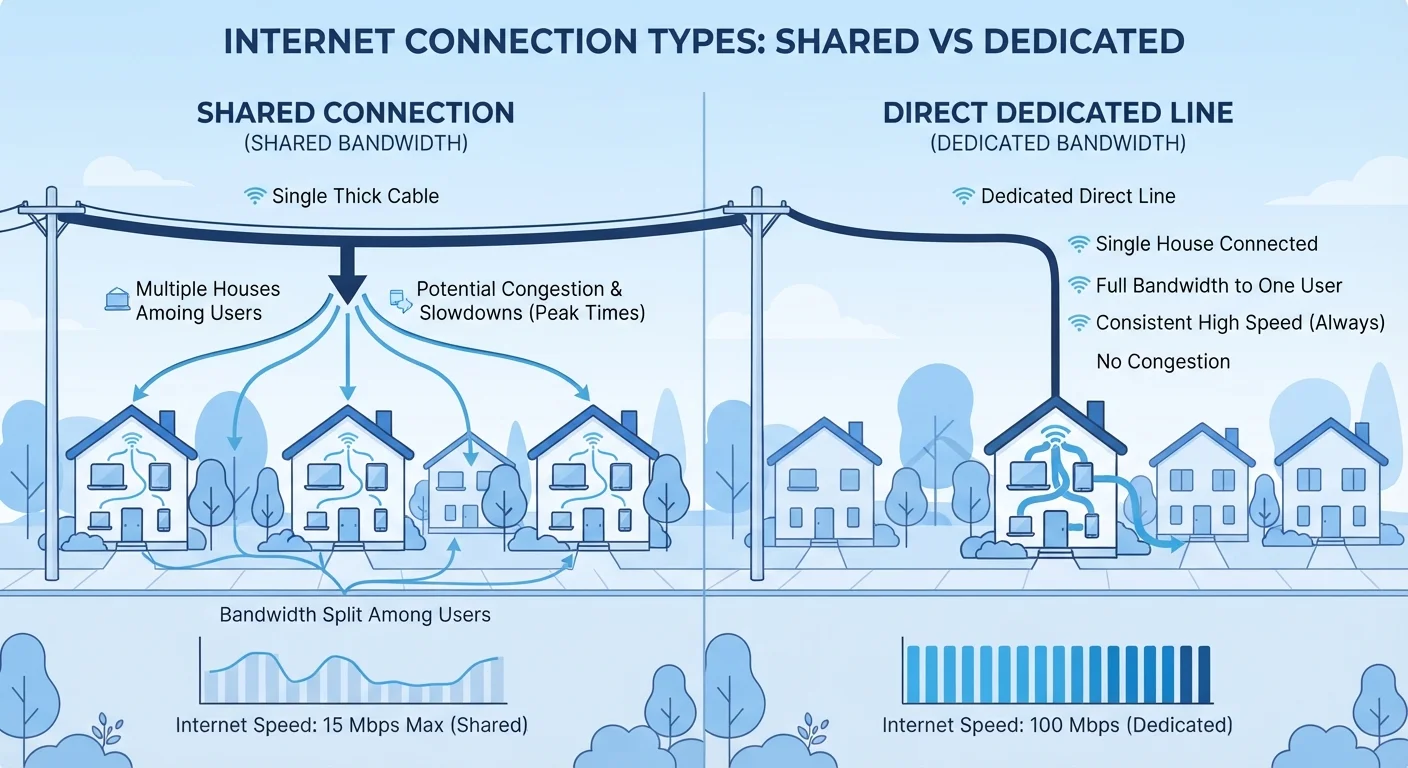
How Shared Internet Infrastructure Actually Works
When you subscribe to a home internet plan, you're almost never getting a private pipe running exclusively from your house to the internet. Instead, your ISP runs a single high-capacity line through your neighborhood - think of it as a main water pipe - and each home taps into it. The total available bandwidth on that segment is divided among all the active subscribers connected to it.
Cable internet, which remains one of the most widely used residential technologies in the US, is built on this shared model. A neighborhood node might serve dozens to hundreds of homes. When few people are online, each household can draw speeds close to what their plan advertises. When everyone is streaming simultaneously on a weekday evening, that shared pool shrinks for everyone.
DSL and cable both use legacy infrastructure but handle sharing differently. DSL runs over your home's existing phone line, which gives it a dedicated local loop, but upstream aggregation is still shared. The practical result: peak-hour slowdowns are a common experience regardless of which of these technologies your household uses.
~88%
US homes with access to cable or fiber broadband
According to FCC broadband deployment data, the vast majority of US households have access to shared-infrastructure cable or fiber services.
30-50%
Typical peak-hour speed reduction on cable networks
Industry analyses and FCC Measuring Broadband America reports have documented significant speed drops on cable networks during evening peak periods.
5-10x
Cost premium for dedicated business internet
Dedicated Internet Access circuits are generally priced several times higher than comparable residential plans, reflecting exclusive infrastructure costs.
What Dedicated Internet Access Looks Like
A dedicated internet connection - sometimes called Dedicated Internet Access, or DIA - means your household or business has an exclusive circuit that isn't shared with anyone else. No matter what your neighbors are doing online, your available bandwidth stays constant.
This architecture is standard for commercial customers: hospitals, large offices, and businesses that depend on internet reliability for operations. It's priced to reflect the infrastructure cost of running point-to-point lines, which is why you'll typically see DIA plans cost significantly more than residential tiers.
Fiber-to-the-home (FTTH) services frequently come closer to dedicated performance than cable does - not always because the circuit is literally exclusive, but because fiber networks are often engineered with far more capacity per subscriber. The result is that congestion, while still possible, tends to be less pronounced. Fiber and cable internet work very differently at the infrastructure level, and that gap shows up most clearly during peak hours.
“The gap between advertised speeds and real-world performance is largely a story about how networks are engineered to handle simultaneous users - not about the raw capacity any single provider claims to offer.”
— FCC Measuring Broadband America Program, Annual broadband performance reporting initiative
What This Means for Your Household Day to Day
Understanding the shared versus dedicated distinction reframes how you interpret your internet experience. That 8 p.m. slowdown isn't necessarily a sign that your plan is inadequate or that your router needs replacing - it may simply reflect how your provider's local network is loaded. Common myths about internet speeds often cause households to overspend chasing higher plan tiers when the real bottleneck is shared infrastructure.
A practical step: run speed tests at different times of day over several days. Tools like the FCC's Measuring Broadband America program or ISP-independent speed test services can give you a clearer picture. If daytime speeds match your advertised plan but evening speeds fall well short, congestion on a shared node is the most likely explanation.
For most households, the answer isn't to seek out expensive dedicated access - it's to understand the limits of shared service and make decisions accordingly. If you work from home and require highly consistent upload speeds for video calls, it may be worth asking your provider about business tiers or exploring whether fiber is available in your area. For general streaming and browsing, a well-provisioned shared connection is typically sufficient. Rural households comparing fixed wireless and fiber face this same trade-off with fewer options to choose from.
Frequently Asked Questions
Evening slowdowns are a classic sign of shared infrastructure congestion. When many households in your area stream, game, or video call at the same time, they all draw from the same pool of bandwidth. This is sometimes called the 'neighborhood effect,' and it's built into how most residential cable and DSL networks work.
Not automatically. Fiber-to-the-home (FTTH) networks are often engineered with more capacity per user, which reduces congestion compared to cable. However, some fiber deployments still use shared segments. The key is how much bandwidth is provisioned per user on your provider's local node, which varies by ISP and location.
Dedicated internet access (DIA) is available, but it's typically marketed as a business-grade service and priced accordingly - often several times more expensive than standard residential plans. For most households, the performance improvement over a well-provisioned shared connection may not justify the cost.
Run an internet speed test at different times of day - midday versus 8 p.m. on a weekday is a useful comparison. If your speeds drop significantly in the evening but recover during off-peak hours, shared network congestion is likely the cause rather than a problem with your router or modem.
DSL uses your home's dedicated phone line for the last stretch to your home, which reduces some local contention. However, aggregation points further upstream are still shared. The experience can vary widely depending on your distance from the provider's equipment and how many users share upstream capacity.
The content on this site is provided for informational purposes only and should not be considered a substitute for professional advice. While we strive to provide accurate and up-to-date information, we make no guarantees regarding its completeness or accuracy. Always consult a qualified professional for advice specific to your circumstances before making any decisions