

The Infrastructure Behind the Map
When you search whether internet is available at your address, you're querying a database - not a live test of physical infrastructure. Broadband availability in the U.S. is determined by what ISPs have actually built: coaxial cable lines, fiber optic strands, DSL copper loops, fixed wireless towers, or satellite footprint. None of that infrastructure is uniform, and it doesn't follow neat geographic boundaries.
Deployment decisions are largely economic. ISPs invest in areas where the density of potential customers justifies the cost of building or upgrading infrastructure. That's why suburban neighborhoods often have multiple providers while rural stretches or low-income urban blocks sometimes have one - or none. Understanding that availability is an infrastructure question, not just a geographic one, is the first step to decoding what your options really are. For more on how different technologies reach your home, see our plain-language guide to internet types.
~14.5M
U.S. households without broadband access
The FCC's broadband data has estimated this range, though independent researchers argue the true number is likely higher due to map inaccuracies.
Census block
Historical unit of ISP coverage reporting
Under the prior reporting system, a single serviceable location in a census block could cause the entire block to be classified as covered - inflating national coverage statistics.
$42.45B
BEAD program funding for broadband expansion
The Broadband Equity, Access, and Deployment program allocated this amount through the Infrastructure Investment and Jobs Act, with eligibility tied directly to federal coverage map data.
Why Coverage Maps Are Misleading
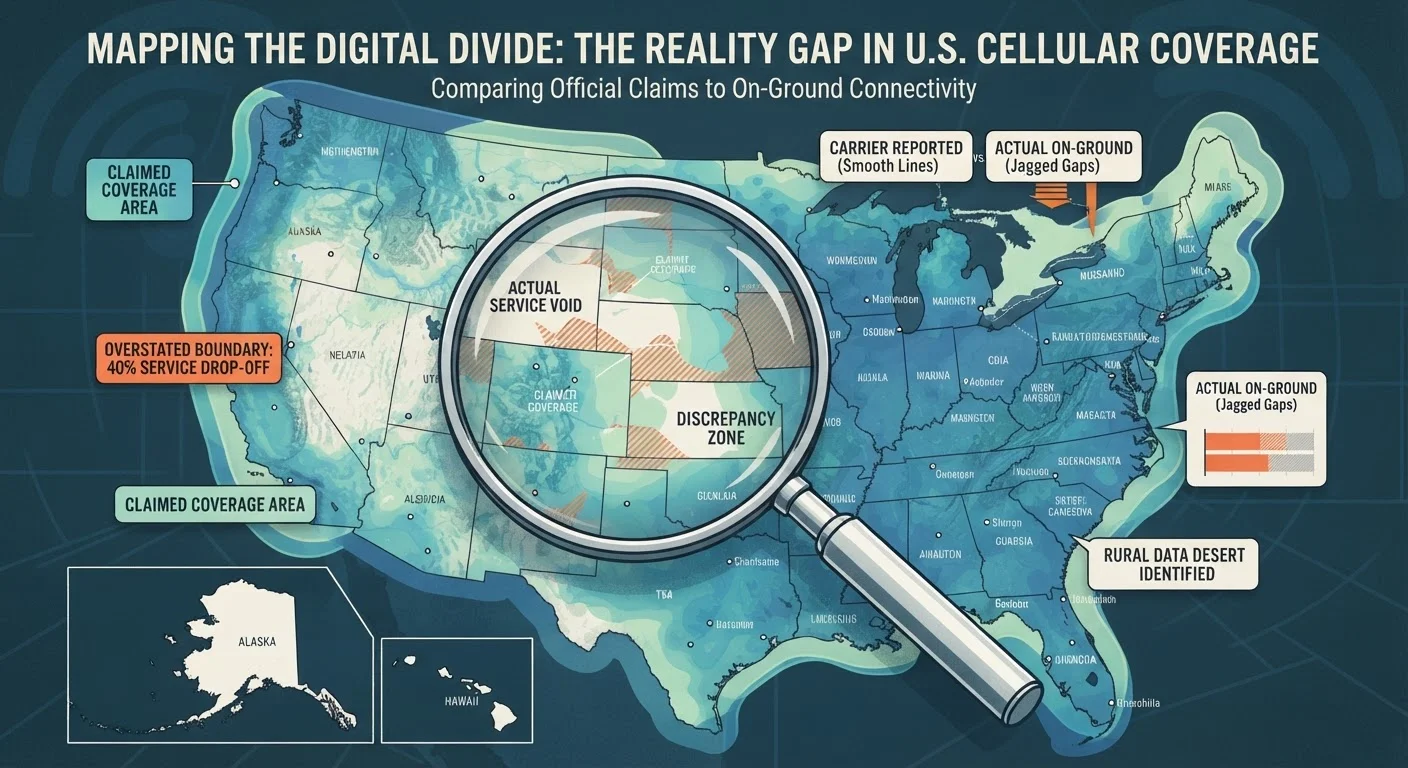
Federal and ISP-published coverage maps have a known flaw baked into how they're built: ISPs self-report their service areas, historically at the census-block level. If a single household in a census block can receive service, the entire block - which can span dozens of homes - may be shaded as covered. This methodology inflates coverage numbers significantly.
The FCC's National Broadband Map, updated with more recent data collection methods, has introduced address-level reporting and a formal challenge process that lets households dispute incorrect data for their location. That's a meaningful improvement, but self-reported data from carriers still forms the foundation of the map. ISPs have little regulatory incentive to underreport, and verification has historically been inconsistent.
The practical result: a household might appear on every official map as having fiber or cable access, yet the nearest termination point is two streets away and extension has never been funded.
How the FCC Challenge Process Works
If your address is incorrectly shown as having broadband service on the FCC National Broadband Map, you can submit a challenge at broadbandmap.fcc.gov. You'll need to provide your address and indicate the type of service shown versus what's actually available. Accepted challenges update the map and can affect which areas qualify for federal funding - making this more than just a bureaucratic exercise.
How to Actually Check Your Real Options
Rather than relying on a single source, use a layered approach:
- FCC National Broadband Map: Visit broadbandmap.fcc.gov and enter your exact address. If the data looks wrong, file a location challenge - it feeds into federal funding decisions for underserved areas.
- ISP address checkers: Each carrier's website has a serviceability tool. These are more granular than national maps and can surface installation-level detail, though they're still self-reported.
- Neighbors and local forums: What your neighbors actually use - and how reliably - is often the most honest signal. Local subreddits, neighborhood apps, and community Facebook groups frequently surface ISP performance data that no map captures.
- Municipal broadband offices: Some counties and cities maintain their own connectivity databases, especially in regions that have received federal broadband expansion funding.
Before committing to any provider, it's worth reviewing questions to ask before signing an internet plan - coverage is only the first variable.
The Rural and Urban Underserved Gap
The availability gap is most visible in two places: rural areas and lower-income urban neighborhoods. Rural locations are underserved because infrastructure build-out costs are high relative to the number of customers. Fixed wireless internet has expanded rural options meaningfully in recent years, and for some households it competes well with wired alternatives - see how fixed wireless compares to fiber for rural households for a side-by-side look.
Urban underservice is less visible but well-documented. Dense cities often show high coverage on maps because wealthy or commercial districts are well-served. But deployment within the same city can be uneven, with lower-income residential blocks receiving slower, older infrastructure or fewer competitive options.
Federal programs like the Broadband Equity, Access, and Deployment (BEAD) program are directing funding specifically at these gaps, with states currently in the process of identifying eligible locations. Coverage maps directly influence which areas qualify for those funds - which is exactly why challenging inaccurate map data matters beyond personal convenience.
A family in a semi-rural county sees their address marked as having cable internet on the FCC map. When they call the ISP, they're told the nearest node is 1.2 miles away and extension to their street isn't planned.
A renter in a major city finds three ISPs listed as available on carrier websites, but when she calls each one, only one actually services her building - the others require easement agreements the landlord hasn't signed.
A homeowner files a location challenge on the FCC broadband map after noticing his address is listed as having fiber service. The county uses corrected data to qualify the area for a federal broadband grant.
Making a Decision With Incomplete Information
Even after doing your research, you may not have a clean picture of what's available. That's normal - the U.S. broadband landscape is genuinely fragmented. The practical approach is to narrow your real options to two or three candidates, then evaluate them on reliability and contract terms rather than headline speeds alone.
Once you've confirmed service availability, your ISP's equipment and your home network setup will shape the experience as much as the plan itself. Getting the most from your ISP's router is a step many households skip but often makes a noticeable difference. And before you sign anything, understand what you're agreeing to - ISP contracts contain clauses around pricing, data, and cancellation that are worth reading carefully.
Coverage maps will keep improving as federal data requirements tighten, but for now, ground-level verification remains the most reliable tool you have.
Frequently Asked Questions
ISPs historically report coverage at the census-block level, meaning if one home in a block has service, the entire block may be marked as covered. Your specific address might sit at the edge of infrastructure that hasn't been extended to you. Always request a formal serviceability check directly with the ISP.
The FCC's National Broadband Map aggregates availability data that ISPs self-report. It has improved with recent updates and now allows individual households to file challenges if the data is wrong for their address. It's a useful starting point but should not be treated as ground truth.
Start with the FCC broadband map, then cross-check with each ISP's address-level service finder. Ask neighbors what they use and whether it's reliable. Local community forums and municipal broadband offices can also surface options that don't appear in national databases.
Not always. Dense urban areas often have more ISP competition, but low-income urban neighborhoods can be underserved due to the economics of infrastructure deployment. Multiple providers may be mapped to an area while only one or two actually serve certain blocks.
Satellite internet has become a more viable option - especially low-earth-orbit services - but it still involves latency trade-offs, weather sensitivity, and data management considerations. It's worth comparing with fixed wireless if both are available in your area.
The content on this site is provided for informational purposes only and should not be considered a substitute for professional advice. While we strive to provide accurate and up-to-date information, we make no guarantees regarding its completeness or accuracy. Always consult a qualified professional for advice specific to your circumstances before making any decisions