

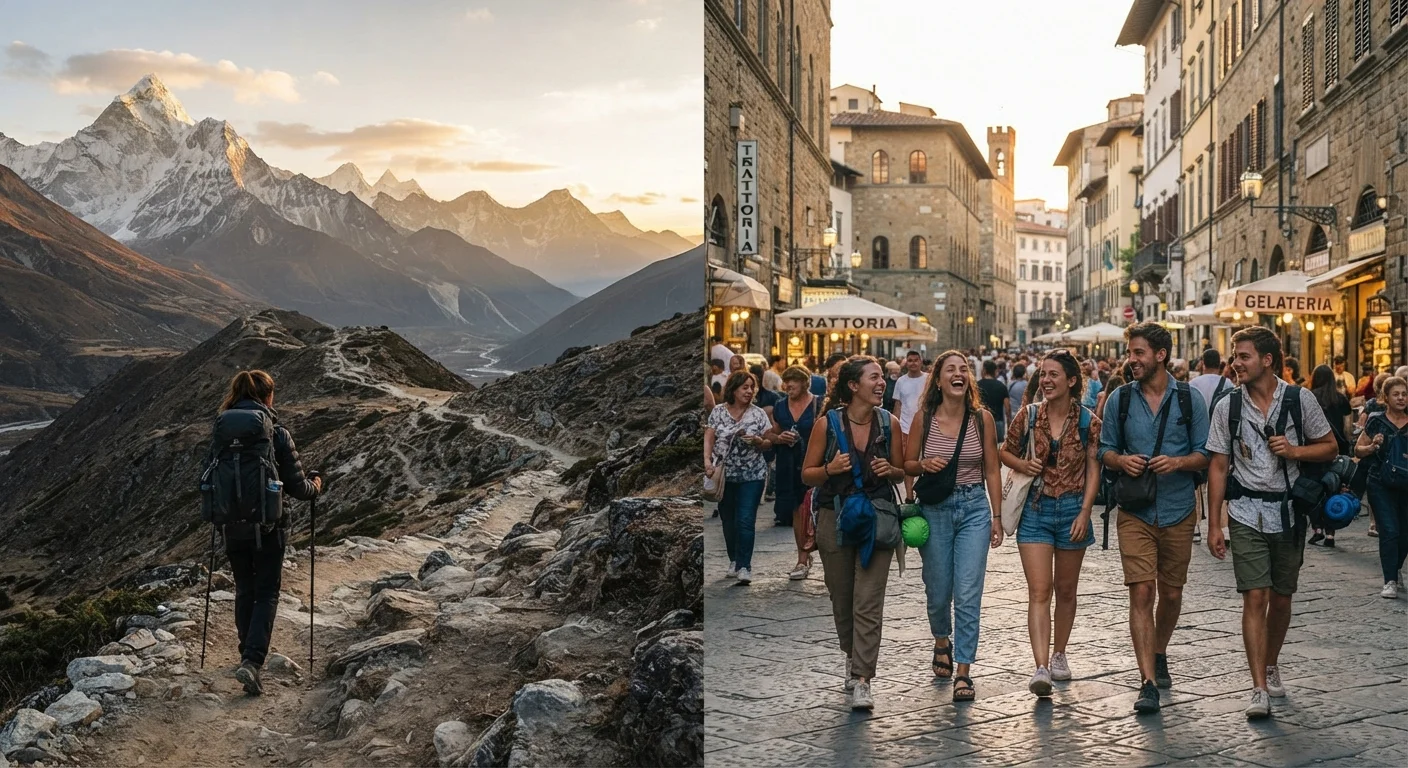
Option A
Solo Travel
The self-reliant, high-awareness approach to seeing the world.
Best for: Independent travelers who want full control over their itinerary and are prepared to manage all safety decisions personally.
Option B
Group Travel
The shared-responsibility model with built-in social safety nets.
Best for: Travelers who benefit from collective decision-making, shared vigilance, and the deterrent effect of traveling in numbers.
The Core Safety Difference: Who's Watching Your Back?
The most fundamental safety distinction between solo and group travel isn't destination or activity - it's accountability. When you travel alone, every decision, every risk assessment, and every response to a problem lands entirely on you. When you travel with others, those responsibilities are shared, whether formally or informally.
Solo travelers must maintain a near-constant state of situational awareness. That means knowing your surroundings, keeping track of your belongings, and having a clear plan for what to do if something goes wrong - before it does. The upside is control: you move at your own pace, you trust your own instincts, and you're not waiting for group consensus in a moment that demands quick judgment.
Group travelers benefit from distributed attention. If one person notices something feels off in a neighborhood, they can raise it. If someone is targeted by a scammer, others can intervene or de-escalate. This collective vigilance is a genuine protective advantage - but it can also breed complacency. When everyone assumes someone else is paying attention, gaps can form. For a deeper look at what each style demands before the trip even starts, see our guide on what solo and group travel each demand from a planner.
| Criterion | Solo Travel | Group Travel |
|---|---|---|
| Safety accountability | Entirely individual | Shared across group |
| Situational awareness demand | High - constant personal vigilance | Distributed - but risk of complacency |
| Visibility as a target | Higher in unfamiliar settings | Lower, but groups attract attention |
| Emergency response | Sole responder; slower access to help | Companions can assist immediately |
| Decision-making speed | Fast - no coordination needed | Slower - consensus required |
| Coordination risk | None | Separation and communication failures |
| Ability to blend in | Easier with deliberate effort | Harder; groups are inherently visible |
| Medical emergency support | Relies on strangers or services | Immediate peer support available |
Risk Profiles: Where Each Style Is More Vulnerable
Solo travelers are generally considered more visible targets for opportunistic crime - pickpocketing, scams, and unsolicited approaches. A person traveling alone may appear less confident in unfamiliar settings, and there's no one to step in if a situation escalates. This doesn't mean solo travel is inherently dangerous, but it does mean the margin for inattention is smaller.
Groups face a different category of vulnerabilities. Coordination failures - losing a member in a crowd, disagreements about routes, or one person wandering off - can create genuine safety incidents. In emergencies, diffused decision-making can slow response. Larger groups also attract more attention, which in some environments can be a liability rather than an asset.
~70%
Solo travelers who are women
Survey data from multiple travel industry sources consistently shows women make up the majority of solo travelers globally, a demographic that often requires additional safety planning in certain destinations.
1 in 3
Travelers who experience theft or scams abroad
Estimates from travel insurance claims and consumer surveys suggest roughly a third of international travelers encounter some form of financial theft or scam during their trips.
72 hours
Critical window for emergency response planning
Travel safety organizations generally recommend that all travelers - solo or group - have a documented emergency contact and check-in plan covering at minimum the first 72 hours of an unfamiliar trip.
Transportation is one area where both styles carry overlapping risks that deserve attention. Whether alone or in a group, using unlicensed taxis, poorly maintained transport, or unfamiliar transit systems carries real danger. Our breakdown of transportation safety across different modes abroad covers what to watch for regardless of your travel style.
It's also worth questioning assumptions. Many travelers hold misconceptions about what makes either style safer. For example, the idea that hotels are automatically safe, or that a group is always a deterrent - these are worth scrutinizing. Our piece on common travel safety myths Americans believe addresses several of these directly.
Safety Habits That Apply to Both - and Where They Diverge
Certain safety fundamentals don't change based on whether you're alone or in a group. Registering with the U.S. State Department's STEP (Smart Traveler Enrollment Program) before international trips, carrying photocopies of key documents, purchasing travel insurance that covers medical evacuation, and researching your destination's current conditions are non-negotiable practices for any traveler.
Where solo and group travelers diverge is in implementation. Solo travelers should always have a trusted contact at home who knows their itinerary - with check-in intervals established in advance. They should be especially deliberate about how and where they share their plans with strangers. Consider how you pay for things, too: the trade-offs between carrying cash and cards can affect your exposure to financial theft differently depending on whether you're alone or have companions who can assist.
The STEP Program: A Simple Solo Safety Layer
The U.S. State Department's Smart Traveler Enrollment Program (STEP) is a free service that allows American citizens traveling abroad to register their trip with the nearest U.S. embassy or consulate. In an emergency - natural disaster, civil unrest, or a personal crisis - registration makes it easier for the embassy to locate and assist you. Solo travelers especially benefit from enrollment, since there's no travel companion to report their situation. Enrollment takes only a few minutes at travel.state.gov.
Group travelers should designate a point person for emergencies - someone who holds backup contact numbers, knows the group's insurance details, and has a plan for what happens if the group becomes separated. Groups also benefit from agreeing in advance on a rally point and communication protocol for crowded or unfamiliar environments. These aren't formalities; they're the difference between a disruption and a crisis.
For anyone building a fuller picture of safe travel habits, our foundational travel safety guide provides a structured starting point applicable to both travel styles.
This article provides general travel safety information for educational purposes. Always verify entry requirements, travel advisories, and local conditions with official government sources before traveling. This is not a substitute for professional security or legal advice.
The content on this site is provided for informational purposes only and should not be considered a substitute for professional advice. While we strive to provide accurate and up-to-date information, we make no guarantees regarding its completeness or accuracy. Always consult a qualified professional for advice specific to your circumstances before making any decisions