

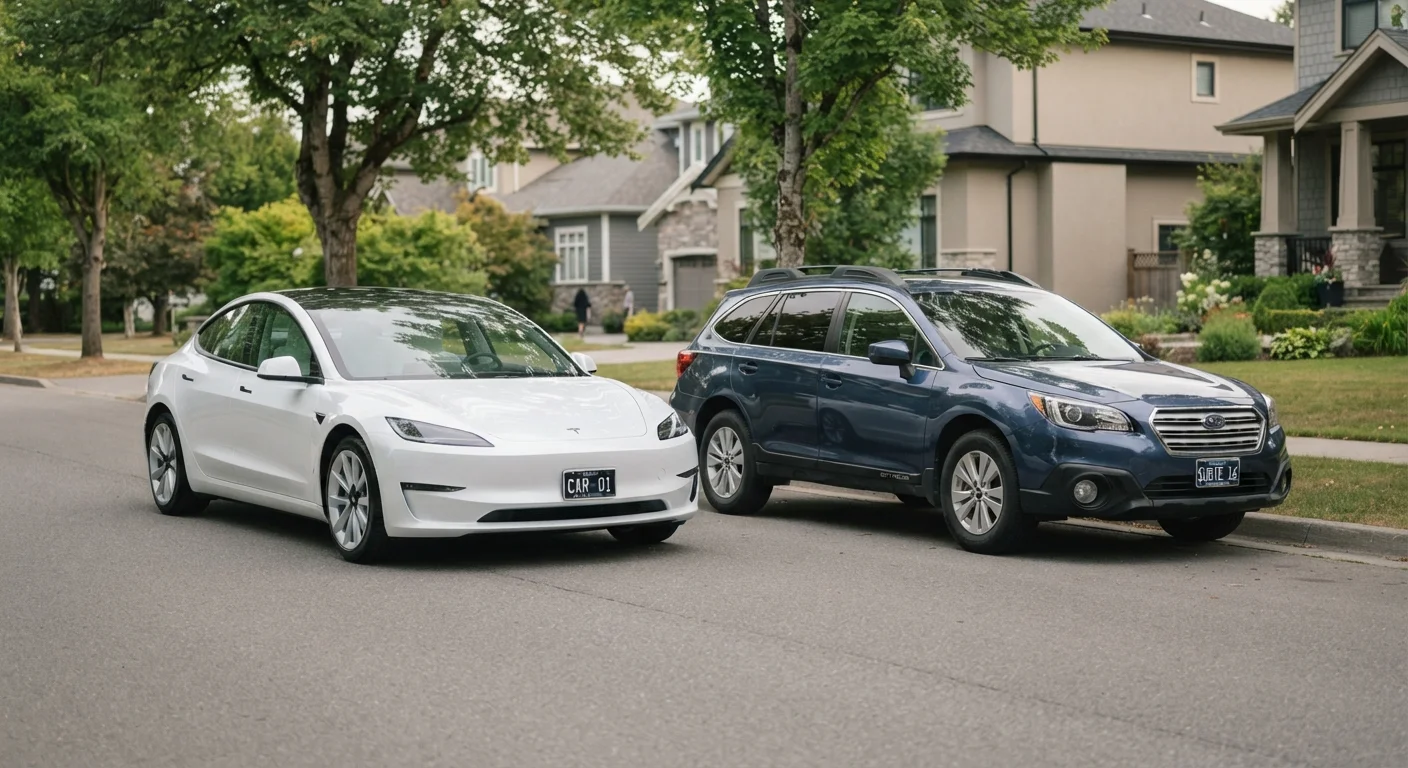
Option A
New Car
The full-warranty, latest-tech, zero-miles option.
Best for: Buyers who want predictable ownership costs, the latest safety features, and manufacturer financing incentives.
Option B
Used Car
The depreciation-adjusted, lower-entry-cost alternative.
Best for: Buyers who want to avoid the steepest depreciation hit and are comfortable with some ownership history.
Depreciation: The Number That Changes Everything
Depreciation is the largest single cost most vehicle owners never consciously pay - because it doesn't show up as a monthly bill. A new car typically loses a substantial share of its value within the first one to three years of ownership. The exact percentage varies by segment and market conditions, but the pattern is well-established: the original buyer absorbs the steepest drop.
When you buy a used vehicle that's already three to five years old, that initial depreciation curve has largely flattened. You're paying a price that already reflects that loss, which means your own depreciation exposure going forward is considerably smaller.
This is why many financial analysts describe depreciation as one of the strongest arguments for buying used - not because used cars are without cost, but because someone else has already paid the most expensive portion of the vehicle's value decline.
| Criterion | New Car | Used Car |
|---|---|---|
| Depreciation exposure | Absorbs steepest initial drop | First-owner drop already priced in |
| Purchase price | Higher | Lower (varies widely) |
| Warranty coverage | Full manufacturer warranty | Varies; may be expired or limited |
| Financing rates | Often lower; promo rates available | Generally higher rates |
| Vehicle history | Fully known - you're first owner | Requires research and verification |
| Technology & safety features | Latest generation | Depends on model year |
| Insurance costs | Typically higher | Often lower on older models |
| Selection | Current models and trims only | Broader range of years and prices |
Warranties and Reliability: What Coverage You Actually Get
New vehicles come with manufacturer warranties - typically a bumper-to-bumper coverage period and a longer powertrain warranty - providing a structured safety net against defects and mechanical failures during the early years of ownership. The terms vary by automaker, so it's worth reading what's actually covered rather than assuming all warranties are equivalent.
Used vehicles are a more varied picture. A car just outside its factory warranty window carries different risk than one still within that coverage period. Certified Pre-Owned (CPO) programs represent a middle ground worth understanding: they extend coverage and include multi-point inspections, though the specifics differ significantly between automakers. Our guide on certified pre-owned vs. standard used breaks down what those programs actually cover and when the premium changes the math.
Reliability, it's worth noting, is not synonymous with age. Many vehicles manufactured in the last decade hold up well into high mileage with routine maintenance. A used car with documented service history and a clean pre-purchase inspection from a trusted mechanic can be every bit as dependable as a new one for most drivers.
~20%
Typical new car value loss in year one
Industry estimates suggest new vehicles can lose roughly 15-25% of their value in the first 12 months, depending on make, model, and market conditions.
3-5 yrs
Optimal used-car age for value vs. reliability
Consumer research broadly suggests vehicles in this age range have cleared the steepest depreciation while often retaining strong mechanical reliability.
~60%
Share of U.S. vehicle sales that are used
Used vehicles consistently outsell new ones in the U.S. market, reflecting both affordability considerations and the breadth of available inventory.
Financing: Lower Rates vs. Lower Principal
Automakers frequently offer promotional financing rates - sometimes as low as zero percent - on new vehicles to stimulate sales. If you qualify for those offers, the financing cost advantage can be real and meaningful. However, these promotions typically require strong credit, and they apply to the full (higher) purchase price of a new vehicle.
Used car loans generally carry higher interest rates than new car loans, reflecting the lender's assessment of collateral value and risk. But the lower purchase price of a used vehicle often means the total interest paid over the life of the loan is still competitive or lower, even at a slightly higher rate.
The right comparison isn't just the interest rate - it's the total cost of the loan across its full term, including the price difference between the vehicles. Our article on financing through a dealership vs. your own bank explains how to compare loan offers clearly, regardless of whether you're buying new or used.
Down payment requirements, loan-to-value ratios, and the risk of being "underwater" on a loan - owing more than the car is worth - are all factors that play out differently depending on which path you choose.
Practical Considerations Before You Decide
Beyond the financial mechanics, a few practical realities are worth weighing. New cars give you complete certainty about the vehicle's history - no prior accidents, no unknown maintenance gaps, no previous driver habits baked in. Used cars require more due diligence: a vehicle history report, a pre-purchase inspection, and ideally some understanding of where the car came from. Our guide on where used cars actually come from covers how the buying channel affects risk and pricing.
Insurance costs also differ. New vehicles often cost more to insure due to higher replacement values and loan requirements for comprehensive coverage. Used vehicles, particularly older ones, may carry lower premiums - though this varies by vehicle type, driver profile, and insurer.
If you already own a vehicle, understanding what it's worth before you shop affects your budget on either path. Common misconceptions about trade-in values can meaningfully affect the deal you walk away with - a topic covered in our piece on trade-in myths that cost buyers real money.
Finally, if you're leaning toward used and are preparing to inspect a vehicle in person, knowing the right questions to ask before the test drive puts you in a much stronger position. See our questions worth asking before a used car test drive for a practical starting point.
Dealer Add-Ons Affect Both Paths
Whether you buy new or used from a dealership, the finance-and-insurance office will likely present add-on products - extended warranties, paint protection, GAP insurance, and others. These products vary significantly in value and are generally negotiable. Understanding what each one actually does before signing is worth the extra time. Our article on dealer add-ons and what they cover walks through the most common offerings.
The content on this site is provided for informational purposes only and should not be considered a substitute for professional advice. While we strive to provide accurate and up-to-date information, we make no guarantees regarding its completeness or accuracy. Always consult a qualified professional for advice specific to your circumstances before making any decisions