

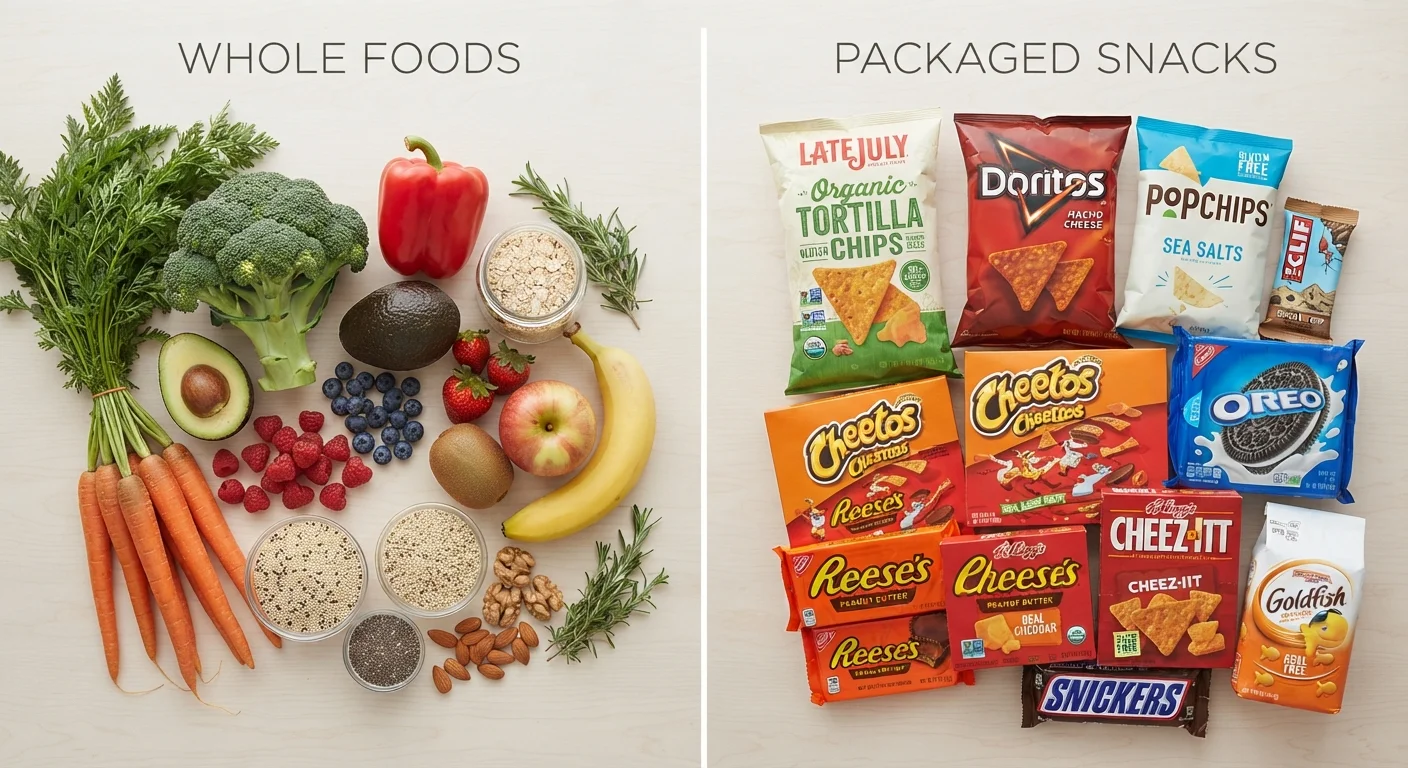
Option A
Whole Foods
Foods in their natural, minimally altered state.
Best for: People seeking maximum nutrient density, fiber, and minimal added ingredients in their everyday diet.
Option B
Processed Foods
Foods changed from their original form through industrial or culinary methods.
Best for: Anyone balancing convenience and shelf life, though the level of processing varies widely in nutritional impact.
Defining the Terms: What Makes a Food 'Whole' or 'Processed'?
The word whole food refers to any food consumed in - or very close to - its natural state. Think an apple, a handful of walnuts, a raw sweet potato, or a plain chicken breast. The key characteristic is that nothing significant has been added or removed. These foods retain their full complement of fiber, vitamins, minerals, and, in many cases, beneficial plant compounds called phytochemicals.
Processed food is a broader category than most people realize. At its most basic level, any food that has been altered from its natural state through mechanical, chemical, or thermal methods counts as processed. That definition technically includes sliced bread, pasteurized milk, canned tomatoes, and frozen peas - foods most nutrition professionals do not consider problematic.
To make this more useful, researchers and public health bodies have developed classification frameworks. The most widely cited is the NOVA system, which organizes foods into four groups ranging from unprocessed or minimally processed (Group 1) to ultra-processed formulations (Group 4). Understanding this spectrum is more valuable than applying a simple whole-versus-processed binary.
For a broader grounding in how nutrients, food groups, and eating patterns connect, see our introduction to nutrition science.
The Processing Spectrum: From Minimal to Ultra-Processed
Not all processing is equal, and treating it as such can lead to unnecessarily restrictive or confusing eating patterns. A helpful way to think about this is as a continuum:
- Minimally processed: Roasted nuts, washed salad greens, plain frozen vegetables, pasteurized milk. Nutritional profiles remain largely intact.
- Processed culinary ingredients: Olive oil, flour, salt, vinegar. Used to prepare food rather than eaten alone.
- Moderately processed: Canned beans, plain yogurt, cheese, whole-grain bread with short ingredient lists. Generally retain meaningful nutritional value.
- Ultra-processed: Packaged snack foods, many breakfast cereals, flavored instant noodles, and sugary drinks formulated with additives, colorings, emulsifiers, and added sugars well beyond what home cooking requires.
| Criterion | Whole Foods | Ultra-Processed Foods |
|---|---|---|
| Fiber content | Naturally high | Often very low |
| Added sugars | None | Frequently high |
| Sodium | Naturally low | Often elevated |
| Ingredient list length | One ingredient (the food itself) | Long; many additives |
| Micronutrient density | Generally high | Generally low |
| Shelf life | Short (perishable) | Long (preservatives used) |
| Convenience | Requires preparation | Ready to eat |
Research - including large observational studies published in journals such as The BMJ - has associated higher ultra-processed food intake with elevated risks of cardiovascular disease, type 2 diabetes, and certain cancers. However, these associations are observational, meaning they reflect patterns in populations rather than direct cause-and-effect in individuals. Consulting a registered dietitian is the most reliable way to evaluate what dietary adjustments make sense for your specific circumstances.
Learning to read nutrition panels is a practical first step. Our guide on reading a Nutrition Facts label explains how to interpret serving sizes, daily values, and ingredient lists clearly.
How Processing Affects Nutritional Value
Processing can affect food in ways that add or subtract nutritional value, depending on the method and degree involved.
Nutrient losses: Heat, exposure to oxygen, and water-based processing can degrade heat-sensitive vitamins such as vitamin C and certain B vitamins. Refining whole grains into white flour removes the bran and germ, stripping significant fiber, iron, and B vitamins - which is why enrichment (adding some nutrients back) became standard practice.
Nutrient additions: Some processing genuinely improves nutrition. Fortification adds iodine to salt and vitamin D to milk - practices that have contributed to public health improvements. Fermenting dairy into yogurt increases bioavailability of some nutrients and introduces beneficial bacteria.
Additions that reduce nutritional quality: Ultra-processed foods frequently contain high levels of added sugars, sodium, and saturated fats alongside low fiber content. These additions are associated with energy-dense but nutrient-poor dietary patterns. For a closer look at how added and natural sugars compare, see our breakdown of added vs. natural sugars.
Processing and Protein Sources
The protein in a grilled salmon fillet and the protein in a highly processed meat product may look similar on a nutrition label, but the surrounding nutritional context differs significantly. Whole or minimally processed protein sources tend to come with more beneficial nutrients and fewer additives. For a detailed comparison of protein quality across food types, speaking with a registered dietitian can help clarify choices relevant to your dietary needs.
When building meals around protein, the source matters alongside its processing level. Our comparison of animal and plant protein sources can help you weigh the options.
Practical Guidance: Making Informed Food Choices
A dietary pattern does not need to be entirely whole-food-based to support good health. Public health bodies including the USDA and the Dietary Guidelines Advisory Committee emphasize patterns over individual food choices - encouraging more vegetables, fruits, legumes, whole grains, and lean proteins while reducing ultra-processed items high in added sugars and sodium.
57%
Of U.S. adult calorie intake from ultra-processed foods
A study published in BMJ Open (2016) estimated that ultra-processed foods accounted for more than half of total caloric intake in U.S. adults based on nationally representative dietary data.
28g
Daily dietary fiber recommended for most adults
The USDA Dietary Guidelines for Americans recommend approximately 28 grams of fiber per day for a 2,000-calorie diet - a target most Americans fall significantly short of, largely due to low whole food intake.
Here are practical ways to shift your diet toward less-processed options without overhauling everything at once:
- Scan ingredient lists. A shorter list of recognizable ingredients is generally a sign of less processing. Labels with lengthy additive names signal a more processed product. Our article on food label claims worth paying attention to clarifies which terms carry weight.
- Swap strategically. Replace flavored instant oatmeal (high added sugar) with plain rolled oats. Choose canned tomatoes over tomato-based sauces with added sugars and oils.
- Leverage minimally processed convenience foods. Frozen vegetables, plain canned legumes, and unsweetened plain yogurt are processed for practical reasons and remain nutritionally sound choices.
- Cook more from scratch when feasible. Home preparation gives you control over added salt, sugar, and fat - not because processed food is inherently dangerous, but because home cooking naturally tilts toward less ultra-processed ingredients.
This article is for general informational and educational purposes only and does not constitute medical or dietary advice. Speak with a qualified healthcare professional or registered dietitian before making significant changes to your diet, especially if you have an existing health condition.
The content on this site is provided for informational purposes only and should not be considered a substitute for professional advice. While we strive to provide accurate and up-to-date information, we make no guarantees regarding its completeness or accuracy. Always consult a qualified professional for advice specific to your circumstances before making any decisions