

Why Water Leaks Don't Stay Small
The most costly home repairs rarely begin dramatically. A hairline crack in a pipe fitting, a worn wax ring under a toilet, a gap where a roof flashing has lifted - each starts as an almost invisible problem. What makes these situations dangerous is the physics of water itself: it flows toward the lowest point, wicks into porous materials, and evaporates slowly when trapped in enclosed spaces.
Wood, drywall, insulation, and subfloor materials are highly absorbent. Once moisture penetrates these layers, it doesn't simply dry out. It cycles - absorbing during damp periods, partially drying, then re-absorbing - creating cumulative degradation with every cycle. A joint that weeps a tablespoon of water per day may seem trivial, but over three months that totals roughly 2.5 gallons deposited directly into your wall cavity.
This compounding effect is why deferred maintenance is so costly - problems that are inexpensive to fix in week one become structural remediation projects by month six.
10,000 gal
Average annual water wasted by household leaks
According to the U.S. Environmental Protection Agency (EPA), the average American home loses approximately 10,000 gallons per year to leaks - equivalent to 270 loads of laundry.
10%
Homes with leaks wasting 90+ gallons daily
The EPA estimates that roughly 10% of U.S. homes have plumbing leaks severe enough to waste more than 90 gallons of water every day.
24-48 hrs
Time for mold growth to begin after water intrusion
The EPA and CDC note that mold can begin to develop on wet building materials within 24 to 48 hours under typical indoor temperature and humidity conditions.
The Damage Chain: From Drip to Structural Problem
Water damage follows a predictable escalation path. Understanding each stage helps homeowners recognize where they are in that progression - and how urgently they need to act.
Stage 1: Material Saturation
The first effect is absorbed moisture in drywall, wood framing, or insulation. At this stage, damage is often reversible with drying and minor repair if caught quickly.
Stage 2: Mold and Mildew Growth
Mold spores are present in virtually every home environment. They need only moisture, a surface to grow on, and moderate temperature to colonize. Within 24-48 hours of sustained wet conditions, colonies can begin forming inside wall cavities. Mold remediation - especially in large areas - is an expensive, disruptive process that frequently requires licensed contractors.
Stage 3: Structural Deterioration
Wood framing that remains wet long enough begins to soften and lose load-bearing integrity. Subfloor panels delaminate, joists weaken, and in severe cases, structural support elements can fail. At this stage, costs shift from repair to replacement, and the work typically requires permits and professional contractors.
Basement and foundation areas are particularly vulnerable - see our guide to basement moisture sources for a detailed look at how water enters and accumulates in lower levels of the home.
Do a Quick Leak Check Each Season
Every three months, take 10 minutes to visually inspect under sinks, around the base of toilets, and behind your washing machine. Run your hand along supply lines to feel for moisture or mineral buildup. Catching a slow drip at this stage typically costs less than a professional service call - and far less than remediation.
Warning Signs Homeowners Often Overlook
Because leaks frequently occur in concealed spaces, the signals they produce are easy to dismiss. Knowing what to look for - and taking those signals seriously - is the most practical form of early intervention.
- Unexplained water bill increases: A sudden or gradual rise in water usage with no change in household habits is a reliable indicator of an active leak somewhere in the supply system.
- Musty or earthy odors: Mold and mildew produce recognizable smells before they become visible. An odor that persists in a bathroom, basement, or under a sink suggests hidden moisture accumulation.
- Staining on ceilings or walls: Yellow or brown rings are traces left by water that traveled through the structure and evaporated, leaving mineral deposits behind. Stains often indicate an ongoing - not historical - problem.
- Warped, soft, or buckling flooring: Floors adjacent to plumbing fixtures or below bathrooms that feel spongy or have begun to bow are showing subfloor saturation.
- Peeling paint or bubbling drywall: Paint loses adhesion when the substrate behind it is repeatedly wet and drying.
Left unaddressed, these warning signs can begin to affect your home's long-term value - a dynamic explored further in our article on factors that erode home value.
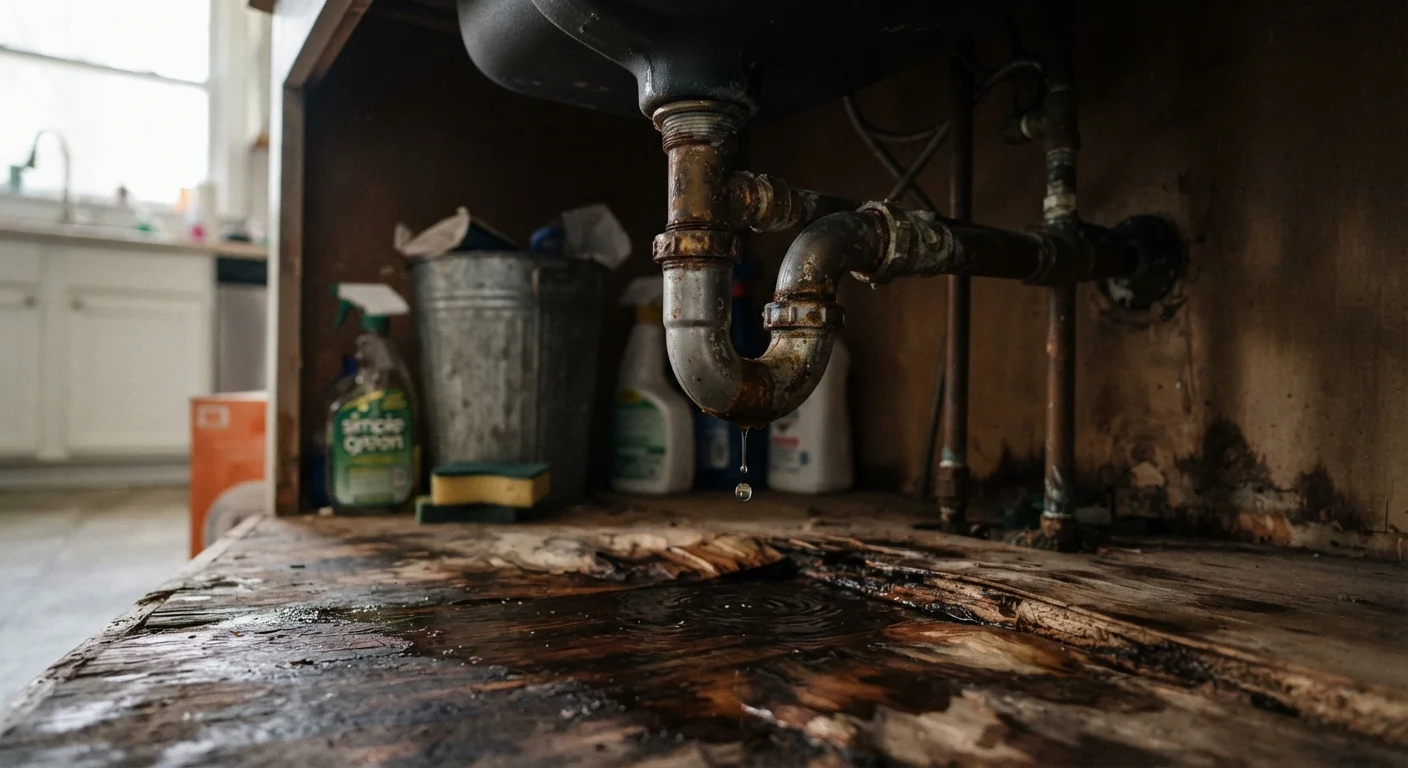
A homeowner notices the cabinet under their kitchen sink occasionally feels slightly damp but assumes condensation is to blame. Six months later, the particleboard cabinet floor has collapsed and the adjacent drywall shows mold.
A slow leak develops where a second-floor bathroom toilet's wax ring seal has degraded. The water travels through the subfloor and appears only as a faint ceiling stain in the room below.
A family returns from a two-week vacation to find that a refrigerator ice-maker supply line had been slowly dripping onto the kitchen floor. The hardwood flooring has buckled across a 40-square-foot area.
Practical Prevention: Catching Leaks Before They Escalate
Prevention is overwhelmingly more cost-effective than remediation. A few consistent habits can intercept most leak scenarios before they reach the structural damage stage.
Conduct annual visual inspections of all accessible plumbing connections - under sinks, behind toilets, around water heaters, and at washing machine hose connections. Look for mineral deposits (white or greenish crust), discoloration, or soft spots in the cabinet floor or surrounding drywall.
Monitor your water meter. Turn off every water-using fixture and appliance in the house, then observe the meter for 15-30 minutes. Movement during this window signals an active leak somewhere in the system - even if you can't see it.
Check appliance supply lines. Braided stainless steel hoses on refrigerators, dishwashers, and washing machines have a finite service life. Replacing aging hoses before they fail is a low-cost measure that prevents one of the most common household flood scenarios.
Inspect caulking and grout around tubs, showers, and tile backsplashes seasonally. Cracks and gaps in these surfaces allow water to penetrate behind tile and into the wall structure - a slow but highly damaging intrusion path.
When in doubt about a leak's source or severity, consult a licensed plumber. The cost of a diagnostic visit is a fraction of what remediation costs once water damage has had time to develop.
Frequently Asked Questions
Damage timelines depend on leak volume and where moisture accumulates. Wood framing can begin to rot within weeks of sustained saturation, while mold colonies can establish themselves in as little as 24-48 hours in warm, damp cavities. Visible damage may not appear until the problem is already significant.
Look for unexplained increases in your water bill, musty or earthy odors, water stains on ceilings or walls, warped or buckled flooring, and peeling paint or bubbling drywall. These signs often indicate moisture that has been accumulating for some time before becoming visible.
A dripping faucet at 10 drips per minute can waste hundreds of gallons per month. If that drip is at a joint or fitting behind a wall rather than at the spout, the accumulated water can rot wood, delaminate subflooring, and support mold growth - none of which may be obvious until the damage is advanced.
Simple fixture repairs - replacing a washer or tightening a fitting - are manageable DIY tasks. However, leaks involving supply lines inside walls, under slabs, or near electrical systems should be assessed by a licensed plumber. Incorrect repairs can worsen the leak or cause additional damage.
Turn off all water-using appliances and fixtures, then watch your water meter for 15-30 minutes. If the meter continues to move, water is flowing somewhere it shouldn't be. A licensed plumber can use pressure testing or moisture detection equipment to locate the source.
Coverage depends on your specific policy and the cause of the damage. Sudden, accidental leaks are often covered; gradual damage from a long-ignored leak is frequently excluded. Review your policy carefully and document any damage promptly - consult your insurer for specifics.
The content on this site is provided for informational purposes only and should not be considered a substitute for professional advice. While we strive to provide accurate and up-to-date information, we make no guarantees regarding its completeness or accuracy. Always consult a qualified professional for advice specific to your circumstances before making any decisions