

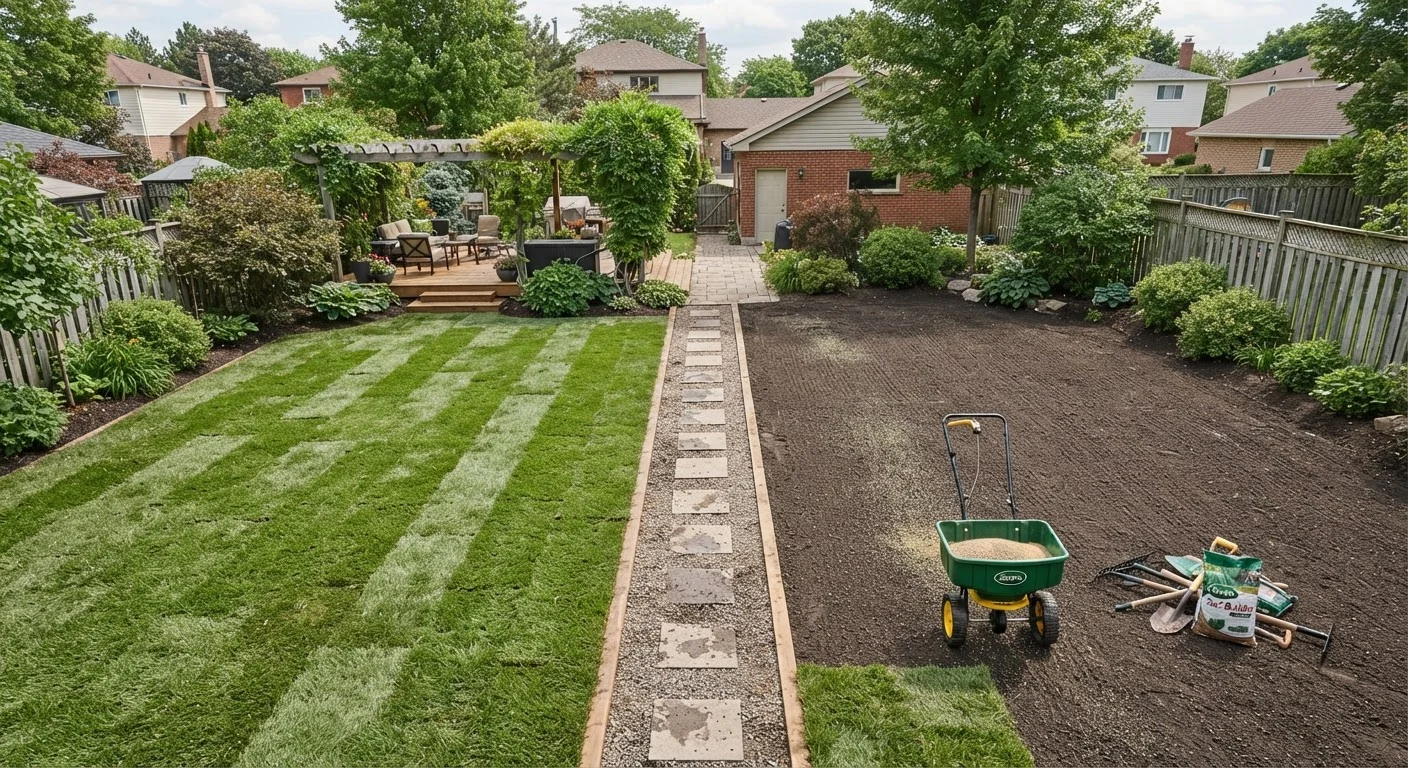
Option A
Grass Seed
The patient, budget-friendly approach to lawn establishment.
Best for: Homeowners with flexible timelines and tight budgets who are willing to invest consistent care over several growing seasons.
Option B
Sod
The instant, ready-to-use lawn solution for faster results.
Best for: Homeowners who need an established, usable lawn quickly - especially for erosion control, high-visibility yards, or new construction projects.
The Core Trade-Off: Time vs. Money
Choosing between grass seed and sod almost always comes down to one central tension: how much time you're willing to wait versus how much you're willing to spend upfront. Neither option is universally better - each has a logical place depending on your lawn's condition, your regional climate, and your personal priorities.
Sod - pre-grown grass harvested with its root system intact and delivered in rolls or slabs - gives you a near-instant lawn. Once installed and watered in, it looks established right away. Grass seed, by contrast, requires germination, several mowings, and often a full growing season before it fills in completely. However, the cost difference is substantial: seeding a typical lawn can cost a fraction of what sod installation runs per square foot, with sod often priced several times higher when labor and materials are included.
For context on timing both methods correctly, see our month-by-month lawn care reference - getting the planting window right is just as important as the method itself.
| Criterion | Grass Seed | Sod |
|---|---|---|
| Upfront cost | Low to moderate | High |
| Time to usable lawn | 2-6 months | 2-4 weeks |
| Physical labor | Moderate | High (rolls are heavy) |
| Grass variety selection | Very wide | Limited to available cuts |
| Erosion control | Poor until established | Immediate |
| Watering demands (early phase) | Frequent, light misting | Frequent, deep soaking |
| Weed competition risk | Higher during germination | Lower initially |
| Best planting window | Fall (cool) / Spring (warm) | More flexible, but same preferences |
Installation, Soil Prep, and Establishment
Regardless of which method you choose, soil preparation is the step most homeowners underinvest in. Both seed and sod perform best on loosened, graded soil with good drainage. Compacted or nutrient-poor ground will produce mediocre results no matter what you lay on top of it. Tilling to a depth of 4-6 inches and amending with compost before either seeding or sodding is generally recommended.
Seeding involves broadcasting seed at a rate appropriate for the grass species, raking lightly to ensure seed-to-soil contact, and keeping the surface consistently moist until germination - typically 7 to 21 days depending on species and temperature. After germination, the lawn still needs time to develop deep roots, meaning foot traffic should be minimized for 6 to 8 weeks, and the lawn may not be fully established until the following growing season.
Sodding is more physically demanding at installation - rolls are heavy, must be staggered like brickwork to avoid gaps, and need to be laid on moist soil without air pockets. The critical phase is the first two weeks, when the sod must be watered deeply and frequently to encourage root knitting into the underlying soil. If sod dries out during this window, it can die and require replacement.
7-21 days
Typical grass seed germination window
Germination time varies widely by species, soil temperature, and moisture consistency according to university extension guidelines.
2-4 weeks
Sod root establishment period
Most turfgrass experts cite a two-to-four-week window as critical for sod to knit roots into the underlying soil before tolerating regular use.
50°F+
Minimum soil temp for most grass germination
Cool-season grass seeds generally require soil temperatures above 50°F, while warm-season varieties need 65°F or warmer to germinate reliably.
Irrigation method also affects establishment success for both approaches. Our guide on sprinkler vs. drip irrigation can help you match your watering setup to your lawn's needs.
Timing, Climate, and Long-Term Care
Grass type and regional climate play a significant role in determining when each method works best. Cool-season grasses - such as tall fescue, Kentucky bluegrass, and perennial ryegrass - establish most successfully when seeded or sodded in early fall across the northern US. Warm-season grasses - including bermudagrass, zoysiagrass, and St. Augustinegrass - favor late spring installation in southern regions when soil temperatures are consistently warm.
Seeding outside these ideal windows increases the risk of poor germination, weed competition, or heat/cold stress before establishment. Sod is somewhat more forgiving of off-season installation because it has an existing root mass, though summer heat or winter cold can still stress newly laid sod.
Once fully established - whether from seed or sod - the ongoing maintenance requirements converge significantly. Mowing frequency, fertilization schedules, and irrigation needs become more similar over time. Understanding fertilizer timing after establishment is worth attention; our article on why fertilizer timing matters explains how to align feeding with your grass's growth cycle rather than the calendar.
Weed Control Differs by Method
Newly seeded lawns are particularly vulnerable to weed competition during the germination and establishment phase, since bare soil invites opportunistic weeds. Pre-emergent herbicides are generally not compatible with new seeding schedules, so timing and dense planting rates become important defenses. Sod's immediate coverage offers some natural weed suppression, though gaps between rolls can still allow weeds to take hold if not properly pressed and maintained.
If your long-term vision involves reducing lawn area in favor of native plantings, it's worth considering that decision before you invest in either seeding or sodding the full yard. Our comparison of native plants vs. traditional landscaping offers a broader perspective on yard planning.
The content on this site is provided for informational purposes only and should not be considered a substitute for professional advice. While we strive to provide accurate and up-to-date information, we make no guarantees regarding its completeness or accuracy. Always consult a qualified professional for advice specific to your circumstances before making any decisions