

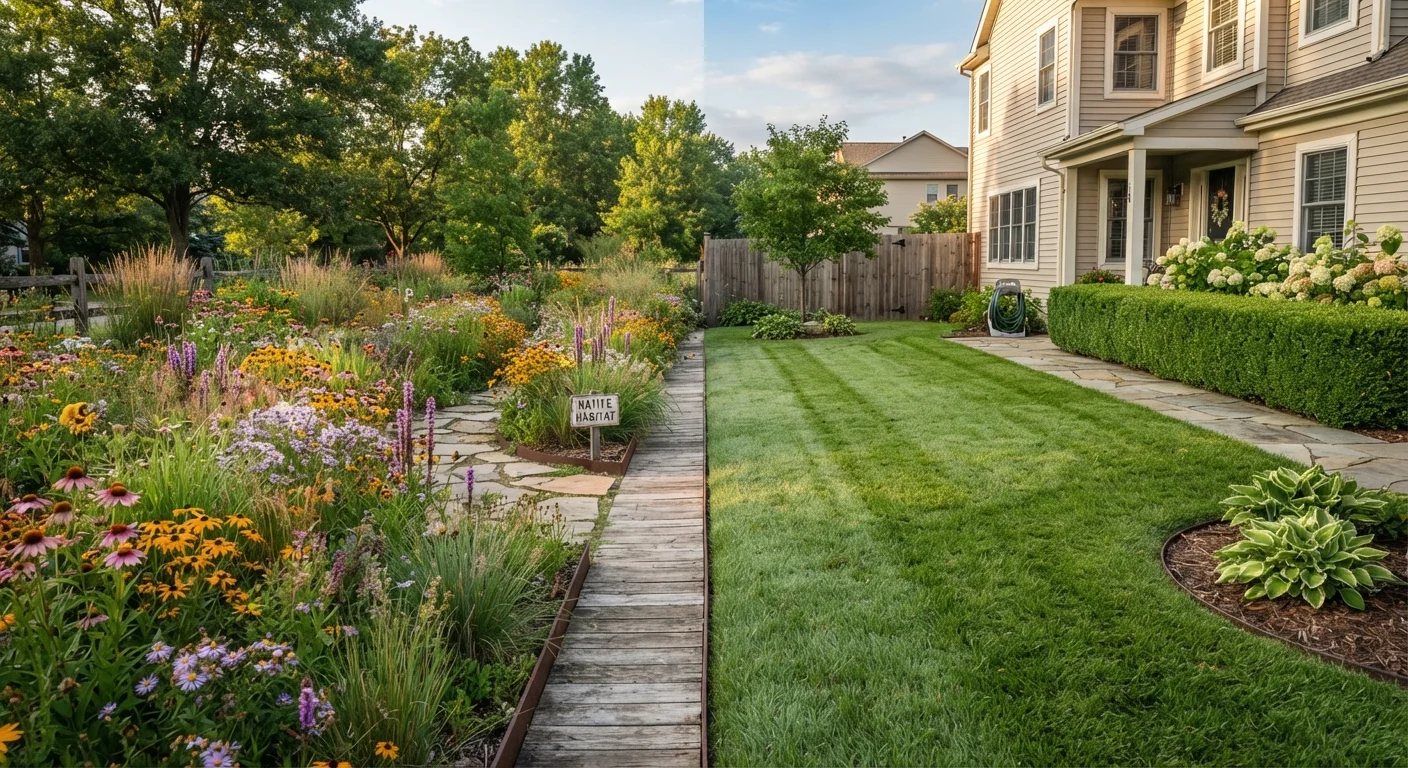
Option A
Native Plant Landscaping
The ecologically adapted, low-input approach.
Best for: Homeowners who want to reduce irrigation and chemical use while supporting local wildlife.
Option B
Traditional Landscaping
The familiar, curb-appeal-focused standard.
Best for: Homeowners who prioritize a uniform, manicured appearance and predictable seasonal results.
What Each Approach Actually Involves
Native plant landscaping means selecting plants that evolved in your specific region - such as coneflowers, black-eyed Susans, native grasses, or oak trees - and designing a yard around their natural growth habits. These plants are genetically adapted to local soils, rainfall, and climate cycles.
Traditional landscaping typically centers on non-native turfgrass (such as Kentucky bluegrass or Bermuda grass), imported ornamental shrubs, and annual flowers that originate from other climates. This approach has dominated American yards for decades and remains the default standard in most suburban developments.
The distinction matters because it determines nearly every downstream decision: how much you water, how often you mow, what chemicals you might apply, and what wildlife your yard can support. If you're also weighing how to establish or replace your lawn's base layer, our guide to grass seed vs. sod covers the practical trade-offs in detail.
| Criterion | Native Plant Landscaping | Traditional Landscaping |
|---|---|---|
| Water requirements | Low once established | Moderate to high year-round |
| Fertilizer needs | Rarely required | Regular applications typical |
| Establishment timeline | 1-3 seasons | Immediate to one season |
| Wildlife and pollinator support | High | Low to moderate |
| Curb appeal consistency | Variable; design-dependent | High; neighborhood-standard look |
| HOA compatibility | May require negotiation | Generally compliant |
| Pesticide/herbicide use | Typically low | Often moderate to high |
| Long-term maintenance effort | Low after establishment | Ongoing, regular effort |
Water Use, Maintenance, and Long-Term Costs
One of the most significant differences between these two approaches is resource demand. Conventional lawns and non-native ornamentals are often not well-suited to local drought cycles, meaning they require regular irrigation to stay healthy. The EPA has estimated that outdoor water use accounts for roughly 30% of household water consumption nationally - and in drier western states, that figure can climb considerably higher.
Native plants, by contrast, are adapted to local precipitation patterns. After an establishment period - typically 1 to 3 growing seasons - they generally require little to no supplemental watering in most U.S. regions. That establishment window is important to understand: native gardens often look sparse or weedy in their first year as root systems develop below the soil surface. Patience is genuinely part of the process.
~30%
Share of household water used outdoors
The U.S. EPA estimates that outdoor water use accounts for roughly 30% of total household consumption on average, rising sharply in arid regions.
500+
Caterpillar species supported by native oaks
University of Delaware research found that native oak trees support over 500 caterpillar species - a critical wildlife food chain link absent in most non-native ornamentals.
1-3 seasons
Typical native plant establishment period
Most native perennials and shrubs require one to three full growing seasons to develop root systems deep enough to thrive without supplemental irrigation.
Fertilization follows a similar pattern. Traditional turfgrass and many ornamentals rely on regular fertilizer applications to maintain color and density. Native plants, evolved in local soils, rarely require supplemental feeding. For either approach, understanding fertilizer types and their soil effects can help you make smarter amendments if needed.
Mulching is another tool relevant to both styles. It suppresses weeds, retains soil moisture, and moderates temperature - benefits that matter whether you're growing native perennials or conventional beds. See our overview of mulching benefits and drawbacks for guidance on application depth and material choices.
Wildlife, Ecology, and Curb Appeal Trade-Offs
Native plantings provide measurable ecological benefits that traditional landscaping cannot easily replicate. Research from institutions such as the University of Delaware has documented that native oak trees alone support hundreds of caterpillar species - a critical food source for nesting birds - while most non-native ornamentals support very few. Pollinators including native bees, butterflies, and hoverflies depend on specific native plant relationships that have developed over thousands of years.
Traditional landscaping, however, has a legitimate advantage in curb appeal consistency. Manicured turf, symmetrical hedges, and annual color plantings deliver a familiar, neighborhood-standard look that many homeowners value - and that HOAs frequently require. A native garden, especially during establishment, may draw questions from neighbors or conflict with local ordinances if it appears unkempt.
A practical middle-ground strategy is gaining traction: defining native plantings clearly with edging, mulched borders, and structured form so they read as intentional rather than neglected. Many homeowners also mix approaches - maintaining a smaller traditional lawn area for recreation while converting beds and borders to native species. Irrigation choices play a supporting role in both cases; our comparison of drip irrigation and sprinkler systems can help you match your watering setup to your plant choices. And once plantings are established, proper pruning technique keeps both native shrubs and traditional ornamentals healthy and shaped appropriately.
Ultimately, neither approach is universally superior. Your region's climate, your local plant palette, your aesthetic preferences, and your tolerance for a multi-season establishment period all shape which direction - or which blend - makes the most sense for your yard.
Check Local Ordinances Before You Plant
Some municipalities have guidelines - or occasionally restrictions - regarding native or naturalistic landscaping, particularly around plant height and 'weed' definitions. Before converting a large portion of your yard, check with your local planning or zoning office and review any HOA rules that apply to your property. Many jurisdictions have updated their ordinances in recent years to be more native-plant friendly, but requirements vary widely by location.
The content on this site is provided for informational purposes only and should not be considered a substitute for professional advice. While we strive to provide accurate and up-to-date information, we make no guarantees regarding its completeness or accuracy. Always consult a qualified professional for advice specific to your circumstances before making any decisions