

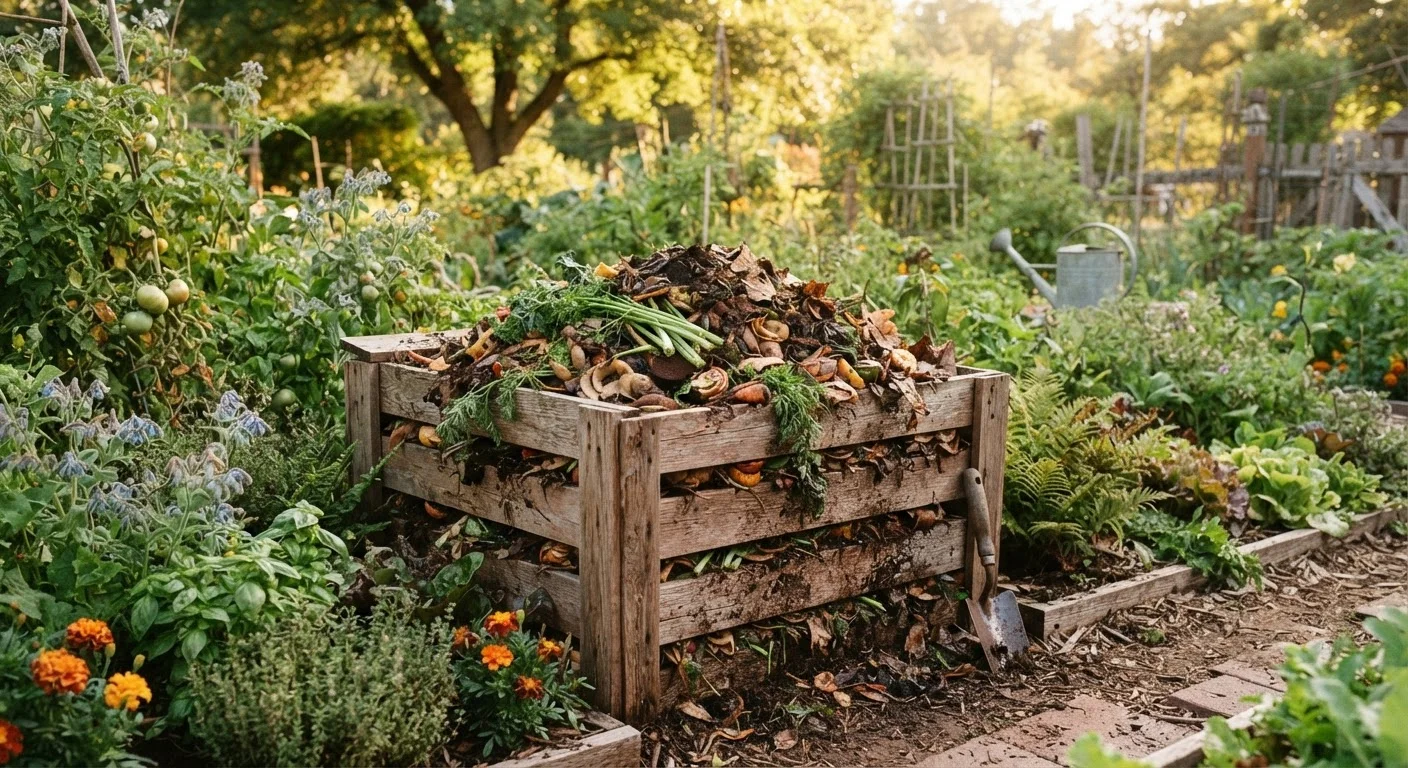
What Composting Actually Does for Your Soil
Composting is the controlled decomposition of organic matter into a stable, humus-rich material that improves nearly every measurable property of garden soil. When worked into beds, finished compost loosens dense clay, improves water retention in sandy soil, and feeds soil-dwelling microbes that make nutrients available to plant roots.
Unlike synthetic fertilizers, which deliver a narrow range of nutrients in a quick-release spike, compost acts slowly and broadly - improving soil biology over multiple growing seasons. If you're building a vegetable garden from scratch, compost is one of the most valuable amendments you can add before the first seed goes in the ground.
30%
Household waste that could be composted
The U.S. EPA estimates roughly 30% of what Americans throw away consists of food scraps and yard waste suitable for composting.
2-6 months
Typical time to finished compost
Active management - regular turning and moisture control - generally produces usable compost within two to six months in most U.S. climates.
3:1
Ideal browns-to-greens ratio by volume
University extension programs broadly recommend three parts carbon-rich material to one part nitrogen-rich material to support efficient microbial activity.
Greens, Browns, and the Balance Between Them
Every compost pile runs on two categories of ingredients: greens (nitrogen-rich materials) and browns (carbon-rich materials). Microorganisms need both to thrive, and the ratio between them controls how fast and how well your pile breaks down.
- Greens include: vegetable and fruit scraps, coffee grounds and paper filters, fresh grass clippings, plant trimmings, and eggshells.
- Browns include: dry leaves, cardboard torn into pieces, newspaper, straw, wood chips, and paper bags.
A working rule of thumb is roughly three parts browns to one part greens by volume. Too many greens and the pile turns slimy and smells like ammonia. Too many browns and decomposition slows to a crawl. When in doubt, add more browns - they're usually easier to find and cheaper to add.
Chop or shred your materials before adding them to the pile. Smaller particle sizes dramatically increase the surface area available to decomposing microbes, cutting breakdown time by weeks.
Decomposition is a surface-area game - the more exposed edges microbes can colonize, the faster they work.
Keep a covered container near your kitchen sink for collecting scraps throughout the week. Empty it every two to three days to avoid odors and make a habit of the routine.
Convenience is the most common barrier to consistent composting. A dedicated countertop container removes the friction of walking to the pile with every scrap.
What to Keep Out of Your Compost Pile
Knowing what to exclude is just as important as knowing what to add. Certain materials either introduce pathogens, attract pests, or produce odors that make backyard composting unpleasant for you and your neighbors.
- Meat, fish, and bones - decompose slowly, smell strongly, and draw rodents.
- Dairy products and oils - similar pest and odor risks.
- Pet waste - can carry harmful pathogens not reliably killed in a typical home pile.
- Diseased or pest-infested plants - unless your pile reaches sustained high temperatures (above 140°F), pathogens and seeds can survive and spread.
- Treated or painted wood - may introduce chemicals you don't want near food plants.
- Invasive plants with mature seeds - seeds can survive and sprout wherever you spread the finished compost.
When you're ready to apply finished compost as a soil topper, it works similarly to mulch in protecting soil moisture - but unlike mulch, it also feeds the soil beneath. See our overview of mulching garden beds for a side-by-side comparison of how both approaches function.
Choosing a Composting Method That Fits Your Yard
There's no single right way to compost. The method you choose should reflect the space you have, how much material you generate, and how quickly you want usable results.
Open Pile or Bin
The simplest approach is a freestanding pile in a corner of the yard, ideally at least 3 feet wide and tall to hold heat. Enclosed bins with lids reduce pest access and look tidier. This method is low-effort but slow - expect four to twelve months to finished compost if you manage it passively.
Tumbler
A rotating drum mounted on a frame lets you mix the pile easily, which speeds decomposition significantly. Tumblers are especially useful in suburban yards where odor and appearance matter. With regular turning and the right balance of materials, some tumblers produce compost in as little as four to six weeks.
Worm Bin (Vermicomposting)
Red wiggler worms process food scraps rapidly and produce exceptionally nutrient-dense castings. Worm bins work indoors or in a garage, making this the go-to option for apartment dwellers or anyone without outdoor space. Worm castings can be applied directly to container plants or mixed into potting soil.
If you're also planning raised beds, knowing your compost output can inform how much fill you'll need. Our guide to raised garden bed planning walks through soil-volume decisions in detail.
Building and Managing Your Pile
Start with a four-to-six-inch layer of coarse browns - wood chips or straw work well - to allow airflow at the base. Add a layer of greens, then another layer of browns. Think of it as lasagna: alternating layers that give microbes a varied, balanced diet.
Three conditions keep a pile active:
- Moisture: The pile should feel like a wrung-out sponge - damp but not dripping. In dry climates or during summer heat, you may need to water it occasionally.
- Oxygen: Turning the pile with a pitchfork every one to two weeks introduces oxygen that aerobic (air-breathing) bacteria need to work efficiently. Without turning, decomposition still happens but takes much longer.
- Mass: Smaller piles lose heat too quickly. Aim for a minimum of 3 cubic feet to sustain the internal warmth that speeds breakdown and kills weed seeds.
As you add kitchen scraps throughout the week, bury them in the center of the pile and cover with a handful of browns. This reduces odor and deters flies. Keeping a small container of dry leaves or cardboard pieces next to your kitchen scrap bucket makes this habit easy to maintain.
Troubleshooting Common Compost Problems
Most compost problems trace back to one of three imbalances. Here's how to diagnose and correct them:
| Symptom | Likely Cause | Fix |
|---|---|---|
| Rotten egg smell | Too wet, not enough air | Turn the pile, add dry browns |
| Ammonia smell | Too many greens | Add carbon-rich browns, turn to aerate |
| Pile not heating up | Too dry, too small, or too many browns | Moisten, add greens, increase pile mass |
| Pests or rodents | Food scraps exposed on surface | Bury scraps, use a lidded bin |
| Very slow breakdown | Large pieces, low nitrogen | Chop materials finely, add grass clippings |
How and When to Use Finished Compost
Finished compost is dark brown to black, crumbles easily in your hand, and smells like forest floor - earthy and clean, not putrid. You should not be able to identify the original materials. If large chunks remain, screen the finished batch through a half-inch wire mesh and toss the lumps back into the active pile.
In Garden Beds
Work two to four inches of compost into the top six to eight inches of soil each spring before planting. This is also a natural time to add it as part of your spring garden readiness routine.
As a Top Dressing
Apply a half-inch layer around established plants as a mulch substitute. It suppresses some weeds, feeds soil life, and breaks down further over the season without the drawbacks of wood-based mulches.
As Compost Tea
Steep a few shovelfuls of compost in a bucket of water for 24 to 48 hours, then strain and use the liquid to water container plants or seedlings. This delivers soluble nutrients and beneficial microbes directly to roots.
Whether you're a first-time gardener or a seasoned homeowner looking to close the loop on kitchen waste, composting is one of the most tangible ways to build a healthier outdoor space - and it starts with what's already on your cutting board.
The content on this site is provided for informational purposes only and should not be considered a substitute for professional advice. While we strive to provide accurate and up-to-date information, we make no guarantees regarding its completeness or accuracy. Always consult a qualified professional for advice specific to your circumstances before making any decisions