

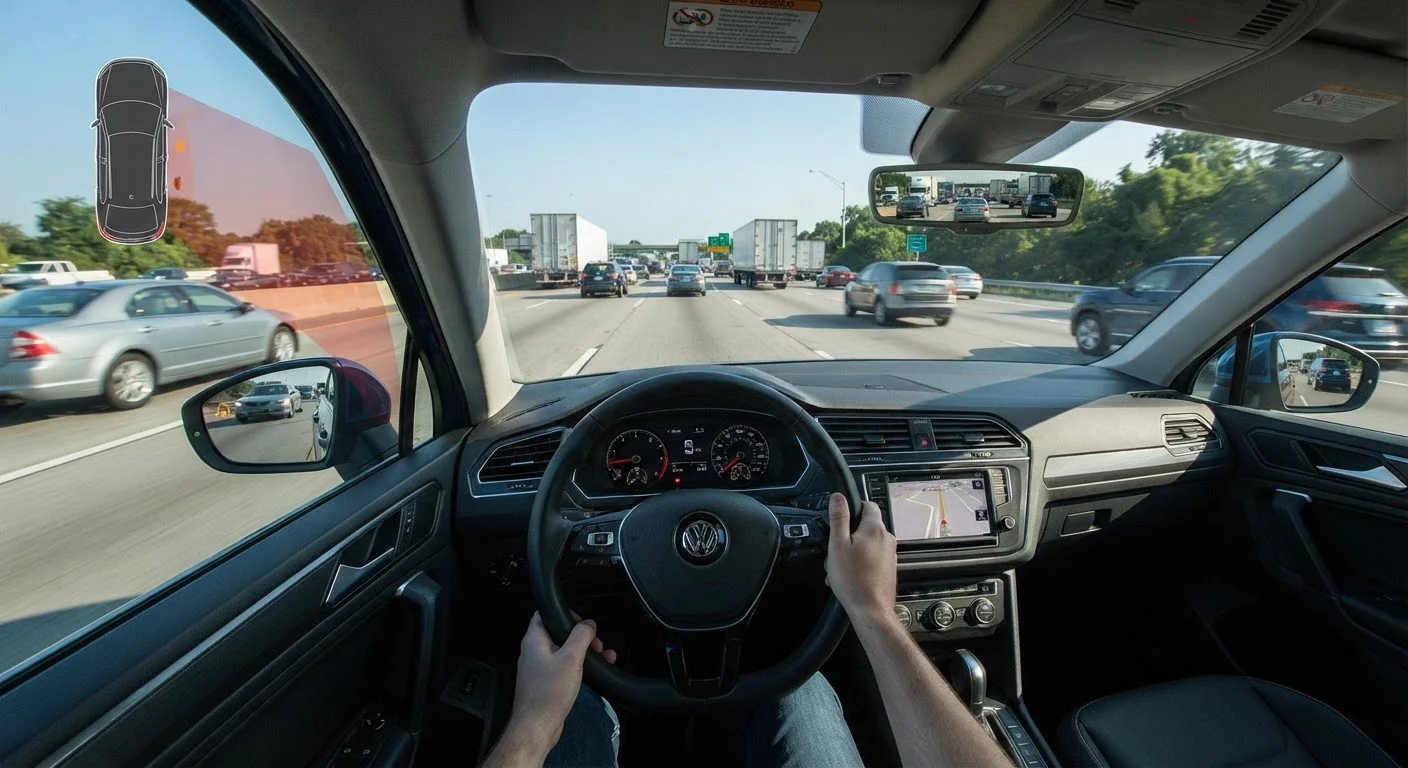
Where Blind Spots Actually Exist Around Your Vehicle
A blind spot is any area surrounding your vehicle that falls outside your direct line of sight and isn't captured by your mirrors when they're properly adjusted. Most drivers think of blind spots as the zones flanking the rear quarters of the car - and those are real - but the full picture is more complex.
Here's a breakdown of the primary blind spot zones:
- Rear quarter zones (left and right): The most commonly discussed blind spots, located diagonally behind the driver and passenger doors. These are where motorcycles and smaller vehicles can disappear between mirror coverage and peripheral vision.
- Directly in front at close range: Especially relevant when pulling forward out of a space. Small children or objects sitting directly in front of the hood may be completely invisible from the driver's seat.
- Directly behind the vehicle: Without a backup camera or rearview mirror adjustment, objects within a few feet of the rear bumper are often invisible - a well-documented hazard with SUVs, trucks, and vans.
- A-pillar blindness: The structural columns on either side of the windshield can momentarily block a pedestrian or cyclist from view, particularly at intersections.
- Large vehicles: Drivers of trucks and vans face extended blind zones on all four sides, sometimes stretching 20 feet or more in front and over 30 feet behind.
Understanding where these zones exist is the first step toward not being surprised by them. See our pre-trip safety walkthrough for a habit that helps you account for blind spots before every drive.
Mirror Adjustment: The Foundation That Most Drivers Skip
Mirrors that aren't properly set create false confidence. Many drivers adjust side mirrors inward - angling them to show part of their own vehicle's rear flank - which wastes coverage and maximizes the rear quarter blind spot rather than reducing it.
Blind spot
Any area around a vehicle that is outside the driver's direct line of sight and not visible through properly adjusted mirrors. Blind spots vary in size depending on the vehicle type and mirror positioning.
A-pillar
The structural column on either side of the windshield that supports the roof. A-pillars can block the driver's view of pedestrians, cyclists, or vehicles at certain angles, particularly at intersections.
Blind spot monitoring
An electronic driver-assistance feature that uses sensors - typically radar or ultrasonic - to detect vehicles in adjacent lanes and alert the driver, usually via a warning light in or near the side mirror.
Shoulder check
A brief, deliberate turn of the driver's head to look directly into the blind spot zone before changing lanes or merging. It supplements mirror coverage for areas sensors and glass cannot reach.
Rear cross-traffic alert
A vehicle safety feature that warns the driver of approaching traffic crossing behind the vehicle while reversing, such as in a parking lot or driveway.
A widely accepted approach, sometimes called the BGE method (developed by the Society of Automotive Engineers), positions the side mirrors significantly further outward than most drivers are used to:
- Lean your head against the driver's window and adjust the left mirror until you can barely see the rear of your own car.
- Center your head in the vehicle and adjust the right mirror until you can just see the car's rear edge.
- The rearview mirror should frame the full rear window.
When done correctly, a vehicle passing you should smoothly transition from your rearview mirror into your side mirror view, and then into your peripheral vision - with minimal gap. The goal isn't to eliminate the blind spot entirely (no mirror setup does), but to reduce it substantially.
Note: This outward-adjusted technique takes some getting used to. If it feels unfamiliar, allow a few drives to recalibrate your expectations before judging whether it's working.
Habits That Close the Gap Mirrors Leave Behind
Even optimally adjusted mirrors leave residual blind zones. These behavioral habits are what experienced drivers rely on to fill that gap - particularly on highways and during lane changes.
The Shoulder Check
A quick turn of the head toward your blind spot zone before changing lanes is one of the most effective single actions a driver can take. It takes less than a second and directly views the area mirrors can't cover. Pair this with signal use - signaling first gives surrounding drivers a moment to react before you move.
Pre-Move Scanning Sequence
Before any lateral move, experienced drivers run through: rearview mirror → side mirror → shoulder check → signal → move. Skipping steps in that sequence is where close calls happen. See highway driving habits experienced drivers practice for how this fits into higher-speed road awareness.
Position Awareness
Knowing where you are in someone else's blind spot matters too. Trucks and large vehicles have especially large blind zones. A general principle: if you can't see the driver's face in their side mirror, they almost certainly can't see you. Adjust your following position accordingly - and consider how following distance compounds blind spot risk.
Low-Speed and Parking Maneuvers
Slow speeds don't make blind spots safer. When reversing, roll down your window to listen, walk around the vehicle before backing if possible, and use backup cameras as a supplement - not a replacement - for physical awareness. Defensive driving principles apply at 5 mph just as much as at 65.
Technology That Assists - and Its Limits
Blind spot monitoring systems, rear cross-traffic alerts, and 360-degree camera displays are now common features on newer vehicles. These tools are genuinely useful - they extend detection into zones that human attention can miss, particularly when fatigued or in high-traffic conditions.
However, none of these systems are fail-safe:
- Blind spot monitoring sensors can be blocked by dirt, ice, or mounting damage.
- Camera views have their own distortion and range limits.
- Alerts require driver response - a system warning is not a substitute for action.
Drivers who rely entirely on technology without maintaining physical awareness habits are trading one blind spot for another. Use these systems as an additional layer, not a replacement for mirror adjustment, shoulder checks, and situational awareness. For other ways perception can mislead you behind the wheel, see our article on night driving and visual reliability.
The content on this site is provided for informational purposes only and should not be considered a substitute for professional advice. While we strive to provide accurate and up-to-date information, we make no guarantees regarding its completeness or accuracy. Always consult a qualified professional for advice specific to your circumstances before making any decisions